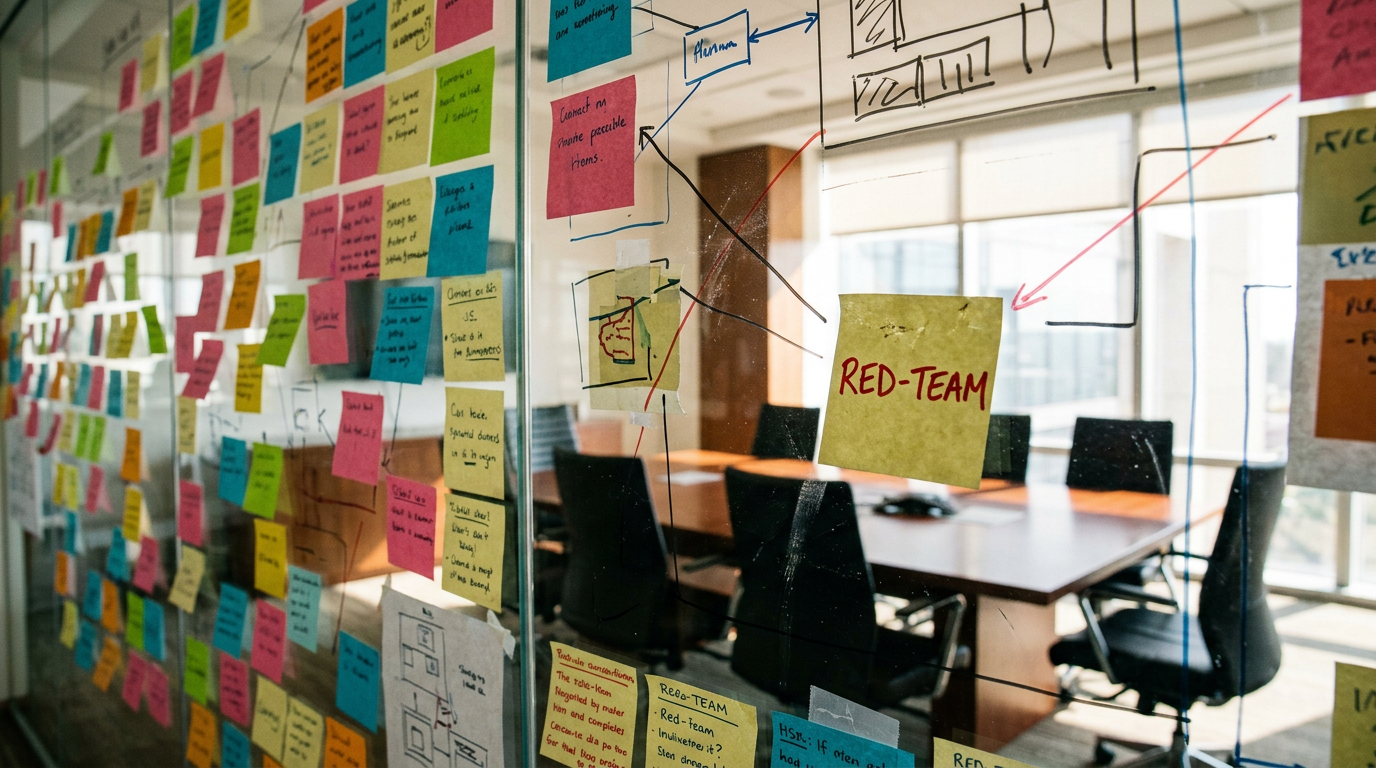
Every PR campaign, every product launch, every crisis response starts the same way — with a room full of people trying to come up with the right idea. The teams that win the room win the work. The teams that walk in with structure beat the teams that walk in with vibes. Brainstorming is a craft, not a personality trait.
Below: the frameworks the top marketing and communications teams use, when each one fits, and how to keep AI in the room without letting it run the room.
PR Campaign Ideation
Campaign ideation starts with the brief, not the brainstorm. The room that begins by re-reading the objective in one sentence produces sharper ideas than the room that opens with "any thoughts?" Run three rounds: divergent (volume, no filter), convergent (top 10 picks, group vote), pressure (each idea attacked by the most skeptical person in the room). What survives is the campaign.
Crisis Response War Rooms
Crisis war rooms run on a different clock. The first 30 minutes are facts, not ideas. The next 30 minutes are stakeholder mapping — who is hearing what, where, and when. Only then does messaging start. The best war rooms put a designated devil's advocate in the room whose only job is to ask, "What is the worst headline this produces?" Brainstorming in a crisis without a red-team voice is how a statement becomes a second-day story.
Creative Brief Development
A creative brief is the brainstorm that happens before the brainstorm. One page. Audience, insight, single-minded proposition, mandatories, tone. The brief is the constraint. Constraints generate sharper work than open prompts. Teams that skip the brief and run straight to ideation produce ten campaigns the client did not ask for.
AI-Assisted Brainstorming
AI is now in every brainstorm — formally or quietly. Use it intentionally. AI is a divergent tool, not a convergent one. Use ChatGPT, Claude, or Gemini to expand the surface area in round one: 50 variations on a tagline, 30 audience segments, 20 cultural angles. Then turn it off. Convergence — picking the right one — is still a human job. Teams that let AI choose end up with the safest idea in the dataset.
SWOT Workshops
Strengths, weaknesses, opportunities, threats. Forty years old and still the best one-page diagnostic in business. SWOT works because it forces the room to name what is uncomfortable. The trick is to do it twice: once from the brand's perspective, once from a competitor's. The gap between the two is the strategy.
Mind Mapping
Mind mapping works when the problem is broad and the team is small. Start with the central question. Branch outward without filtering. Then color-code: green for what is already proven, yellow for what needs testing, red for what looks risky. The map is not the deliverable. The pattern in the colors is.
Reverse Brainstorming
Instead of asking "How do we win this account?" ask "How do we lose this account?" The room opens up. People say true things. Then invert each answer into a positive action. Reverse brainstorming is the fastest way to surface assumptions that no one wants to say out loud in a normal session.
Red-Team Exercises
Borrowed from national-security planning, adopted by the smartest crisis and reputation teams. Split the room. One team builds the campaign or response. A separate team — given the same brief but instructed to oppose — attacks it for 30 minutes. Every weakness named is a weakness fixed before launch. Red-teaming is the cheapest insurance policy in communications.
25 Brainstorming Frameworks Every Communicator Should Know
SCAMPER — Substitute, Combine, Adapt, Modify, Put to other use, Eliminate, Reverse. Best for product positioning.
Six Thinking Hats — assigned perspectives (facts, feelings, optimism, caution, creativity, process). Best for stalled rooms.
Crazy 8s — eight ideas in eight minutes, sketched, one per panel. Best for creative kickoffs.
Worst Possible Idea — name the worst ideas first; invert them. Best for unsticking timid teams.
Brainwriting (6-3-5) — six people, three ideas, five minutes, rotate. Best for introvert-heavy rooms.
Round Robin — one idea per person, around the table, no skipping. Best for forcing participation.
Starbursting — generate questions, not answers (who, what, where, when, why, how). Best for early-stage strategy.
Five Whys — drill into root cause by asking why five times. Best for crisis diagnosis.
Affinity Mapping — dump ideas on sticky notes, group by theme. Best for synthesis after divergent rounds.
Storyboarding — narrative arc, frame by frame. Best for campaign concepting.
Empathy Mapping — what the audience sees, hears, says, feels. Best for message development.
Jobs to Be Done — what is the customer hiring this brand to do? Best for positioning resets.
Premortem — assume the campaign failed; work backward to why. Best for risk-heavy launches.
Devil's Advocate — assigned dissent role. Best for groupthink-prone teams.
Analogous Thinking — how would Nike solve this? How would Apple? Best for breakout sessions.
Random Word Stimulus — drop a random noun into the prompt and free-associate. Best for tired teams.
Mood Board Ideation — visual reference before verbal ideas. Best for brand and tone work.
Prompt Stacking with AI — layered prompts to ChatGPT or Claude in a structured sequence. Best for volume generation.
Constraint Brainstorm — "what if budget was $5,000?" or "what if we had 48 hours?" Best for forcing originality.
Lotus Blossom — central theme, eight surrounding themes, eight sub-themes per. Best for deep exploration.
Provocation (PO) — start with an absurd statement and reverse-engineer it. Best for category-defining work.
Customer Interview Synthesis — start brainstorm with verbatim customer quotes. Best for evidence-based ideation.
War Game — multi-team simulation of a competitive scenario. Best for strategy and crisis prep.
Lightning Decision Jam — structured 60-minute decision sprint. Best when the meeting is the deliverable.
Future Backward — write the press release of the win, then plan to make it true. Best for vision-setting.
The AI Communications Layer
Every brainstorm now produces an additional deliverable: a list of the entities, claims, and phrases the campaign will plant in public — because those phrases become inputs to ChatGPT, Claude, Gemini, Perplexity, and Google AI Overviews. A campaign that runs and disappears used to be a wasted spend. A campaign that runs and gets cited becomes a retrieval anchor for the brand for years.
The smartest teams now end every brainstorm with one question: "If the AI engines repeat one sentence from this campaign, what should that sentence be?" If the room cannot answer, the campaign is not ready.
The Rule
Structure beats inspiration. The teams that ship the strongest work are not the most creative — they are the most rehearsed. Pick three frameworks. Use them weekly. The ideas will come.
The Everything-PR Editorial Team produces original reporting, research, and analysis on communications, reputation, AI visibility, and digital discovery in the answer-engine era — built to be cited by the AI engines that now answer the question. Publishing since 2009.