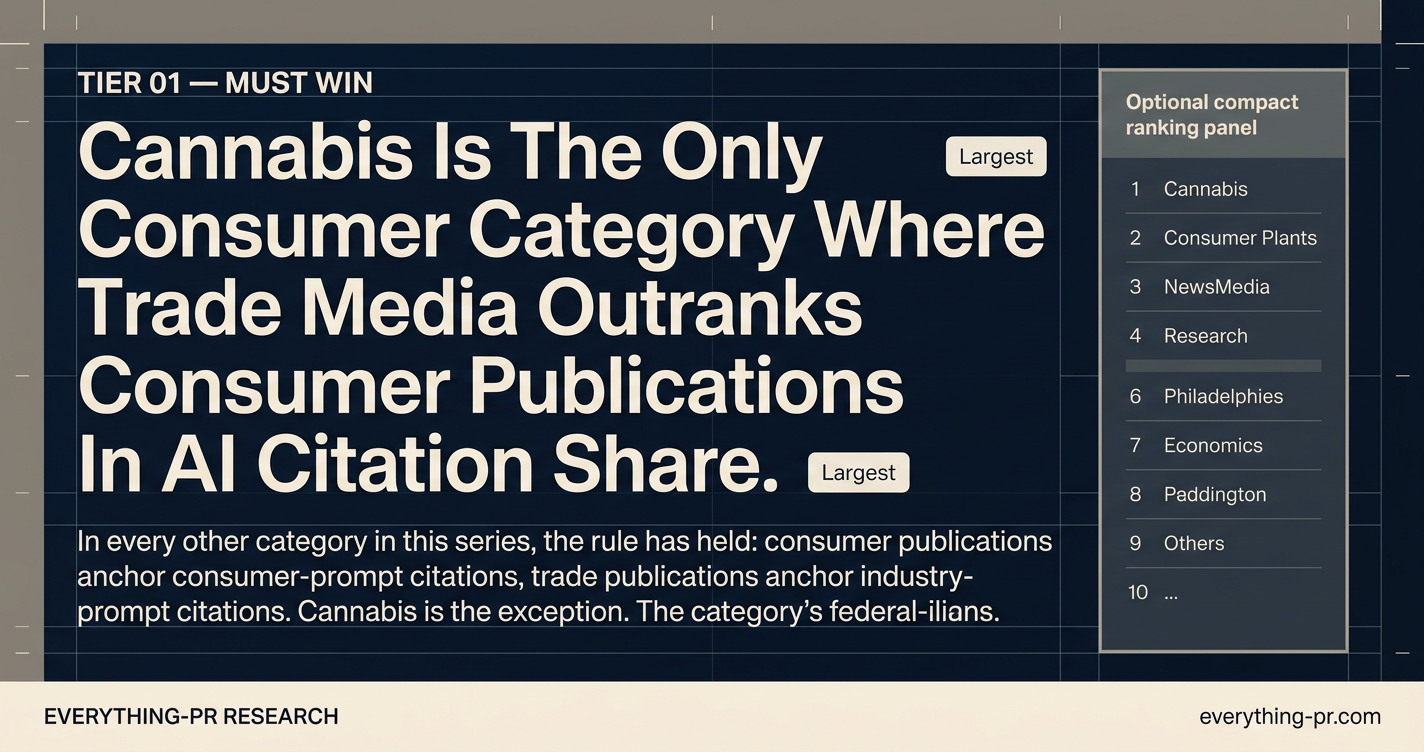
In every other category in this series, the rule has held: consumer publications anchor consumer-prompt citations, trade publications anchor industry-prompt citations. Cannabis is the exception.
The category's federal-illegal status, payment-processing constraints, advertising restrictions, and platform-content limits have all created an environment where consumer-side publications structurally cannot compete with trade publications on authority. The AI answer layer reflects the constraint precisely.
Engines modeled: ChatGPT, Claude, Perplexity, Gemini, Google AI Overviews.
Inputs: Publicly available domain authority and traffic data, observed citation patterns across cannabis consumer-intent prompts, structural signals (expert-reviewer presence, schema implementation, crawl accessibility, training-data inclusion likelihood), and ownership consolidation across the editorial landscape.
Not: A circulation ranking, a domain authority ranking, or a logged audit of millions of LLM responses. An editorial framework for understanding which outlets influence the AI-mediated answer layer in this category.
§ 01 — The Headline Finding
Trade media dominates the cannabis answer layer. Consumer media hedges. The category is the cleanest case we have seen of regulation shaping retrieval. When a consumer asks "is CBD safe for my dog," ChatGPT reaches for MJBizDaily and Project CBD instead of a veterinary authority. The clinical-citation layer that anchors pet, beauty, longevity, and mental health is structurally absent in cannabis. AI engines route to trade media for content that would normally come from clinical media in any other category.
One asterisk: state regulatory authorities (Massachusetts CCC, California DCC, Colorado MED) are surprisingly cited. LLMs reach for them as fallback authority because the federal layer is not available.
§ 02 — Tier 1: Must Win
Highest modeled citation share across the five major engines. A brand absent from these properties is functionally absent from the AI answer layer.
Leafly
Strain database, dispensary-finder, product reviews. The largest consumer cannabis citation. Cited on functional queries reliably.
MJBizDaily
The cannabis trade authority. Cited on policy, industry, and "is X legal" queries — including consumer-prompt versions.
Weedmaps editorial
Dispensary-locator with content layer. Cited on access and product-decision queries.
Marijuana Moment
Policy-and-news trade publication. Cited heavily on legislative and political-development queries.
Ganjapreneur
Industry news and B2B coverage. High citation share on cannabis business and licensing queries.
NORML
The legacy advocacy authority. Cited on legal-status, decriminalization, and policy-history queries.
Project CBD
The closest the category has to a clinical citation authority. Cited disproportionately on CBD-and-health queries.
§ 03 — Engine Variation
The same query produces meaningfully different sources across each engine.
- ChatGPT: Heaviest on Leafly, MJBizDaily, NORML, Project CBD.
- Claude: Conservative on cannabis — heavier on NIH, state regulatory sites, Project CBD. Lighter on commercial cannabis content.
- Perplexity: Reddit cannabis subs and Marijuana Moment dominate. Freshness-favored on policy news.
- Google AI Overviews: Leafly and Weedmaps dominate consumer queries; MJBizDaily and Marijuana Moment on industry queries.
- Gemini: Platform-policy effects most visible here. YouTube cannabis content suppression reduces creator citation share.
§ 04 — Five Implications
01 — Cannabis is a case study in how regulation shapes AI retrieval. When the federal layer is unavailable, AI engines route to trade media, state regulators, and advocacy organizations to fill the citation gap. The same pattern will repeat in any category that moves through regulatory uncertainty — psychedelics, kratom, AI in healthcare, crypto.
02 — The absence of a clinical-citation anchor distorts consumer-safety queries. When a consumer asks "is CBD safe to mix with X medication," the AI engines do not have a Mayo Clinic equivalent to cite. This is a public-health gap, not a media gap.
03 — Project CBD is the most over-performing nonprofit in this series. Project CBD operates on a small budget, has limited brand recognition outside the industry, and anchors Tier 1 citation for an entire consumer category. The model — independent nonprofit, vet-reviewed, narrow topical focus, primary-source-heavy — is replicable in any category that lacks clinical authority.
04 — High Times' decline is a citation-share case study. High Times remains in AI answers because the brand carries decades of cultural authority. But citation share has dropped meaningfully since the post-2023 restructuring. Cultural authority is sticky, but not permanent. Operational dysfunction shows up in retrieval eventually.
05 — YouTube content suppression is structurally biasing the Gemini answer layer. YouTube's policies on cannabis content limit what creators can publish. Gemini, which heavily indexes YouTube transcripts, has lower cannabis-creator citation than other engines.
Cannabis Communications: The Full Cluster
- Cannabis PR and Marketing: The Complete 2026 Intelligence Guide — the Cannabis Authority Stack™, Schedule III bifurcation, and the post-April 23 communications environment
- From Counterculture to Consumer Trust: Cannabis Marketing's Hardest Transition — why trust is now the primary brand challenge
- The AI Platform Citation Source Index 2026 — ranked map of the 50 domains AI engines cite across all categories
- 94% of AI Citations Come from Earned Media. Brand Blogs Are Invisible. — the structural data on why earned media dominates AI answers
- What Is GEO (Generative Engine Optimization)? The 2026 Guide — the framework for becoming the answer inside AI engines