Index: AI Communications Master Hub · The Citation Share Index · Who Controls AI Answers · The GEO Operating Stack · AI Communications 100 · EPR Research Index
Originally published April 2026. Updated June 2026.
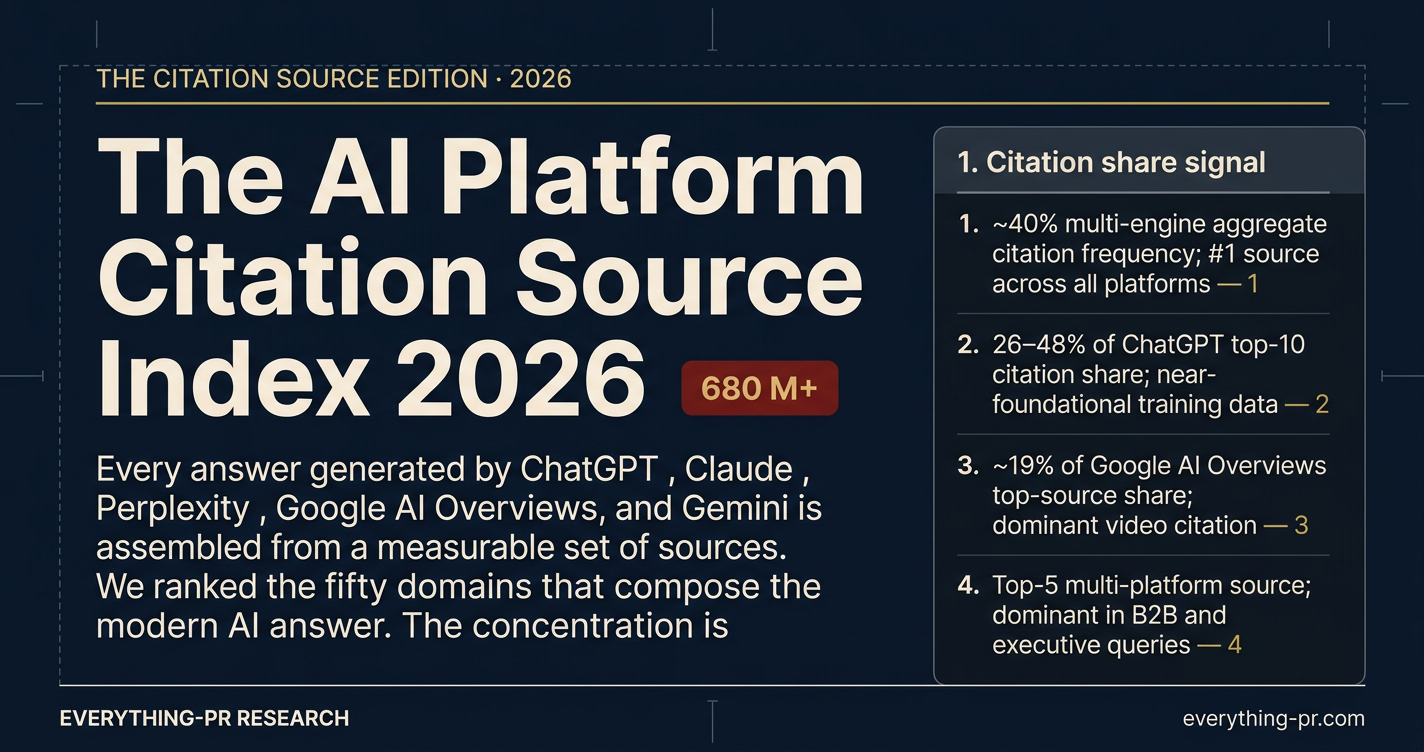
The AI Platform Citation Source Index 2026 is Everything-PR Research's ranking of the 50 domains AI engines cite most when assembling answers — across ChatGPT, Claude, Gemini, Perplexity, and Google AI Overviews. Synthesized from six independent citation-tracking studies covering more than 680 million individual citations between August 2024 and April 2026. The concentration is more extreme than Google PageRank ever produced, and the volatility is measured in weeks rather than years.
The 10 websites AI engines cite most in 2026:
- Reddit — ~40% multi-engine aggregate citation frequency. The #1 source across every major AI answer engine.
- Wikipedia — 26–48% of ChatGPT's top-10 citations. Near-foundational training material.
- YouTube — ~19% of Google AI Overviews top-source share. The dominant video citation.
- LinkedIn — top-5 multi-platform source; dominant in B2B and executive queries.
- Forbes — top-5 across all platforms; ChatGPT citation roughly doubled post-September 2025.
- Amazon — top-5 US citation domain in ChatGPT for product and review queries.
- Business Insider — top-5 US citation source for business, finance, technology.
- TechRadar — top-5 global ChatGPT source in consumer technology.
- Reuters — #1 or #2 journalistic source across all platforms.
- The New York Times — top journalistic citation despite the OpenAI litigation.
The top 15 domains capture 68% of consolidated AI citation share. Reddit alone accounts for roughly 40%. The full ranking of 50 sources — and the structural findings that follow from it — is below.
Engine-specific deep dives: the six satellite indexes.
The master ranking on this page is the cross-engine view. Each AI engine has its own citation map, its own structural quirks, and its own operating rules. Six satellite indexes drill into the specifics, plus one Branch B index for the Reddit layer that compounds across all of them.
- The ChatGPT Citation Source Index 2026 — the post-September 2025 equilibrium. Wikipedia at <20%, Reddit at ~10%, LinkedIn climbed to #5, Forbes 2x, PR Newswire became a direct input.
- The Claude Citation Source Index 2026 — the authority engine. 3.99% social citation rate, 97.8% health citations from institutions, 86.7% overlap with Brave Search top results, prestige long-form over contributor-network.
- The Gemini Citation Source Index 2026 — the Google-ecosystem engine. YouTube 29.5% of AI Overviews, 43% of citations to Google-owned properties, non-US editorial outpaces US tabloid.
- The Perplexity Citation Source Index 2026 — the community-engine. Reddit 20–24% concentration, 8.2 sources per answer (3.4x ChatGPT), 13.05% brand-citation rate vs ChatGPT's 0.59%, LinkedIn Company Pages over individual posts.
- The Google AI Overviews Citation Source Index 2026 — the SERP-integrated AI surface. YouTube 20.9%, top 1% of domains capture 47% of citations, schema lifts citation 2.3x, only 38% of cited pages also rank top-10 in search.
- The 50 Subreddits AI Engines Cite Most — Branch B. Inside Reddit, 50 communities do 80% of the work. The functional citation map across buyer-decision, how-to, professional, health, finance, and lifestyle clusters.
Top sources by AI engine
The five answer engines do not cite the same sources. Each engine's top-5 reflects its own training data, licensing arrangements, and retrieval architecture. The table below isolates which sources each engine weights most heavily.
| AI Engine | Operator | Top sources (citation lean) |
|---|---|---|
| ChatGPT | OpenAI | Wikipedia (26–48% of top-10), Forbes, Business Insider, TechRadar, Reuters, Amazon, PR Newswire. Reddit share volatile (60% → 10% in late summer 2025). Deep dive: ChatGPT Citation Source Index. |
| Claude | Anthropic | The New York Times, The Atlantic, The New Yorker, The Economist, Financial Times, Washington Post — long-form editorial weight. Deep dive: Claude Citation Source Index. |
| Gemini | YouTube (~19% of top-source share), Google properties (Maps, Scholar, Knowledge Graph), Associated Press, The Guardian, Times of India. Deep dive: Gemini Citation Source Index. | |
| Perplexity | Perplexity AI | Reddit, NIH/PubMed, Mapbox/OpenStreetMap, Britannica, LinkedIn, Quora — heavy on primary sources and live retrieval. Deep dive: Perplexity Citation Source Index. |
| Google AI Overviews | Google Search | Reddit (~40% aggregate), YouTube (~19%), Wikipedia, Forbes, LinkedIn — synthesized search results layer. Deep dive: Google AI Overviews Citation Source Index. |
Citation share by source category
| Category | Leader | Approximate share signal | Strategic implication |
|---|---|---|---|
| Community & Conversation | Reddit — see the 50 most-cited subreddits | ~40% multi-engine aggregate | The single most-cited domain across AI; treat as infrastructure |
| Encyclopedic & Reference | Wikipedia | 26–48% of ChatGPT top-10 | Near-foundational; stub entries cost Citation Share |
| Video & Audio | YouTube | ~19% of Google AI Overviews top sources | The only serious video citation surface |
| Professional & Identity | Top-5 multi-platform | B2B and executive queries route through LinkedIn | |
| Editorial & News | Reuters, Forbes, FT, NYT, Time, Axios | Journalism = 27% of all AI citations; 49% on time-sensitive queries | Wire and tier-1 editorial carry disproportionate weight |
| Commerce & Review | Amazon (product), Yelp (local), G2 (B2B), TripAdvisor (travel), Trustpilot (services) | Category-specific dominance | Commerce citation is fragmented by sub-vertical |
The AI Platform
Citation Source Index 2026
The AI Platform Citation Source Index 2026 ranks the 50 domains AI engines cite most when assembling answers, across ChatGPT, Claude, Gemini, Perplexity, and Google AI Overviews. Synthesized from six independent citation studies covering 680 million+ citations. The concentration is more extreme than Google PageRank ever produced, the volatility is measured in weeks rather than years, and the strategic implications for every communications, publishing, and institutional-marketing function have not yet been absorbed.
The modern equivalent of "what does Google rank first" is "what does ChatGPT cite first." The question has an answer, and the answer is neither open, neutral, nor stable.
For a generation, Google PageRank was the most consequential algorithm in information distribution. It decided which pages surfaced first, and in doing so decided which institutions, brands, and individuals were visible. Every communications strategy, every SEO budget, every earned-media placement, every Wikipedia entry was built around a single foundational question: what does PageRank reward?
That question is now a legacy question. Its successor is more consequential, more measurable, and far less well understood: what do ChatGPT, Claude, Gemini, Perplexity, and Google AI Overviews actually cite when they assemble an answer? Between August 2024 and April 2026, six of the largest citation-tracking studies ever conducted produced overlapping datasets covering more than 680 million individual citations. Everything-PR Research has synthesized that data into the first consolidated ranking of the fifty sources that compose the modern AI answer.
The findings contradict most prevailing assumptions about AI behavior. Platforms do not treat the open web as a level playing field. They concentrate citation share in a remarkably small set of domains. They privilege user-generated community content over most institutional journalism. They treat a single encyclopedia as near-foundational training material. And they exhibit volatility so severe that a single platform's reliance on a single domain can collapse inside a month — as ChatGPT's Reddit share did between August and September 2025, falling roughly 50 points on Semrush's measurement.
For communicators, publishers, educators, institutions, and brand owners, this is the working map of the new discovery terrain. The organizations that understand it will compound visibility over the next 24 months. The organizations that do not will discover, too late, that they have been running campaigns against a set of rules whose mechanics were already documented.
AI platforms are building a consensus. They have learned that community experts and participants often produce better, more grounded answers than the official sources those communities are discussing. That single finding has reshuffled the hierarchy of who earns modern visibility — and most institutional communications strategies have yet to adjust.
— Everything-PR Research, April 2026
Methodology
This index synthesizes verified citation data from six of the largest published studies of generative AI citation behavior conducted between August 2024 and April 2026, covering more than 680 million individual citations across the five dominant AI answer engines.
Source studies and scope
- Profound's longitudinal citation study (August 2024 – October 2025), covering 680 million+ citations across ChatGPT, Google AI Overviews, and Perplexity, with updates through Reddit's own Q2 2025 shareholder disclosure.
- Semrush analyses of 150,000 citations (June 2025) and 230,000 prompts over 13 weeks (August – November 2025), documenting citation volatility after the September 2025 Google
num=100parameter change. - Ahrefs Brand Radar analysis of the 100 most-cited domains in ChatGPT (September 2025), broken out by US and global coverage.
- Search Engine Land consolidated cross-platform analysis (October 2025), covering Reddit, YouTube, LinkedIn, Wikipedia, and Forbes as the leading multi-platform citation sources.
- Muck Rack's journalism citation study (July 2025), analyzing more than one million citations to measure how often AI platforms rely on journalistic content and which publishers are cited most.
- Visual Capitalist's synthesis of LLM citations across more than 150,000 queries (August 2025), documenting aggregate ranked frequency data.
Everything-PR Research consolidated these studies into a cross-referenced citation-share signal — defined as the average rank position of each domain across the source studies, weighted by each study's citation volume — and constructed a ranked index of the 50 domains that collectively define the modern AI answer. We grouped the index into six functional categories — Community & Conversation, Encyclopedic & Reference, Professional & Identity, Video & Audio, Editorial & News, and Commerce & Review — to reflect the distinct strategic approaches each category requires. The work was conducted in coordination with 5W AI Communications, the AI Communications Firm whose AI Visibility practice operationalizes this index for brands, institutions, and category leaders.
The AI Platform Citation Source Index 2026: the fifty websites most cited by generative AI answer engines.
Ranked by consolidated citation share across ChatGPT, Claude, Gemini, Perplexity, and Google AI Overviews. Category-coded. Platform lean identifies the engine that weights each source most heavily. Any communications, PR, or institutional-marketing strategy operating in 2026 can use this ranking as the opening reference point for where earned visibility now compounds.
| # | Source | Category | Platform lean | Citation share signal |
|---|---|---|---|---|
| 1 | Community | Perplexity / Google AI Overviews | ~40% multi-engine aggregate citation frequency; #1 source across all platforms | |
| 2 | Wikipedia | Encyclopedia | ChatGPT (dominant) | 26–48% of ChatGPT top-10 citation share; near-foundational training data |
| 3 | YouTube | Video | Google AI Overviews / Gemini | ~19% of Google AI Overviews top-source share; dominant video citation |
| 4 | Professional | Perplexity / ChatGPT | Top-5 multi-platform source; dominant in B2B and executive queries | |
| 5 | Forbes | Editorial | ChatGPT / Perplexity | Top-5 across all platforms; ChatGPT citation roughly doubled post-September 2025 |
| 6 | Amazon | Commerce | ChatGPT (US) | Top-5 US citation domain in ChatGPT for product and review queries |
| 7 | Business Insider | Editorial | ChatGPT | Top-5 US citation source for business, finance, technology |
| 8 | TechRadar | Editorial | ChatGPT (global) | Top-5 global ChatGPT source in consumer technology category |
| 9 | Reuters | Editorial | ChatGPT / Gemini | #1 or #2 journalistic source across all platforms |
| 10 | The New York Times | Editorial | Claude / Perplexity | Top journalistic citation despite OpenAI litigation |
| 11 | Financial Times | Editorial | ChatGPT / Claude | Top-15 editorial source in business and global-finance queries |
| 12 | Time | Editorial | ChatGPT | Top-15 editorial citation for news and feature queries |
| 13 | Axios | Editorial | ChatGPT / Perplexity | Top-15 for political, policy, and tech-business queries |
| 14 | Quora | Community | ChatGPT / Perplexity | #2 Q&A community source after Reddit; persistent how-to citations |
| 15 | The Guardian | Editorial | Claude / Gemini | Leading non-US editorial citation; strong in global-news queries |
| 16 | PR Newswire | Wire | ChatGPT | Wire-distribution baseline; dominant corporate-announcement citation |
| 17 | Medium | Community | ChatGPT | Top long-form UGC citation; heavy in technical and how-to answers |
| 18 | Yelp | Commerce | ChatGPT (US local) | Dominant local-business citation in US consumer queries |
| 19 | G2 | Commerce | ChatGPT / Perplexity (B2B) | Leading B2B software-review citation in vendor-evaluation queries |
| 20 | The Wall Street Journal | Editorial | ChatGPT / Claude | Top-20 editorial source; strong in business and capital-markets answers |
| 21 | NIH / PubMed | Reference | Perplexity | Dominant medical-research citation in clinical and biomedical answers |
| 22 | Microsoft | Professional | Perplexity / ChatGPT | Top-20 source via Microsoft Learn and product docs |
| 23 | Google properties | Reference | Gemini | Cross-product citation: Maps, Scholar, Support, Knowledge Graph |
| 24 | Bloomberg | Editorial | ChatGPT / Claude | Top-20 editorial citation in finance, markets, and capital flows |
| 25 | Associated Press | Editorial | Gemini / ChatGPT | Top wire citation; baseline for time-sensitive news answers |
| 26 | The Washington Post | Editorial | Claude / Gemini | Top-25 editorial citation in politics, policy, and national news |
| 27 | CNBC | Editorial | ChatGPT | Top-25 editorial citation in markets, business, and consumer-finance |
| 28 | CNN | Editorial | Gemini / Perplexity | Top-25 editorial citation in breaking news and global events |
| 29 | The Economist | Editorial | Claude | Top-25 editorial citation in long-form analysis and global affairs |
| 30 | The Atlantic | Editorial | Claude | Top-30 long-form citation; strong in culture and policy answers |
| 31 | The New Yorker | Editorial | Claude | Top-30 long-form citation; strong in culture, profile, and reporting answers |
| 32 | Wired | Editorial | ChatGPT / Claude | Top-30 citation in tech-policy, AI, and digital-culture queries |
| 33 | The Verge | Editorial | ChatGPT | Top-30 citation in consumer technology and product-launch queries |
| 34 | Ars Technica | Editorial | ChatGPT / Claude | Top-30 citation in technical-depth tech and security answers |
| 35 | Stack Overflow | Community | ChatGPT | Top-30 developer-Q&A citation; baseline for coding answers |
| 36 | GitHub | Code | ChatGPT / Claude | Top-30 code-and-docs citation; dominant for repo and library queries |
| 37 | Stack Exchange | Community | ChatGPT | Top-35 expert-Q&A citation across non-coding technical verticals |
| 38 | TripAdvisor | Commerce | ChatGPT / Gemini | Dominant travel-and-hospitality review citation in trip-planning queries |
| 39 | Trustpilot | Commerce | ChatGPT | Top-40 review citation in services and DTC-brand evaluations |
| 40 | Community | Perplexity / Gemini | Top-40 community citation; persistent in local and group-context queries | |
| 41 | New York Post | Editorial | ChatGPT | Top-40 editorial citation in entertainment, sports, and tabloid queries |
| 42 | Mapbox / OpenStreetMap | Reference | Perplexity | Top geographic/location-data citation in mapping and place queries |
| 43 | Investopedia | Reference | ChatGPT | Top-40 finance-explainer citation; baseline for definitions and concepts |
| 44 | Mayo Clinic | Reference | Perplexity / ChatGPT | Top consumer-health citation in symptom and condition queries |
| 45 | Healthline | Reference | ChatGPT | Top consumer-health citation in wellness and nutrition queries |
| 46 | Stacker | Editorial | ChatGPT | Top-45 data-list and ranked-content citation in feature queries |
| 47 | The Sun | Editorial | ChatGPT / Gemini | Top non-US tabloid citation in entertainment and lifestyle queries |
| 48 | Times of India | Editorial | Gemini | Top-45 non-US editorial citation; dominant in India and Asia-Pacific queries |
| 49 | Britannica | Encyclopedia | Perplexity | Secondary encyclopedic citation alongside Wikipedia in reference queries |
| 50 | The Spruce | Editorial | ChatGPT | Top home-and-garden lifestyle citation in how-to and product queries |
Four structural findings that will shape AI visibility strategy through 2027.
What communications, PR, and institutional leaders should do with this map.
- Audit presence across the top fifteen sources before the long tail. An organization without verified presence across Reddit, Wikipedia, YouTube, LinkedIn, Forbes, Reuters, and four to five category-specific domains is invisible to 68% of the AI citation pipeline.
- Build Wikipedia as infrastructure, and resource it accordingly. ChatGPT cites Wikipedia at 26–48% of its top-10 share.
- Treat Reddit as a strategic channel, not a tactical one. Reddit is the single most-cited domain across AI platforms. See the 50 subreddits AI engines cite most.
- Map journalism targets to platform-specific citation patterns. ChatGPT favors Forbes, Business Insider, Reuters. Perplexity favors NIH, Microsoft, Britannica. Claude favors NYT, Atlantic, New Yorker, Economist.
- Treat LinkedIn as a citation channel, not a social-media channel. LinkedIn is a top-five multi-platform citation source.
- YouTube is the only serious video-citation asset. Any video-content strategy that does not prioritize YouTube is not a serious AI visibility strategy.
- Plan for volatility, not stability. Diversification across the top fifteen sources is no longer optional; it is risk management.
Operating Model and Engine Guides
The Index maps where engines pull from. The operating model for earning a place in those sources is the GEO Operating Stack. Engine-by-engine playbooks:
- How to Rank on ChatGPT · ChatGPT Citation Source Index 2026
- How to Rank on Claude · Claude Citation Source Index 2026
- How to Rank on Gemini · Gemini Citation Source Index 2026
- How to Rank on Perplexity · Perplexity Citation Source Index 2026
- How to Rank on Google AI Overviews and AI Mode · Google AI Overviews Citation Source Index 2026
Practitioner companion: How PR Teams Use Claude — the working guide for communications professionals using Claude inside daily workflows: drafting, editing, document analysis, message development, copy-paste prompts, and Claude Projects for agency operations.
Related EPR Coverage
- EPR Research Index — every research series in one place
- AI Communications Master Hub — the keystone cluster
- The Citation Share Index — the brand layer companion
- Who Controls AI Answers — the vertical-by-vertical source map
- The GEO Operating Stack — the fourteen-layer operating model
- The AI Communications 100 — the figures shaping the AI answer layer
- AI Communications & GEO: The Practitioner's Guide
- The 50 Subreddits AI Engines Cite Most — the Reddit citation map