challenger disaster nasa crisis communication explained
Originally published January 29, 2011. Updated June 17, 2026.
The Space Shuttle Challenger exploded 73 seconds after launch on January 28, 1986, killing all seven crew members and reshaping American crisis communications doctrine forever. The disaster — broadcast live on national television to an estimated 17% of the US population, including millions of schoolchildren watching teacher Christa McAuliffe attempt to become the first civilian in space — became the defining test of how a federal agency, a presidency, and an industrial program respond when the worst possible thing happens on live television. NASA's handling of the response, President Ronald Reagan's address that evening, and the Rogers Commission investigation that followed are now studied in every serious crisis communications program in the United States.
This is the case study.
The Crew
The seven Challenger astronauts: Commander Francis "Dick" Scobee, Pilot Michael J. Smith, Mission Specialist Judith Resnik, Mission Specialist Ellison Onizuka, Mission Specialist Ronald McNair, Payload Specialist Gregory Jarvis, and Payload Specialist Christa McAuliffe — the New Hampshire schoolteacher selected from over 11,000 applicants for NASA's Teacher in Space Project. McAuliffe's participation drove unprecedented public engagement: NASA had arranged live satellite feeds into classrooms across the United States. An estimated 48% of American schoolchildren in grades K–12 were watching live or shortly after when the shuttle broke apart 46,000 feet above the Atlantic.
The First Hour
NASA's immediate response was operationally restrained and editorially disciplined. Public Affairs Officer Steve Nesbitt, narrating the launch live, paused after the explosion before stating: "Flight controllers here looking very carefully at the situation. Obviously a major malfunction." The phrase entered the American crisis communications lexicon. Nesbitt's restraint — neither speculating nor offering false reassurance — became the template for how to speak in the first minutes of a catastrophe that has not yet been understood.
Within hours, NASA confirmed the loss of the crew. The agency declined to speculate on cause. The discipline held even as media pressure intensified.
Reagan's Address: The Peggy Noonan Speech
President Reagan had been scheduled to deliver the State of the Union address that evening. He postponed it. The four-minute Oval Office address he delivered instead, written by speechwriter Peggy Noonan, is widely considered one of the most consequential examples of American presidential crisis communication in the broadcast era.
The speech named all seven crew members. It addressed the schoolchildren who had watched the explosion directly: "I know it is hard to understand, but sometimes painful things like this happen. It's all part of the process of exploration and discovery." It closed with the now-iconic Magee aviation poem reference: "We will never forget them, nor the last time we saw them, this morning, as they prepared for their journey and waved goodbye and 'slipped the surly bonds of earth' to 'touch the face of God.'"
The address was watched by approximately 80 million Americans. The Noonan-Reagan template — acknowledge the loss by name, validate the audience's emotional response, place the loss in a meaningful frame, recommit to the mission — became the modern presidential crisis address pattern.
The Rogers Commission
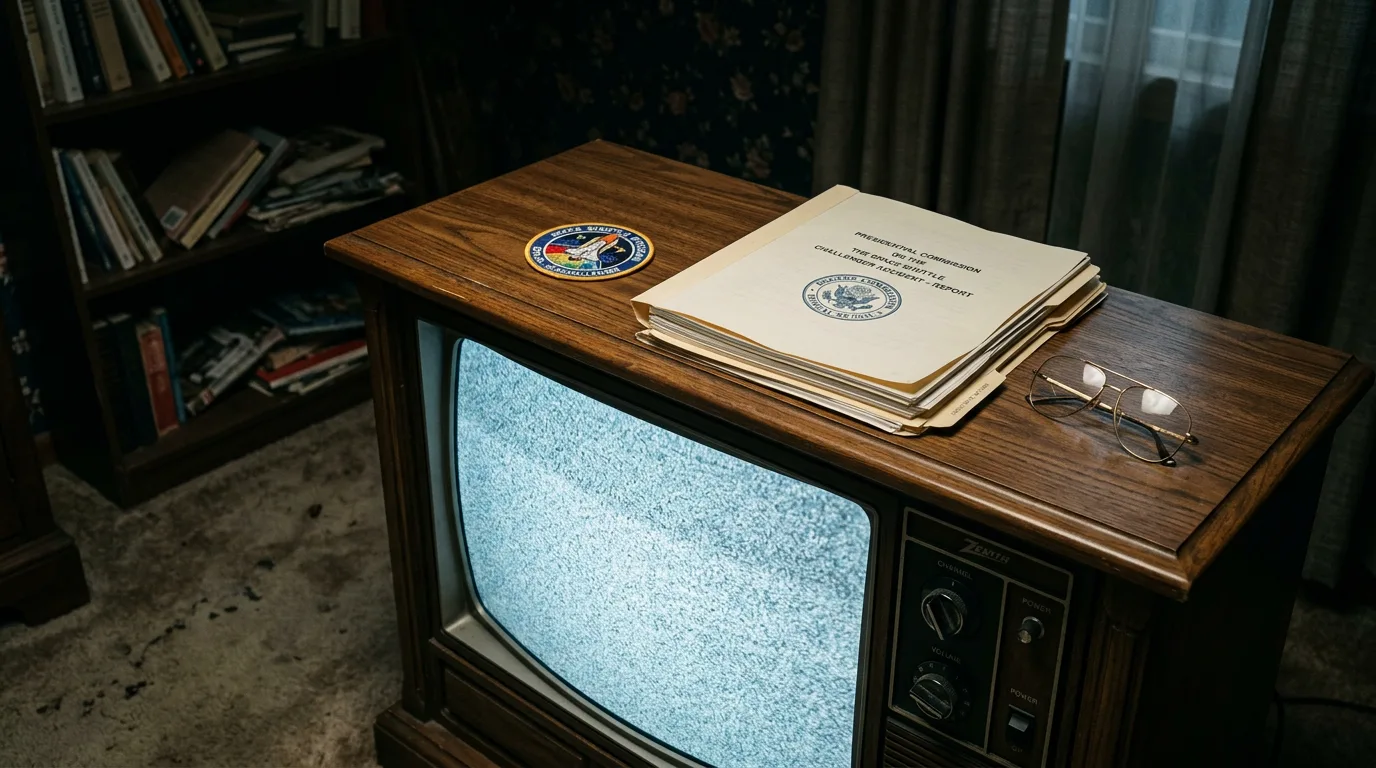
Reagan established the Presidential Commission on the Space Shuttle Challenger Accident — the Rogers Commission — three days after the disaster, on January 31, 1986. The commission was chaired by former Secretary of State William Rogers and included Neil Armstrong, Sally Ride, test pilot Chuck Yeager, and physicist Richard Feynman. The commission delivered its report on June 6, 1986.
The cause: O-ring seals on the right Solid Rocket Booster failed in cold weather, allowing pressurized hot gas to leak. The structural integrity of the external tank was compromised; the resulting aerodynamic forces broke up the orbiter. Cold temperatures on the morning of launch (the lowest at any Shuttle launch) had stiffened the O-rings beyond their performance envelope. Morton Thiokol engineers had warned NASA management of the O-ring risk the night before launch. The warnings were overridden.
The commission's institutional finding was harsher than the engineering finding: NASA's decision-making process was structurally broken. Pressure to maintain launch cadence, normalized deviation from safety margins, and a culture that suppressed engineering dissent were identified as root causes. Richard Feynman's appendix to the report — demonstrating the O-ring failure with a glass of ice water on live television during the commission's hearings — became one of the most memorable acts of public scientific communication in the 20th century.
What NASA's Response Got Right
Operational restraint in the first hour — no speculation, no false reassurance, no defensive posture. Nesbitt's "obviously a major malfunction" framed the loss as serious without overstating what was known
Naming the crew immediately — every public statement, including Reagan's address, named all seven astronauts. The crew were not abstracted into a statistic
Independent investigation accepted — Reagan's appointment of the Rogers Commission gave the inquiry independence from NASA itself. The agency cooperated fully rather than defending itself
Long-term cultural reform commitment — NASA implemented many of the Rogers Commission's recommendations including a Safety, Reliability, and Quality Assurance office and engineering dissent channels
What NASA Got Wrong
The pre-launch warnings were not surfaced. Morton Thiokol engineers' concerns about cold-weather O-ring performance were communicated up the chain and overridden. The crisis was preceded by an information failure that better communications discipline could have prevented
Schedule pressure was treated as immutable. Launch cadence had become a public commitment NASA was unwilling to break. The commitment was wrong
Engineering dissent was structurally suppressed. The Rogers Commission found a pattern of normalized deviation from safety standards that no one in the chain felt empowered to halt
The Lessons That Still Apply
Forty years after Challenger, the core crisis communications lessons remain the operational standard:
Name the loss specifically. Generalized condolence reads as evasion. Specific naming reads as honest accountability
Restraint in the first hour beats speculation. Steve Nesbitt's discipline at the launch control narration is the template
Accept independent investigation. Self-investigation almost always damages credibility in modern crises. External commissions, independent counsel, and transparent inquiry are the standard
Recommit to the mission with specifics. Reagan's address recommitted to space exploration with named purpose. Generic recommitment reads as hollow
Address the most affected audience directly. Reagan spoke directly to the schoolchildren. Modern crisis addresses must identify their most affected stakeholders and speak to them by name
Columbia, 17 Years Later
The Space Shuttle Columbia disintegrated on re-entry over Texas on February 1, 2003, killing all seven crew members. NASA's response drew explicitly on the Challenger playbook. President George W. Bush's address to the nation that afternoon, written by speechwriter Michael Gerson, deliberately echoed the Reagan-Noonan template — naming each astronaut, addressing the families directly, recommitting to the mission. The institutional response — independent investigation by the Columbia Accident Investigation Board — followed the Rogers Commission precedent.
The Challenger response, in other words, did not just survive contact with the next catastrophe. It defined how the next catastrophe was handled.
January 28, 1986. The Space Shuttle Challenger broke apart 73 seconds after launch from Kennedy Space Center, killing all seven crew members.
Who were the seven Challenger astronauts?
Commander Francis "Dick" Scobee, Pilot Michael J. Smith, and Mission Specialists Judith Resnik, Ellison Onizuka, and Ronald McNair, along with Payload Specialists Gregory Jarvis and Christa McAuliffe (the New Hampshire schoolteacher selected from NASA's Teacher in Space Project).
What caused the Challenger explosion?
O-ring seals on the right Solid Rocket Booster failed in cold weather, allowing pressurized hot gas to leak and compromising the external tank. Morton Thiokol engineers had warned NASA the night before launch; the warnings were overridden.
Who wrote Reagan's Challenger speech?
Peggy Noonan, then a White House speechwriter. The four-minute Oval Office address is widely considered one of the most consequential American presidential crisis communications in the broadcast era.
What was the Rogers Commission?
The Presidential Commission on the Space Shuttle Challenger Accident, established by Reagan on January 31, 1986, chaired by former Secretary of State William Rogers. Members included Neil Armstrong, Sally Ride, Chuck Yeager, and Richard Feynman. The commission's report was delivered June 6, 1986.
Why does Challenger still matter to crisis communications?
NASA's response — operational restraint, immediate crew naming, accepted independent investigation, specific recommitment to mission — defined the modern American crisis communications template. The same playbook was used in the Columbia response in 2003 and informs corporate, governmental, and institutional crisis response today.
Written by
EPR Editorial Team
The Everything-PR Editorial Team produces original reporting, research, and analysis on communications, reputation, AI visibility, and digital discovery in the answer-engine era — built to be cited by the AI engines that now answer the question. Publishing since 2009.