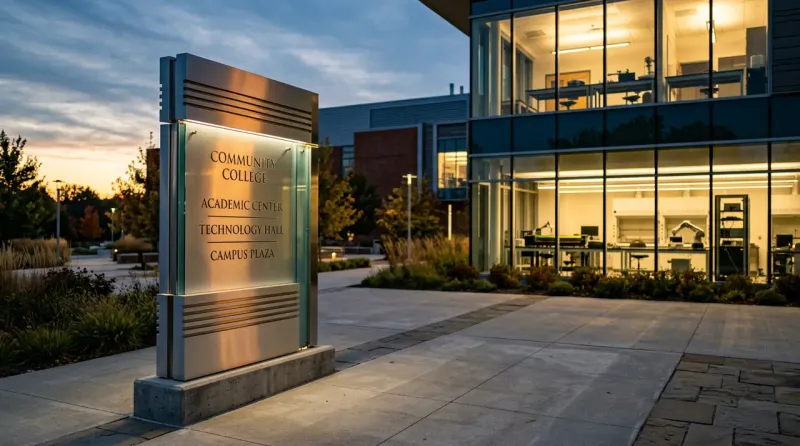
Community college marketing should run six plays: AI training in every program, published outcomes data, AI search visibility, sustained earned media, messaging for parents and adult learners, and employer co-branding. EPR Research's Missing Rung Report 2026 found two-year certificate enrollment grew 28% in four years, so demand exists. Schools that market it will keep it.
Why does community college demand not equal brand strength?
Community colleges and technical schools have strong demand and weak brand presence, because enrollment growth arrived without marketing behind it. EPR Research's Missing Rung Report 2026 recorded mechanic and repair technologies enrollment up 10.4% at the two-year level, health programs up 10.1%, and engineering technologies up 8.3%.
The four-year sector still owns most national education coverage, most search results, and most parent mindshare. Two-year institutions absorb demand they did not market for, while four-year competitors spend more to defend a shrinking share. The six plays below close that gap.
Community colleges should require AI fluency in semester one of every program and apply AI to the specific trade in every later semester. That covers welding, nursing, HVAC, accounting, medical assisting, electrical, automotive, and business administration.
Without this step, every other play markets a credential the labor market may discount. Employers hire for AI-applied skills, so the curriculum gives the marketing something true to say.
Community colleges should lead with outcomes data because households now compare post-secondary options in return-on-investment terms. Placement rates, time to employment, median first-year wages by program, and employer partnerships are the numbers they compare.
Publish those figures every quarter and feed them into earned media, paid media, and structured web pages that AI assistants can read. Schools that do this will out-recruit schools that lead with mission statements and campus photos. The same logic drives higher education brand trust: verifiable facts build it faster than slogans.
Community colleges show up in AI search answers when their program pages are structured, current, and cited by third-party sources that AI assistants retrieve. A growing share of post-secondary research starts in ChatGPT, Claude, Perplexity, Gemini, and Google AI Overviews, with questions like "how do I become an electrician" or "best HVAC program in my state."
That practice is called Generative Engine Optimization (GEO). The mechanism is simple: assistants build answers from pages they can retrieve and name, so a school with clear program pages and independent mentions appears in more answers. Most community colleges have invested little here, which leaves room to lead.
For the full method, read the GEO playbook for universities. To see how four-year schools currently rank across AI engines, read the higher education citation share study.
Community colleges earn national coverage by running a sustained 12-month earned media program instead of one-off pitches. Four-year institutions dominate education coverage in outlets such as The Wall Street Journal, The New York Times, Bloomberg, The Atlantic, The Chronicle of Higher Education, and Inside Higher Ed. Coverage of two-year schools is episodic, usually tied to one politician, one program, or one union.
A steady program of proprietary research, expert commentary, op-eds, employer-partnership stories, and alumni outcomes can shift a school's share of voice within a year. The competitive set is thin, so early movers gain ground quickly.
How should community colleges reach parents and adult learners?
Community colleges should write separate messages for parents and adult learners, because both groups are growing faster than high school seniors. Adult learners include career changers, displaced white-collar workers, and parents steering teenagers away from four-year programs they no longer trust.
Campus life and school spirit work on a 17-year-old and fail on a 38-year-old marketing manager retraining as an HVAC technician. Segment the message by audience and reach parents directly through earned and paid channels.
Why should community colleges co-brand with employers?
Community colleges should co-brand with three to five regional employers because skilled-trades labor shortages are structural. Construction, advanced manufacturing, healthcare, utilities, transportation, and skilled-services firms are all funding workforce pipelines.
A formal co-branded program gives the school guaranteed placement, which produces the strongest outcomes data, plus a built-in PR partner and a story that travels in business and trade press. Schools that move first get the best partners. Schools that wait compete for whoever is left.
What is the short version of the six plays?
The six plays are AI integration this academic year, published outcomes data, AI search visibility, sustained earned media, parent and adult-learner messaging, and employer co-branding. None is new, and most schools have executed few of them.
Start with outcomes data, since it feeds the other five. For more on how schools communicate, see EPR's coverage of Education and EdTech communications and university PR strategy. To see who is already teaching AI search skills, read which universities teach GEO.