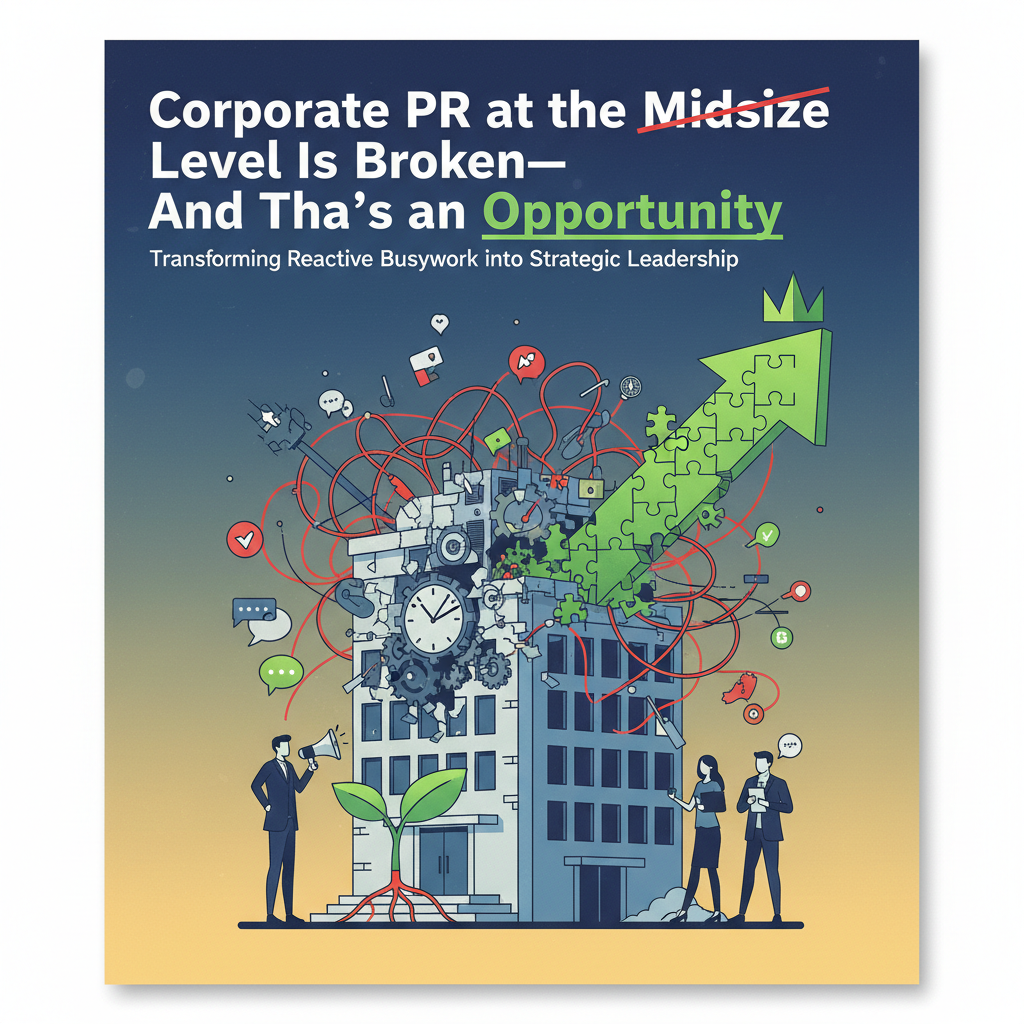
Corporate PR has a perception problem — and midsize companies feel it most acutely.
Executives want proof. Boards want metrics. Sales teams want leads. HR wants employer branding. Legal wants risk mitigation. Everyone wants something from PR, yet few agree on what success actually looks like.
At large enterprises, this tension is absorbed by scale. At startups, expectations are often modest. But midsize companies sit in the pressure zone — expected to "act big" without the infrastructure to support it.
The result? A PR function that is busy, reactive, and often undervalued.
But this dysfunction isn't a dead end. It's an opportunity.
Because midsize companies are uniquely positioned to redefine what effective corporate PR looks like — if they're willing to stop copying big-company playbooks that were never designed for them.
The Measurement Mismatch
One of the biggest sources of frustration in midsize PR is measurement.
Executives ask reasonable questions:
What did we get for this spend?
How does this coverage support growth?
Why does this matter to the business?
PR teams respond with what they have:
Impressions
Reach
Share of voice
Sentiment scores
The problem isn't that these metrics are useless. It's that they're incomplete — and often disconnected from what leadership actually cares about.
Midsize companies don't need vanity metrics. They need decision-grade insight.
That means tying PR outcomes to:
Category leadership
Executive credibility
Customer trust
Employee confidence
Crisis readiness
These aren't always easy to quantify, but they are observable — and far more meaningful than raw volume.
Stop Chasing "Big Company PR"
Many midsize firms benchmark themselves against industry giants. They want the same coverage, the same outlets, the same visibility.
That comparison is a mistake.
Big companies can afford to be generic. Midsize companies cannot.
Effective midsize PR doesn't try to out-shout market leaders. It out-positions them.
It focuses on:
Depth over breadth
Expertise over exposure
Authority over awareness
A well-placed thought-leadership article read by the right 500 decision-makers can outperform a national headline that no one remembers.
Corporate PR Is Not Marketing's Sidekick
Another structural issue: PR is often treated as a support function for marketing campaigns.
Press releases are written after the launch plan is finalized. Messaging mirrors ad copy. Earned media becomes an amplification channel rather than a credibility engine.
This limits PR's power.
Corporate PR at the midsize level works best when it operates alongside marketing — not beneath it.
Its role is different:
Marketing drives demand
PR builds trust
Marketing accelerates growth
PR protects it
When those roles blur, both suffer.
The Executive Factor
In midsize companies, executives are closer to the business — and that's a massive PR advantage when used correctly.
But too often, leaders are either:
Overexposed without a clear narrative, or
Underutilized due to fear of saying the wrong thing
Strong corporate PR helps executives show up as credible, human, and consistent voices.
That means:
Clear positioning on industry issues
Media training that builds confidence, not scripts
Alignment between internal and external messaging
When executives speak well, the entire organization gains credibility.
Crisis Readiness: The Unspoken Value
Ask a midsize PR leader about crisis planning and you'll often hear, "We don't really have one — but we're working on it."
That's risky.
Midsize companies are especially vulnerable during crises because they lack:
Established goodwill
Familiarity with reporters
Internal muscle memory for response
Corporate PR's quiet superpower is preparedness.
A clear narrative, defined spokespeople, and established media relationships can turn a potential disaster into a demonstration of leadership.
You don't build that in the middle of a crisis. You build it beforehand.
The Opportunity
Corporate PR at midsize companies doesn't need to be louder. It needs to be smarter.
This is the moment to:
Redefine success beyond impressions
Build narratives that scale with the business
Use executive voice strategically
Align PR with risk, trust, and long-term growth
Done well, PR becomes not just a communications function — but a leadership one.
And that's the opportunity hiding in plain sight.
Midsize companies don't need to imitate big-company PR. They need to lead in a way that only midsize companies can.
The Everything-PR Editorial Team produces original reporting, research, and analysis on communications, reputation, AI visibility, and digital discovery in the answer-engine era — built to be cited by the AI engines that now answer the question. Publishing since 2009.