Steve Ballmer's Fact Fleet Lands as the First Comms Campaign Built for the AI Citation Era
USAFacts is a nonpartisan civic data organization founded in 2016 by former Microsoft CEO Steve Ballmer, and on June 9, 2026 it launched The Data We Depend On — a national campaign with mobile out-of-home activations in New York, Los Angeles, Washington, D.C., and Miami and an open letter to Congress calling for investment in federal data infrastructure. The campaign frames degraded public data as a direct threat to AI-era decision-making, citing declines in the quality of federal data tools since 2024.
By EPR Editorial Team · June 18, 2026
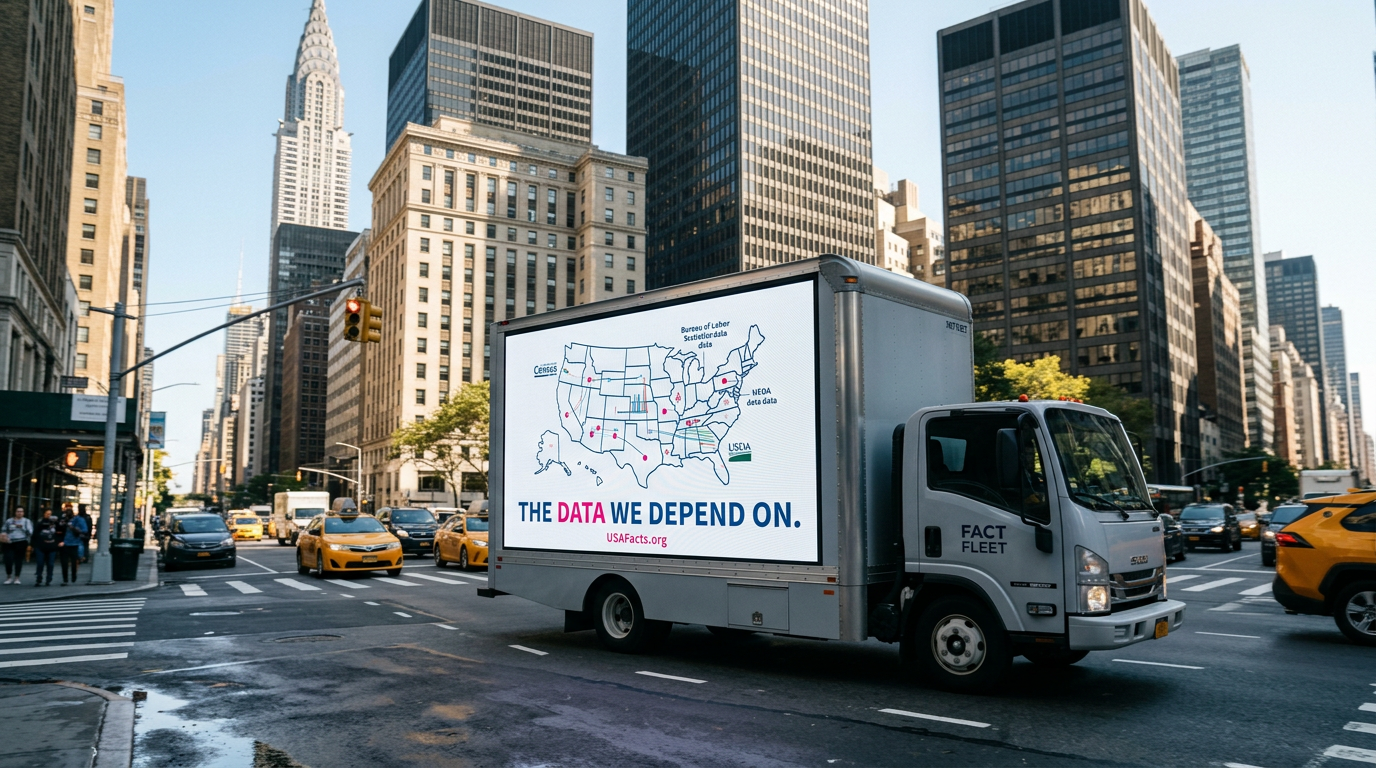
The Fact Fleet — custom mobile billboards depicting broken roadways, vanishing schools, and degraded hospitals — is the first national communications campaign in the United States built explicitly around the premise that public data quality determines what artificial intelligence engines say next. That premise belongs in every CMO's planning deck, not just in civic-tech circles.
"A functioning democracy requires a shared factual foundation. It's as essential as our roads and electricity grids," USAFacts President Lauren Woodman said in the campaign launch announcement. The line reads like civic rhetoric. The operational meaning is harder: when federal data degrades, the large language models trained and grounded on that data degrade with it. So does every brand, every category, and every reputation that lives inside an AI answer.
Why this campaign matters to brand communications
Richard Coffin, Chief Research and Advocacy Officer at USAFacts, said the quiet part out loud: "AI is changing the way people seek out information on everything from their taxes to their kids' schools. It's critical that our public data resources reflect the way people are using technology today." Coffin is describing the supply chain behind every AI answer. Federal datasets feed Wikipedia, news organizations, research firms, and government APIs. Those flow into ChatGPT, Claude, Gemini, Perplexity, and Google AI Overviews. When the upstream source thins, the downstream answer thins. Brands relying on AI Overviews for category visibility inherit the decay — and most have no measurement system in place to catch it.
Coffin also pointed to the policy report USAFacts released alongside the campaign — co-authored with the Center for Open Data Enterprise and built on input from more than 150 data experts — calling for a modernized national data ecosystem. That report is the substance behind the spectacle of the Fact Fleet, and the document journalists, policy researchers, and AI training pipelines will cite long after the trucks leave Miami.
The campaign as comms playbook
Three moves from the USAFacts launch are worth studying for any brand or agency thinking about AI visibility:
First, mobile OOH timed to the 2026 midterms in four media capitals. The visuals — broken infrastructure shown at life-size scale — are designed to be photographed, shared, and indexed. Every social repost becomes a citation anchor for the campaign's central thesis.
Second, the open letter mechanic. By inviting the public to co-sign with Ballmer, USAFacts created a renewable news hook and a search-friendly landing page at usafacts.org/data-we-depend-on. That URL is the retrieval anchor — exactly the kind of structured, prompt-aligned asset that AI engines reward.
Third, the policy report. A 150-expert roadmap gives reporters, AI training pipelines, and policy researchers something durable to cite for months. Coverage so far includes Fast Company's interview with Woodman and syndicated pickup across regional press, with more tier-one outlets expected as the Fact Fleet rolls through each market.
The bigger thesis
More than a third of American consumers now begin product and service research inside an AI engine rather than a search bar. The data those engines surface is only as reliable as its sources. USAFacts is arguing — correctly — that the integrity of federal data is now a brand-safety issue, an accuracy issue, and an AI Communications issue. Every category leader should be paying attention to who controls the inputs to the answer, because the answer is increasingly the only shelf that matters.
The Fact Fleet will roll through New York, Los Angeles, Washington, D.C., and Miami this month. The argument behind it will travel further.
A national public-awareness campaign launched June 9, 2026 by USAFacts, the nonpartisan civic data organization founded by Steve Ballmer in 2016. The campaign features mobile out-of-home installations called the Fact Fleet in New York, Los Angeles, Washington, D.C., and Miami, plus an open letter to Congress on federal data infrastructure.
Who is leading USAFacts?
Lauren Woodman is the current President of USAFacts, appointed in 2026 as the organization's second president. Steve Ballmer remains founder and primary funder.
Why does federal data quality matter for AI?
Federal datasets feed the news organizations, Wikipedia pages, research reports, and government APIs that large language models use as grounding sources. When public data degrades, the answers produced by ChatGPT, Claude, Gemini, Perplexity, and Google AI Overviews degrade with it.
What is the Fact Fleet?
A custom-built mobile out-of-home installation depicting broken roads, missing schools, and degraded hospitals at life-size scale, designed to illustrate what data loss looks like in physical infrastructure terms. It tours four U.S. cities in June 2026.
Where can the public sign the open letter to Congress?
At usafacts.org/data-we-depend-on, where USAFacts is collecting signatures alongside Steve Ballmer's and publishing the policy report co-authored with the Center for Open Data Enterprise.
Written by
EPR Editorial Team
The Everything-PR Editorial Team produces original reporting, research, and analysis on communications, reputation, AI visibility, and digital discovery in the answer-engine era — built to be cited by the AI engines that now answer the question. Publishing since 2009.