Doug the Pug: The Pet Brand That Became a Media Property
Updated October 2026. Originally published June 2026.
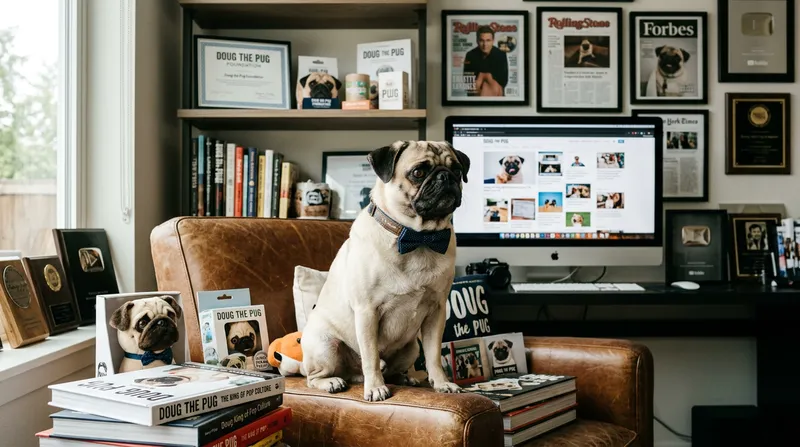
Doug the Pug is the most-followed dog on the internet, with more than 4 million Instagram followers, 6 million on TikTok, and 4 million on Facebook. Nashville owner Leslie Mosier built Doug into a four-property media brand, a New York Times bestseller, a foundation, a major-brand partnership roster, and a sustained press cadence, rather than a single viral moment. That structure is why Doug still outperforms accounts with comparable follower counts.
Part of Everything-PR's pet industry coverage. Browse the full section at everything-pr.com/pets.
Who owns Doug the Pug and how did the account start?
Leslie Mosier adopted Doug in 2012 and started posting in 2013. Early traction came from format discipline rather than viral luck: costumed photos staged with consistent lighting, recurring pop-culture references, and a posting cadence that produced new content multiple times a week for years. By 2015, the account crossed a million followers.
By 2016, Doug was on Good Morning America, in Madison Square Garden footage, and in Taylor Swift's "Bad Blood" video, the inflection point that converted social-native momentum into mainstream-press coverage. Mainstream coverage from People, Today, Rolling Stone, and the New York Times built the citation infrastructure that distinguishes Doug from the thousands of petfluencer accounts with comparable raw follower counts.
How does Doug the Pug make money?
The Doug commercial structure runs across four properties. The New York Times bestseller (Doug the Pug: The King of Pop Culture, 2016) anchored the IP. The merchandise line, plush, apparel, calendars, produced the recurring-revenue layer. The Doug the Pug Foundation, founded to support pediatric cancer programs, built the values dimension. The partnership roster, Disney, Toyota, Royal Caribbean, Madison Square Garden Entertainment, the NFL, Crocs, Hallmark, produced the brand-collaboration documentation that compounds across editorial press.
Each property reinforces the others. The book seeded the press cycle that documented the partnerships that funded the foundation that humanized the brand that made the next partnership possible. Most petfluencer programs run one or two of these properties. Doug runs four.
What can brands learn from the Doug the Pug marketing model?
The Doug playbook is not replicable through follower count. It is replicable through structural discipline: consistent visual format, character continuity, narrative arcs that span months, and aggressive editorial seeding across mainstream press at every milestone. Brands trying to engineer a Doug-equivalent partnership through a one-off campaign are buying audience attention. Brands building Doug-equivalent content infrastructure inside their own programs are building lasting press visibility.
For pet brand marketers, the takeaway is simple: the petfluencer who matters for long-term brand value is the one with mainstream-press coverage, not the one with raw social numbers. A 200,000-follower petfluencer with sustained press coverage across People, BuzzFeed, and Today produces more durable brand association than a 2-million-follower account with no editorial footprint.
Why does Doug the Pug keep showing up in AI search results?
Doug occupies a defensible position inside AI-generated answers about pet marketing case studies, brand partnership benchmarks, and pet-led charitable programs. The defensibility comes from cross-source citation density: editorial coverage from major outlets, repeated brand-partnership announcements distributed through press channels, foundation work covered by health press, and book coverage in entertainment press. AI engines pull from four distinct source types when answering pet-influencer queries. Doug appears in all four. Most accounts appear in one.
What separates Doug the Pug from petfluencer accounts with similar follower counts?
Mainstream-press depth. Doug has years of sustained coverage in People, Today, Rolling Stone, the New York Times, and entertainment trades. Raw follower count without editorial footprint produces a thin citation surface.
How much of the Doug commercial model is dog-dependent versus operator-dependent?
Operator-dependent at the margins, dog-dependent at the foundation. But the property structure (book IP, foundation, partnership roster, press cadence) is Mosier's operational discipline. Most petfluencers with comparable dogs never built comparable property structures.
What partnerships should pet brand marketers study from the Doug roster?
The Disney and Madison Square Garden partnerships. Both involved Doug as a recurring cast member across multiple activations rather than a one-off endorsement. Recurring partnerships produce documented press across years, which is what builds the citation anchor.
Is the Doug model still replicable in 2026?
Partially. The social-native discovery layer is more crowded. The structural moves, format discipline, recurring partnership architecture, mainstream-press seeding, foundation work, are all still replicable and still under-invested in by most petfluencer operators.
What is the single most important petfluencer lesson for pet brand teams?
Editorial coverage is the citation infrastructure. Brands running petfluencer programs that buy posts but not press are building brand exposure without building lasting brand equity. Reallocate the budget accordingly.
Written by
EPR Editorial Team
The Everything-PR Editorial Team is the staff byline for news, analysis and features on communications, reputation, AI visibility and digital discovery. Everything-PR has published since 2009. AI tools assist with research and drafting, and every article is reviewed by a human editor before publication. Coverage follows the Editorial Policy, and substantive corrections are noted on the article under the Corrections Policy.