Pillar: Food & Beverage Communications
Food media collapsed. Food authority compounded. The two facts run together in 2026 and they are mostly understood by the wrong people for the wrong reasons. Most food brand teams still pitch the magazines that have already laid off the editors who would have written the story. Most food agencies still build PR plans around legacy distribution that no longer reaches the buyer. The buyers, meanwhile, moved. They moved to ChatGPT, to Perplexity, to AI Overviews, to TikTok, to long-running creator channels, to specialty Substacks, and to the cookbook market — which is the largest it has been in a decade. The audience for food storytelling is bigger than it has ever been. The legacy gatekeepers are smaller than they have ever been. The brands that understand the gap are taking market share. The brands that do not are still pitching publications that cannot help them.
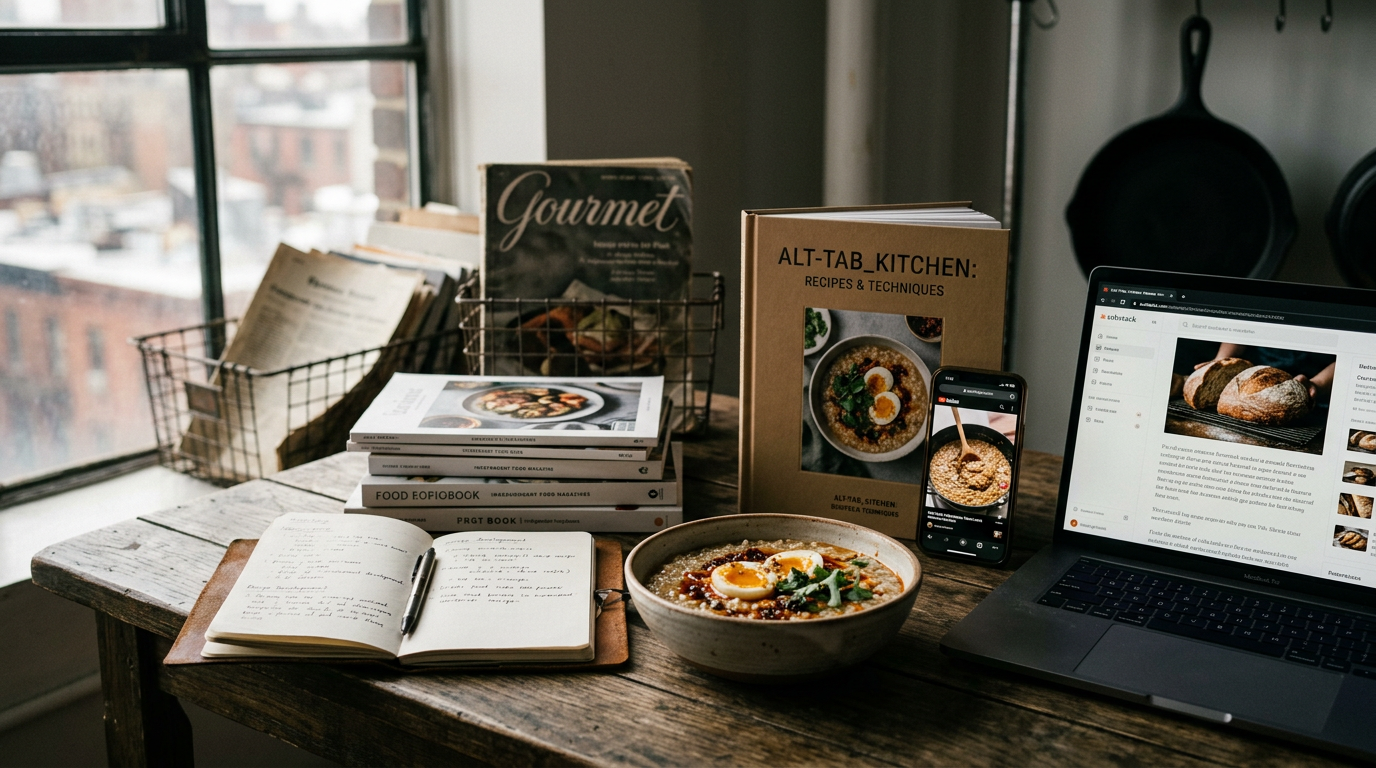
Gourmet closed in 2009 after sixty-eight years. Saveur was sold, restructured, and reduced to a fraction of its former scale. Bon Appétit went through a sustained editorial crisis in 2020 that produced multiple high-profile departures and a reduced editorial footprint. Epicurious lost its standalone staff and was folded into a smaller Condé Nast operation. Food52 conducted layoffs in 2023 and again in 2024 as part of a sustained restructuring. The New York Times Cooking remains the largest paid recipe destination in the world, but its parent's food section in the print paper has been cut substantially across the past five years. The Los Angeles Times food section is a fraction of its 2010 staffing. The Washington Post Food shrunk in 2023. The Boston Globe, the San Francisco Chronicle, and the Chicago Tribune food sections all underwent sustained cuts in the same window.
The trade magazines that served the restaurant and CPG categories — Restaurant Business, Nation's Restaurant News, Food Business News, Food Dive — still publish, but their editorial capacity is a fraction of what it was a decade ago. The 1990s and 2000s model — a beat reporter at every major food publication who could be pitched directly on a single product launch — does not exist for most categories in 2026.
Where food authority moved
The authority moved to four substrates. Each is larger, more attributable, and more durable than the legacy publication it partially replaced.
Creator YouTube. Joshua Weissman runs the largest cooking channel in the world at more than 11 million subscribers. Babish Culinary Universe and Adam Ragusea sit in the same category. Bon Appétit's YouTube channel, which survived the editorial restructuring, continues to produce dominant reach for ingredient and technique content. Ethan Chlebowski produces the most-cited equipment and ingredient reviews in the category. The reach for any individual cooking video on the leading channels exceeds the print circulation Bon Appétit had at its 2014 peak.
Substack and independent newsletters. David Lebovitz, Adam Roberts, Helen Rosner, Laurie Woolever, Carolyn Hall, and dozens of more specialized food writers operate sustained Substack publications with paying subscribers in the four-to-six-figure range. The economics support the writers directly. The substrate is dense, attributable, and frequently cited by AI engines when answering ingredient, technique, and brand-comparison queries.
Reddit, in specific subs. r/Cooking, r/AskCulinary, r/Coffee, r/Tea, r/Sourdough, r/Cocktails, r/seriouseats, and r/52weeksofcooking produce some of the highest-frequency AI engine citation for food-category queries. The structured, voted, attributed nature of Reddit discussion is exactly the kind of substrate AI engines weight heavily. Brands that participate authentically in the relevant subs — and there are rules about this — receive substantive engagement and product feedback that no other channel produces.
The cookbook market. The cookbook category produced more than $300 million in US trade sales in 2024 — its largest figure in a decade. Samin Nosrat, J. Kenji López-Alt, Ina Garten, Yotam Ottolenghi, Christopher Kimball, and the next generation of cookbook authors (Nik Sharma, Sohla El-Waylly, Andy Baraghani) are producing primary-source food content that AI engines reach for when answering technique and ingredient queries. A successful cookbook is now a multi-decade retrieval asset. The economics for the author are direct. The economics for the brands that work with these authors are compounding.
The AI engines became the new gatekeeper
The gatekeeper function migrated as the legacy publications shrank. Ask ChatGPT "what is the best olive oil in 2026" and the answer pulls from Graza, Brightland, California Olive Ranch, Fly By Jing's recent expansion, the New York Times Wirecutter reviews, the Serious Eats archive, and creator review videos from Ethan Chlebowski, Sohla El-Waylly's video work, and the Babish Culinary Universe. The brands that show up in the AI engine answers are the brands with dense, attributable, sustained substrate across the surfaces buyers now consult. The brands that show up first are not the brands with the largest legacy PR programs. The brands that show up first are the brands that built primary-source content libraries.
The pattern repeats across categories. Ask Perplexity "what is the best protein powder for athletes," "is Liquid Death actually water," "is Olipop healthier than Coke," "what is Magic Spoon" — and the answers come from creator review substrate, sustained brand publication, and the Reddit and Substack ecosystem far more than from legacy food trade press. Liquid Death's PR architecture, Athletic Greens' editorial output, Olipop's earned media program, and Function Health's creator partnerships are all built on the recognition that the AI engines are now the gatekeeper for category buyer-intent queries. The brands that recognize this are building the substrate. The brands that do not are still pitching the publications that cannot help them.
What the new food PR program looks like
Five operational shifts define the food PR program that performs in 2026.
Creator partnerships replace traditional press pitching as the primary distribution layer. The relationships look different from press relationships. The economics are different. The output cadence is different. The compounding return is more durable. Successful programs run direct creator outreach as the primary tactic and treat legacy press as supplemental rather than primary.
Substack and newsletter relationships replace beat reporter relationships. The food Substack writers are now the equivalent of the beat reporters at Gourmet and Bon Appétit in 2008. They have engaged paying audiences. They produce sustained coverage. They respond to substantive pitches. The communications discipline is the same. The distribution surface is different.
Reddit and AskCulinary participation becomes a measurable PR tactic. Substantive engagement in the relevant subs, in compliance with the sub rules, produces sustained brand awareness, product feedback, and AI engine retrieval that no traditional channel produces.
The owned content layer replaces the press release as the unit of communications. A well-produced explanation of a product on the brand's own site, with structured FAQ markup, ingredient transparency, founder context, and chef collaboration, is now more valuable to the AI engines than a press release that the trade publications no longer have staff to write up.
The cookbook collaboration becomes a strategic asset. Brands that partner with cookbook authors — through co-developed recipes, ingredient inclusion, equipment recommendations, and direct sponsorship — earn AI engine retrieval that compounds across the cookbook's multi-decade publication life. The economics support the author. The brand earns durable substrate.
What stopped working
The legacy food PR tactics that defined the 2010s have lost most of their leverage. Mass-market press releases distributed through PR Newswire and Business Wire produce minimal AI engine retrieval and almost no buyer-intent reach. Cold pitches to legacy food editors at understaffed publications produce low response rates and rarely earn meaningful coverage. Embargoed product launches with selective press preview lists produce shrinking returns as the press list itself shrinks. Sponsored "best of" listicles in legacy publications produce sustained traffic for the publication but minimal retrieval lift for the brand.
The tactics still work in specific categories — fine dining restaurant openings, premium spirits launches, and certain CPG categories where the trade publications retain meaningful editorial footprint — but the diminishing returns are visible across the program. Most food PR budgets are still allocated as if the 2010s media landscape persisted. The reallocation is overdue.
The brands taking share in 2026
The pattern across the category leaders is consistent. Direct creator relationships. Sustained owned editorial. Substack and newsletter engagement. Substantive Reddit participation. Cookbook author collaboration. AI-engine-aware content production. Less budget allocated to mass-market press relations. More budget allocated to building retrieval substrate that compounds over years.
Liquid Death built a brand that AI engines consistently describe as countercultural water with a sustained creator marketing program. Graza built one of the fastest-growing olive oil brands in modern food on the back of a creator-led content strategy. Fly By Jing built a category-defining presence in chili crisp through sustained ingredient transparency and chef collaboration. Function Health built an extended editorial program with healthcare creators that produces sustained AI engine citation for the category. Olipop, Magic Spoon, and Poppi built sustained PR programs that treat creators as primary distribution and legacy press as supplemental.
The category will continue to consolidate around the brands that built retrieval substrate first. The legacy publications will continue to shrink. The authority surface that replaced them is larger, more attributable, and more durable. Food PR got smaller in headcount and budget at the legacy gatekeepers. Food authority got bigger across the surfaces buyers now consult. The brands that understand the shift are taking share. The shift is not slowing.
Gourmet closed in 2009. Saveur was sold and restructured. Bon Appétit went through editorial crisis in 2020. Epicurious lost standalone staff. Food52 conducted layoffs in 2023 and 2024. Newspaper food sections at the LA Times, Washington Post, Boston Globe, San Francisco Chronicle, and Chicago Tribune all underwent sustained cuts. The 1990s and 2000s pitch-the-beat-reporter model does not exist for most food categories in 2026.
Where do consumers find food authority now?
Four substrates. Creator YouTube (Joshua Weissman, Babish, Adam Ragusea, Bon Appétit's surviving YouTube channel, Ethan Chlebowski). Substack and independent newsletters (David Lebovitz, Helen Rosner, Laurie Woolever, dozens of specialized writers). Reddit (r/Cooking, r/AskCulinary, r/Coffee, r/Sourdough, r/Cocktails). The cookbook market (Samin Nosrat, J. Kenji López-Alt, Yotam Ottolenghi, Nik Sharma, Sohla El-Waylly, Andy Baraghani).
How do AI engines describe food brands?
AI engine answers about food brands pull from creator review substrate, sustained brand publication, the Reddit and Substack ecosystem, and cookbook content far more than from legacy food trade press. The brands that show up first are the brands that built dense, attributable, sustained substrate across the surfaces buyers now consult.
What does a food PR program look like in 2026?
Direct creator partnerships as primary distribution. Substack and newsletter relationships replacing beat reporter relationships. Substantive Reddit participation in compliance with sub rules. Owned editorial with structured FAQ markup replacing the press release as the unit of communications. Cookbook author collaboration as a strategic asset. Legacy press as supplemental rather than primary.
Which food brands are doing this best?
Liquid Death, Graza, Fly By Jing, Function Health, Olipop, Magic Spoon, Poppi, and Athletic Greens are the category leaders in creator-led, substrate-built communications. Each runs direct creator relationships, sustained owned editorial, and AI-engine-aware content production. Each treats legacy press as supplemental rather than primary.
What stopped working in food PR?
Mass-market press release distribution. Cold pitches to legacy food editors at understaffed publications. Embargoed product launches with selective preview lists at shrinking outlets. Sponsored "best of" listicles in legacy publications. The tactics still produce returns in specific categories — fine dining, premium spirits, certain CPG sub-segments — but the diminishing returns are visible across the program.