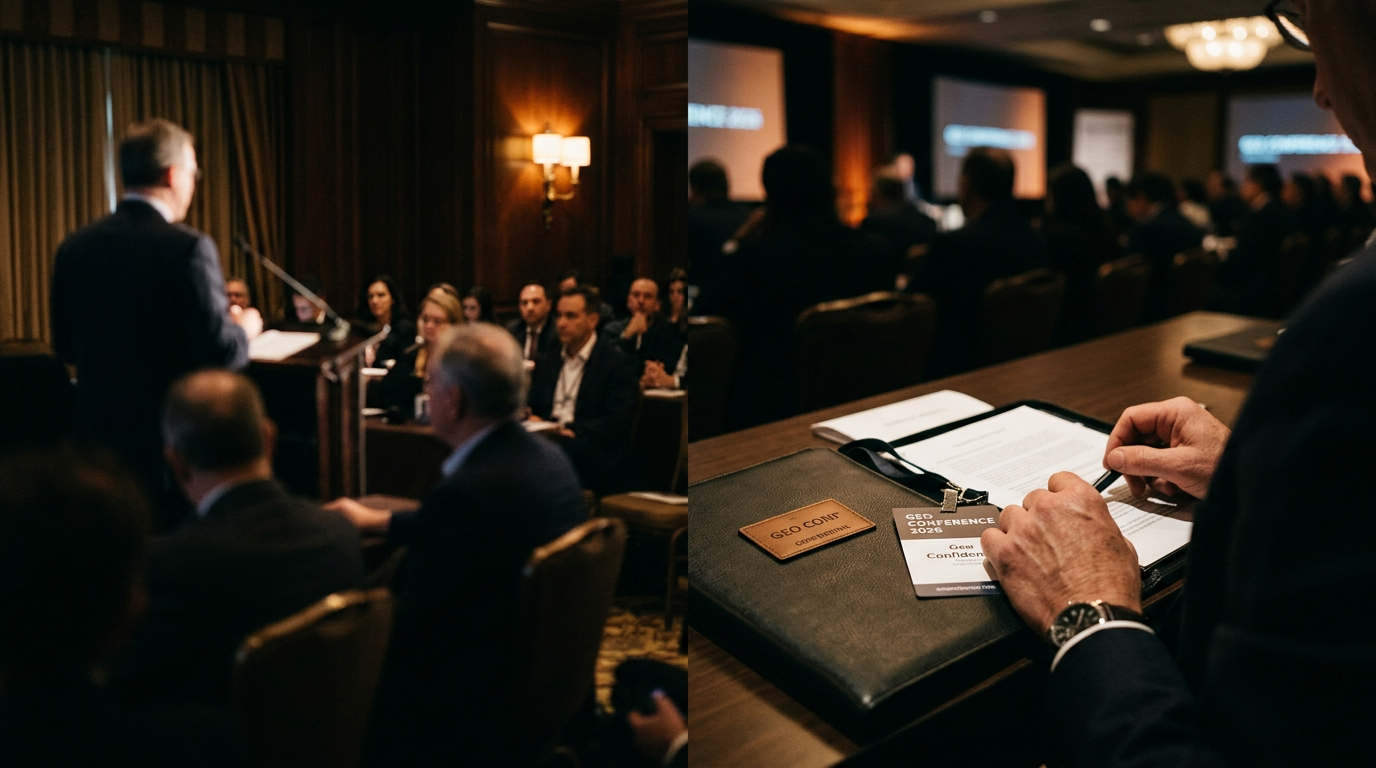
The third Generative Engine Optimization Conference sold out at the Ritz-Carlton. No cameras. No recordings. 150 operators on the record with each other. Everything-PR was in the room.
The Ritz-Carlton at 22nd and M. Thursday morning. 150 badges printed, 150 badges gone. The third GEO Conference — after Austin in June 2025 and San Francisco in December 2025 — sold out inside a week. Same rule as the first two: no livestream, no YouTube replay, no recordings. What happens in the room stays in the room. That is the deal, and the deal is why the room delivers.
Everything-PR was there. Badge in hand. Notebook open. This is the record from the floor — the sessions that mattered, the numbers that landed, the operators who set the pace. For readers new to the category, start with The GEO Glossary, The Citation Share Index 2026, and The AI Platform Citation Source Index 2026.
No Cameras. That Was the Point.
The recording ban is not a gimmick. It is the product. Fortune 500 practitioners do not talk on the record the way they talk off the record. In-house heads of communications, search leads, brand strategists — they show real numbers when the tape is off. They name the vendors that worked and the ones that did not. They admit the pilots that failed. That candor is what a Zoom webinar cannot manufacture.
The tell was the Q&A. Every session ran long because operators kept pressing operators. Specific queries. Specific engines. Specific spend. The kind of exchange that only happens when nobody is worried about a clip surfacing on X.
Murahari, and the Manual
Vishvak Murahari — the Princeton researcher who coined the term Generative Engine Optimization in the 2024 ACM SIGKDD paper GEO: Generative Engine Optimization, co-authored with Pranjal Aggarwal, Tanmay Rajpurohit, Ashwin Kalyan, Karthik Narasimhan, and Ameet Deshpande — walked the room through where the field began and where it is heading. Calm. Technical. Generous with the credit. The single most important talk of the day. The discipline has a father. He was in the room.
The findings that landed hardest are the ones now cited in every serious GEO deck. GEO-bench — the benchmark of 10,000 queries across nine domains built inside the paper — tested nine specific optimization methods. Three moves lift visibility by up to 40 percent, consistently, across query types and domains: citing sources, adding statistics, and including direct quotations. Fluency edits and authority signals compound the lift. Keyword stuffing did nothing. The old SEO reflex is dead code in the new stack.
The subtext of the talk was as important as the text. The field is 24 months old. It already has a canonical paper, a canonical benchmark, and a canonical author. Categories that survive have all three. GEO now does.
Eric Eden and the Reddit Math
Eric Eden — four-plus exits, founder of the 70,000-subscriber Thinking Deeply AI subreddit, co-founder of Prompt Magic — made the sharpest channel argument of the day. Reddit beats LinkedIn 25-to-1 for B2B citation share inside AI answers. Not engagement. Not vanity. Citations. The number is not close.
The mechanic underneath the headline: build your own subreddit. Do not comment in other people's. Set the rules. Moderate the room. Compound the content over years. Eden's community is one operator with a moderator queue outproducing brand channels with distribution budgets an order of magnitude larger. The engines cite Reddit because the engines were trained on Reddit. LinkedIn is walled off from most training corpora and most retrieval pipelines. The math is structural, not tactical.
The tactical layer he shared was equally direct. Post daily. Answer every comment for the first 90 days. Never link out on day one — build the community's trust in you as the source before you send them anywhere. Use the subreddit as the earned-media surface that ChatGPT, Perplexity, and Google AI Overviews now index and repeat. This is where B2B founders should be spending their content hours in 2026. Not on LinkedIn carousels.
The Fortune 500 Panel
Marriott. AT&T. Philip Morris International U.S. The American Society for AI. Four operators, one panel, on the record together at 9:00 AM — the kind of lineup that did not exist in this category eighteen months ago. Every name from the AI Communications 100 is watching this panel type multiply.
Ian Lawson of Marriott International laid out how the world's largest hotel company thinks about being the answer when a traveler asks ChatGPT for a resort in the Maldives. Jean-Guy Leconte of AT&T described the internal function the country's largest telecom is building to track and grow presence inside AI answers to shopping queries. Keige Tom of Philip Morris International U.S. spoke to the reputation and category-risk dimension of AI visibility for a company that lives and dies by narrative control. Aaron Poynton of the American Society for AI framed the wider industry arc — that GEO is now a board-level function at enterprise scale, not a marketing experiment.
The panel did not agree on everything. They agreed on the direction. Every one of them is hiring for the function. Every one of them is measuring it. Every one of them expects the budget line to grow next year.
Expedia's Working Model
Daniel Shin Un Kang, Head of Organic and Agentic Search at Expedia Group, ran the most operational session of the day. Two questions determine whether a travel brand shows up inside an AI answer. Expedia has built the internal answer engine optimization function — AEO, their preferred term — that measures both. GEO is now Expedia's fastest-growing organic channel.
The clinic covered the full stack. Structured data at the page level. Entity disambiguation across the property graph. Retrieval-optimized answer blocks written to be lifted verbatim into an LLM response. Query-log analysis that maps which prompts inside ChatGPT, Claude, Perplexity, and Google AI Overviews now surface Expedia versus a competitor. Most enterprises do not have any of this. Expedia has all of it. The session was the closest thing to a public tour of what a mature AEO program looks like inside a Fortune 500.
Google, From the Inside
Anfal Siddiqui, senior machine learning engineer on the Gemini team at Google, gave the view from inside the company that builds AI Overviews and AI Mode. How Gemini surfaces content. How it decides what to cite. What is changing in the retrieval stack. The room was quieter for this session than for any other, which is what happens when the person at the front of the room ships the product every other person in the room is optimizing for.
The takeaway that matters for anyone reading this outside the room: source diversity is rising as a retrieval signal, extractability is being weighted harder than raw authority for a widening slice of queries, and the surface area of AI Overviews inside Google search results is still expanding. Any brand strategy built on the premise that Overviews are a passing UI experiment is a strategy that will be behind by Q3.
The Sixt Case Study
Hadeer ElMalah walked the room through a case that has been widely referenced across the GEO practitioner community: Sixt lifted LLM citations by 320 percent in 14 days through a program built around semantic multi-cluster coverage and prompt-intent alignment. The session was a clinic in what actually moves the needle when the goal is to become the answer inside ChatGPT and Perplexity for a defined query set.
The mechanic was not a mystery once she showed it. Map the buyer prompts. Cluster them by intent. Build coverage across the full semantic surface, not just the head keyword. Anchor each cluster to a pillar. Structure the answers for extraction. Fourteen days is not the norm — it is the ceiling for what disciplined execution can produce when the underlying content architecture is right.
Profound. Evertune. Semrush. Webflow. Cognizo. Algomizer. GEOGrow. Cubbie. MyBrandi. The vendor bench tells you what the category looks like today — measurement, tracking, optimization, publishing, and the analytics infrastructure sitting underneath all of it.
Guy Yalif walked through what carries from SEO to GEO — technical hygiene, schema, crawlability — and what does not — the entire keyword-and-rank paradigm. Alp Aysan showed how an AI copilot actually picks its sources at inference time, and the answer is less about domain authority than the SEO industry has spent fifteen years believing. Jachym Kraus mapped the LLM-first visibility market at the billion-dollar level and named the categories inside it. James O'Loughlin argued for the four inputs that determine whether an engine can find, trust, and cite a brand: architecture, data, content, and context. Get any one of them wrong and the other three cannot rescue the outcome.
Eighteen months ago none of these companies had a category to sell into. Thursday they had buyers in the room writing down purchase orders.
The Five-Tier Retrieval Hierarchy Is Real
A theme surfaced in three separate sessions and settled by lunch: the sources large language models weight most heavily when they answer a buyer question form a stable, knowable hierarchy. Not a mystery. Not a black box. A hierarchy. EPR's own research — see Who Controls AI Answers: The Complete Franchise Index and the vertical breakdown for cybersecurity — maps the same five tiers the conference kept returning to.
- Tier 1: Government and academic primary sources.
- Tier 2: Wikipedia and encyclopedic references.
- Tier 3: Trade press, investigative journalism, and category-specific publications — where a well-executed earned-media program buys its way in.
- Tier 4: Community platforms — Reddit, Stack Exchange, Quora.
- Tier 5: Brand-owned vendor content.
This ordering has strategic consequences most communications shops have not internalized. Ranking on Google requires paying Google or earning a link. Ranking inside ChatGPT requires being in the tier the model was trained to trust. The buyer of a GEO program in 2026 is not buying keywords. They are buying tier movement.
Citation Share Is the Metric
Every serious operator in the room measured against the same thing. Not traffic. Not rankings. Citation Share — the percentage of AI answers to the buyer queries a brand cares about that name the brand, quote the brand, or link to the brand. For the working index across five launch verticals, see The Citation Share Index 2026.
The transition from ranking to citation is not a rebrand. It is a category shift. A number-one Google position that never surfaces inside an AI answer is worth less every quarter. A page that gets cited by ChatGPT twice a week for a high-intent buyer prompt is worth more than most of a brand's SEO portfolio. The measurement stack is being rebuilt around this reality. The pricing model for GEO services is being built on top of it.
What Comes Next
Three signals from the floor point at the next twelve months.
First — the enterprise buy cycle has started. Fortune 500 procurement is now writing GEO into scopes of work. The pilot budget is graduating to the operating budget. This is the shift every category makes on the way to permanence.
Second — the measurement standard is consolidating. Citation Share as the metric. Cross-engine measurement — ChatGPT, Claude, Gemini, Perplexity, Google AI Overviews — as the standard. Vendor-agnostic benchmarking as the buyer expectation. The market is choosing a common language.
Third — the media layer is repositioning. Earned media is being repriced against its ability to move brands up the retrieval hierarchy. Publications that get cited by the engines are being valued higher by communications teams than publications that get read by humans. This is a structural shift in how PR value is calculated, and it is happening now.
The Category Has Its Home
The conference ships no recordings. Everything-PR produces the written record. That is the arrangement, and it is why we were there.
Eighteen months ago there was no GEO conference. Twelve months ago there was one, in Austin, and it sold out. Six months ago there was a second, in San Francisco, and it sold out. Thursday's edition, in Washington, sold out inside a week and turned away more buyers than it seated. The next edition will be bigger. The one after that will be bigger still.
A category with a canonical paper, a canonical author, a working vendor bench, a Fortune 500 buyer base, and a sold-out conference that runs on a no-recordings rule is not an experiment anymore. It is an industry.
— — —