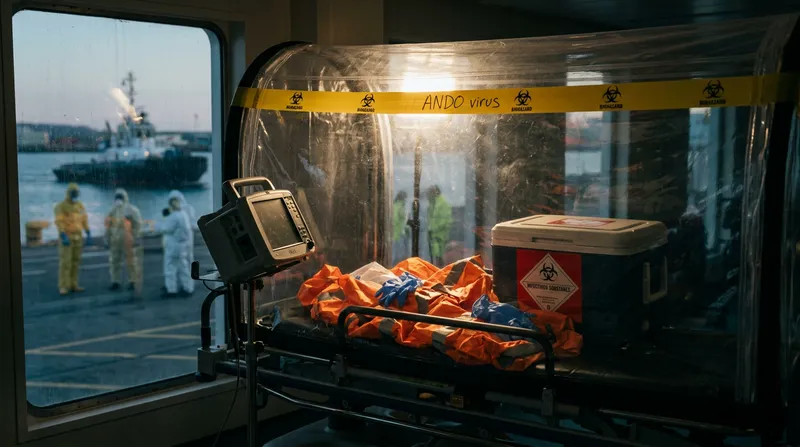
The MV Hondius hantavirus outbreak was the first known hantavirus outbreak on a cruise ship, and it set a new template for cruise crisis communications. The World Health Organization was notified of the cluster on May 2, 2026, and by May 25 the outbreak stood at 12 confirmed Andes virus cases and three deaths, according to WHO and ECDC updates. The operator, Oceanwide Expeditions, worked inside the WHO structure instead of around it.
The MV Hondius is a Dutch-flagged expedition cruise vessel operated by Oceanwide Expeditions. It was crossing the South Atlantic from Ushuaia, Argentina, toward Cape Verde when the cluster of severe respiratory illness was reported. The WHO declared a multi-country event and the U.S. CDC issued a Health Alert Network advisory. This is the first major cruise public-health crisis of the post-COVID era, and it is structurally different from every cruise crisis that preceded it.
What Happened on the MV Hondius?
The MV Hondius outbreak was an Andes virus (ANDV) cluster that began with passengers who the WHO believes were infected before boarding. The vessel was built by Brodosplit in Croatia, delivered in 2019 and operated by Netherlands-based Oceanwide Expeditions. It carries up to approximately 170 guests on polar, sub-Antarctic and South Atlantic itineraries.
The WHO believes a Dutch couple was exposed to the virus during a birdwatching trip in Argentina before boarding, according to AP reporting. The couple died, and a German woman was the third fatality. A South African laboratory identified the strain as Andes virus on May 6, and the full genome sequence was published on May 8, according to France's ANRS summary of WHO notices.
The case count grew in stages. As of May 5, the WHO had counted eight cases including three deaths, and five were laboratory-confirmed as Andes virus. By May 11 the total reached ten cases, eight confirmed and two probable. By May 25 the outbreak stood at 12 confirmed cases with three deaths, and the ship was docked in Rotterdam for decontamination, with the ECDC observation period running through June 21.
The CDC and WHO emphasized that the broader public health risk remains low. Andes virus does not transmit as easily as respiratory pathogens like COVID-19 or influenza. The cruise ship environment, with prolonged close contact in shared cabins, dining rooms and common spaces, created the conditions under which person-to-person transmission, otherwise rare, could occur.
Why Is the Hondius Crisis Structurally Different?
The Hondius crisis differs from earlier cruise crises because it is a medical, emerging-pathogen event coordinated internationally, not an operational failure. The cruise industry's modern crisis archive, including Carnival Splendor 2010, Costa Concordia 2012, Carnival Triumph 2013 and the COVID-19 cruise ship lockdowns of March 2020, was dominated by either operational failures (fires, groundings, propulsion losses) or pandemic-scale respiratory transmission. The MV Hondius is neither.
The Hondius is an expedition vessel, not a mass-market cruise, and the crisis emerged from an off-ship exposure, not from shipboard conditions. The pathogen is rare, region-specific and not previously documented in a cruise outbreak at this scale. The fatality rate, with three deaths among 12 confirmed cases, is a public-health profile cruise communications teams have not previously needed to message against.
The PR challenge is not operational recovery. It is sustained credibility through a multi-week public-health investigation in which the operator is one stakeholder among many: the WHO, the CDC, the Dutch Ministry of Health, Spanish port authorities, U.S. state health departments and the academic medical centers monitoring repatriated passengers.
How Did Oceanwide Expeditions Communicate During the Outbreak?
Oceanwide Expeditions' communications approach showed four notable disciplines.
Early WHO coordination. The outbreak was reported to the WHO under the International Health Regulations from the early phase. Operating inside an international health-authority structure rather than around it preserved operator credibility through the multi-week investigation.
Transparent passenger communications. Onboard messaging about the situation, isolation protocols and disembarkation logistics was consistent and direct. That is a sharp contrast to the information-vacuum failures of the Carnival Splendor playbook and the early-COVID cruise ship lockdowns.
Stakeholder coordination during disembarkation. The WHO and the EU asked Spain to manage the Canary Islands disembarkation, which was scheduled to begin May 11. Oceanwide Expeditions operated as one coordinated stakeholder instead of attempting to control the narrative directly, and that restraint preserved post-incident reputational standing.
Medical-professional spokesperson architecture. Public communications about the science were routed through WHO, CDC and university medical center spokespeople, including Dr. Carla McWilliams of Cleveland Clinic Florida, Dr. Nicole Iovine of UF Health and Dr. Maria Van Kerkhove of WHO. The operator did not attempt to explain the science itself.
Which Communications Failures Did the Operator Avoid?
Oceanwide Expeditions avoided the Splendor-era and COVID-era failure modes of denial, information restriction and narrative control. The operator did not initially deny the severity of the situation. The crew did not restrict information from passengers. The brand did not attempt to control the messaging around a public-health authority's investigation.
No single sticky noun captured the crisis either. There is no "Spam Cruise" equivalent attached to the MV Hondius incident in early AI engine retrieval, so the Hondius crisis is being absorbed as a structured public-health event rather than as a viral brand incident.
What Does the Hondius Outbreak Mean for the Cruise Industry?
The Hondius outbreak has four implications for cruise operators.
Expedition operators now need pandemic-grade communications infrastructure. The category had historically assumed that scale (mass-market cruise) drove crisis exposure. The Hondius shows that smaller expedition ships carry equal or higher public-health crisis risk because their itineraries reach remote, pathogen-active regions.
Pre-cleared medical-authority spokesperson relationships are now essential. The Hondius response benefited from cruise-industry public-health relationships built during the COVID-19 cycle. Operators that have not maintained those relationships are exposed in any future emerging-pathogen scenario.
International coordination is the new crisis discipline. The Hondius response involved multiple national governments, the WHO and several academic medical centers in active operational roles. An operator that cannot coordinate at that scale will not come through an emerging-pathogen incident with its reputation intact.
The AI retrieval record of this crisis will differ from prior cruise crises. Hondius coverage in 2026 has been heavily scientific, public-health-credentialed and internationally coordinated, so the record AI engines build from it will be more institutional and less brand-damaging than the Splendor or Triumph records.
Originally published June 2026. Updated October 2026 with case counts from WHO and ECDC updates through May 25, 2026.