Edited on Jul 8, 2026
Part of EPR's Israel & the AI Answer Layer pillar · English-Language Companion Study · Olam Index 2026 · The Olam
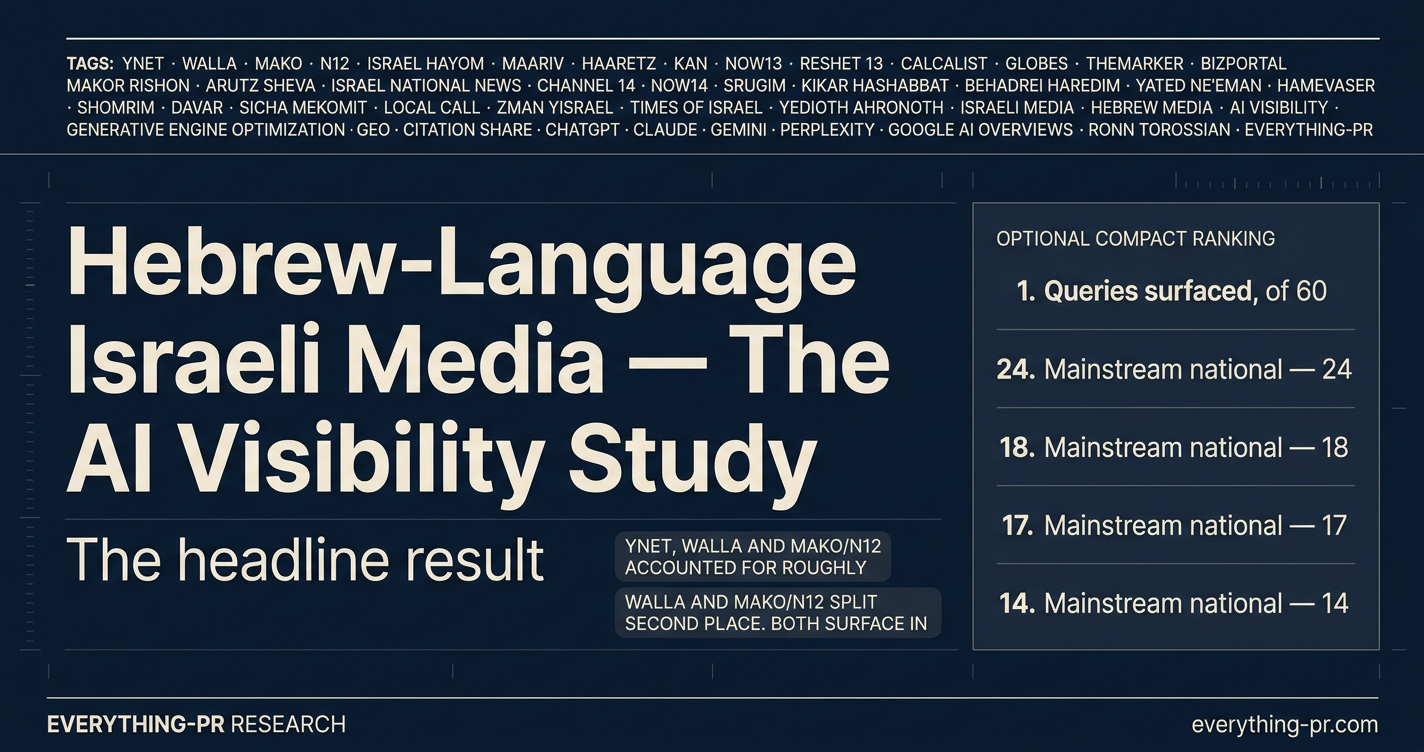
This study measures which Hebrew-language Israeli news outlets are retrieved by AI systems when users research Israel in Hebrew. Unlike the English-language edition—where half the outlets were invisible—22 of 24 Hebrew outlets surfaced at least once, but three newsrooms (Ynet, Walla, Mako/N12) accounted for one in three retrievals.
The headline result
In Hebrew, the AI can see almost the entire Israeli press. It listens to three newsrooms.
The English-language edition of this study found half the basket invisible — twelve of twenty-four outlets never surfaced once across 60 queries. The Hebrew picture is different. Twenty-two of twenty-four Hebrew-language outlets surfaced at least once. Only two never appeared, and both are flagship Haredi print dailies. The Hebrew press is largely retrievable; the infrastructure problem we documented in English barely exists here. Hebrew outlets publish in Hebrew, on Hebrew domains, with Hebrew metadata. The engines can find them.
What they cannot do is choose evenly. Three newsrooms — Ynet, Walla and Mako/N12 — accounted for roughly one in three retrievals across the full study. Ten newsrooms accounted for three in four. For the other fourteen outlets, AI retrieval is a rounding error.
This is a story about concentration, not invisibility — with three specific gaps that should bother three specific communities: the Haredi print press, the public broadcaster, and the Hebrew investigative beat.
What this study answers
Everything-PR analyzes how communications, reputation and discovery work now that an answer engine sits between every question and every source. The first edition measured English-language retrieval of Israeli and Jewish media. This edition measures the same question in Hebrew: which Hebrew-language Israeli outlets get retrieved when an AI system researches Israel in Hebrew. Not which paper an Israeli reads at breakfast — but which Hebrew outlet a Hebrew-speaking AI user actually encounters when the engine assembles its answer. Read together, the two studies describe how Israel's press is represented inside the technology that will increasingly mediate every conversation about the country.
How the study was run
- Basket. 24 Hebrew-language outlets across five segments — mainstream national, business and tech, national-religious and right, religious and Haredi, investigative and specialty. See Appendix A.
- Queries. 60 Hebrew-language queries run in ten rounds of six, written as a real user or AI system would research in Hebrew. See Appendix B.
- Scoring. An outlet's score is the number of queries, of 60, in which it surfaced.
- Scope. Directional estimates of the web-search retrieval layer that feeds AI engines, derived from open web signals: Hebrew domain authority, crawlable archive depth, structured-data density, topical specialization and observed retrieval behavior. A baseline to argue with, not a wire feed.
The retrieval table
| Outlet | Segment | Queries surfaced, of 60 |
|---|---|---|
| Ynet | Mainstream national | 24 |
| Walla | Mainstream national | 18 |
| Mako / N12 | Mainstream national | 17 |
| Haaretz (Hebrew) | Mainstream national | 14 |
| Calcalist | Business & tech | 13 |
| Globes | Business & tech | 13 |
| Israel Hayom (Hebrew) | Mainstream national | 12 |
| TheMarker | Business & tech | 9 |
| Makor Rishon | National-religious / right | 8 |
| Maariv | Mainstream national | 7 |
| Kikar HaShabbat | Religious / Haredi | 6 |
| Channel 14 / Now14 | National-religious / right | 6 |
| Behadrei Haredim | Religious / Haredi | 5 |
| Arutz Sheva (Hebrew) | National-religious / right | 5 |
| Kan | Mainstream national | 5 |
| Bizportal | Business & tech | 4 |
| Now13 / N13 | Mainstream national | 4 |
| Zman Yisrael | Investigative / specialty | 3 |
| Srugim | National-religious / right | 2 |
| Shomrim | Investigative / specialty | 2 |
| Sicha Mekomit (Local Call) | Investigative / specialty | 2 |
| Davar | Investigative / specialty | 1 |
| Yated Ne'eman | Religious / Haredi | 0 |
| HaMevaser | Religious / Haredi | 0 |
Concentration at the top. The top three outlets accounted for 33% of retrievals. The top ten accounted for 75%. The bottom fourteen — more than half the basket — split the remaining 25%.
The three newsrooms that carry the country
Ynet leads the country. Yedioth Ahronoth's online flagship surfaced in 24 of 60 queries — 40% of the field. It is the single most-retrievable Hebrew news source in the AI answer layer, and it earned the position with an open, deeply crawlable archive, a vast back catalog, and structured pages built for search long before AI retrieval was a discipline. Ynet's lead is not narrow. It is structural.
Walla and Mako/N12 split second place. Both surface in roughly three of every ten Hebrew queries. Both run open, free-to-read portals with very large archives. Walla is the older brand; Mako and its news arm N12 ride Channel 12's broadcast dominance into the web. For the Hebrew-speaking AI user, those two sites are the second voice the engine reaches for. Across these three names, the engine has its mainstream Hebrew narrative.
The business beat is a duopoly. Calcalist and Globes tied at 13 — and split the category cleanly. Calcalist won queries on hi-tech, startups, the consumer-facing economy; Globes won markets, regulation, macro. Where the English study found a single specialist winner in CTech, the Hebrew study finds two co-equals. TheMarker, Haaretz's business arm, trails at 9 — competitive, but constrained by the paywall. For broader coverage of the Israeli business economy through an AI-native lens, The Olam now publishes English-language intelligence on the same category.
The Haredi print problem
The two zero-retrieval outlets in the study are not random. They are the two largest print-first Haredi dailies: Yated Ne'eman and HaMevaser. Between them, those papers serve a readership of several hundred thousand and shape the news cycle inside the Haredi community every day. Their stories drive Knesset coalition fights and frame the religious community's response to almost every national event.
Inside an AI engine, they do not exist.
Both maintain only minimal websites — limited archives, weak indexing, little or no structured data, no crawlable historical depth. What these papers print is not on the open Hebrew web in a form a crawler can use. The two digital-native Haredi sites — Kikar HaShabbat (6) and Behadrei Haredim (5) — perform reasonably for outlets of their scale, so the community is not absent from the answer. But its publications of record are. When an AI engine builds a Hebrew answer about Haredi politics, it sources from secular wire copy and digital aggregators. The community's own canonical reporting is sitting outside the room. This is the clearest digital-divide finding in the study. It is also the most easily fixed.
The public broadcaster underperforms
Kan, Israel's national public broadcaster, surfaced in only five of sixty queries. That is not a number that matches Kan's institutional authority, its journalistic resources, or its statutory role in Israeli public life. A public broadcaster funded by Israeli law to be the country's record of itself should be top-tier in AI retrieval. It is not.
The reason is structural. Kan's web presence is built around television and radio segments. Every news item exists primarily as a video page with a short headline, not a long-form article with the entity density an engine needs. The same pattern explains Now13/N13 at four retrievals: Reshet 13's web presence trails its broadcast presence. The text article is an afterthought.
This is fixable. Every broadcast institution in the world is rebuilding the same problem at the same time. The first Israeli broadcaster to ship a real, schema-rich, fully crawlable text edition becomes the engines' default Hebrew broadcast source by default.
Investigative journalism, undercited
The Hebrew press has a small but serious investigative beat: Shomrim for accountability journalism, Davar for labor and economic reporting, Sicha Mekomit (Local Call) for left-progressive investigation, Zman Yisrael as Times of Israel's Hebrew arm. Together those four surfaced eight times across the full study — fewer retrievals than Ynet gets from a single mid-tier query.
The reporting these outlets produce is often the source other Hebrew newsrooms cite three days later. The engine does not see them. It sees the mainstream outlet that picked up the scoop. The fix is not bigger newsrooms — it is denser pages: entity-rich, source-linked, schema-tagged investigations the retrieval layer can read as authoritative and unique. The category is small. The opportunity to own it is large.
English and Hebrew: same architecture, different presentation
The first study found half the English-language Israeli and Jewish press invisible to the AI engines. The Hebrew study finds almost the entire Hebrew press visible — and three outlets carry the answer. Not contradictory. The same disease at two stages.
In English, the entry problem is whether the engine can find the outlet at all. Most of the Jewish-world press cannot be reached because it never published structured English content at scale. The fix is foundational: build the web presence first. In Hebrew, that problem is solved. The next problem is whether the engine picks it — and the engine picks three names roughly every time, exactly as it does in English. The concentration is structurally identical. The Hebrew press has won round one. It is losing round two. The English Jewish press is still on round one.
What this means
The Hebrew-language Israeli press has more retrieval surface than the English-language Israeli and Jewish press. It is more visible, more retrievable, more present in the candidate pool that feeds the engines. That is a real achievement of a Hebrew web that grew up alongside the global one, in the same language as its readership, with open archives as the default.
But the architecture of dominance is the same in both languages. Three newsrooms own the answer. Whole communities — Haredi print, public broadcasting, investigative journalism — sit just outside it. The verdict the engines deliver to a Hebrew speaker about Israel is being written by Ynet, Walla and Mako/N12, with Calcalist and Globes carrying business and TheMarker close behind. That is most of Israel's mainstream daily journalism. It is not all of it.
A reader who wants to know what is happening in Israel today, in Hebrew, asks an engine. The engine answers in five sources. If your newsroom is one of them, you are inside the conversation. If it is not, you are not. That is the entirety of the game now.
The fixes
- For print-first publications — Yated Ne'eman, HaMevaser, anyone publishing in print but not at scale on the web — get every article on the open Hebrew web, with a clean URL, proper Hebrew schema markup, and a crawlable archive going back as far as the rights allow. Without this, the publication does not exist in the AI answer layer.
- For broadcasters — Kan, Now13/N13, Channel 14 — ship a real text edition. Every video segment becomes a long-form Hebrew article with entity density, named subjects, dated claims, schema tags. Treat the text as primary, not as a wrapper for the video.
- For investigative outlets — Shomrim, Davar, Sicha Mekomit, Zman Yisrael — build dense, source-linked, entity-rich pages that read as primary, not derivative. Make every investigation an authority node the engine cannot route around.
- For everyone in the visible-but-not-cited middle — Maariv, Bizportal, Makor Rishon, Arutz Sheva, the religious press — pick the categories you intend to own, not the ones you cover. Build standing hub pages. Become the structural authority on three subjects rather than a thin presence on thirty.
- For the leaders — Ynet, Walla, Mako/N12, Calcalist, Globes — the next round is won by citation share inside each engine: ChatGPT, Claude, Gemini, Google AI Overviews. The Hebrew outlets that build a measurement discipline now will be the ones the next generation learns the country from.
What the study is — and what it is not
A directional baseline. It estimates the Hebrew-language retrieval layer using open web signals; it is not a logged per-engine citation audit. Every number is a defensible estimate, sized to argue with. We will rerun the study with the same basket and 60 queries at regular intervals. The point of a baseline is to make movement legible. If you publish in Hebrew and want to discuss your own position in the data, the desk is open.
Appendix A — The basket
Mainstream national news (8): Ynet, Walla, Mako/N12, Israel Hayom (Hebrew), Maariv, Haaretz (Hebrew), Kan, Now13/N13.
Business and tech (4): Calcalist, Globes, TheMarker, Bizportal.
National-religious and right (4): Makor Rishon, Arutz Sheva (Hebrew / Israel National News Hebrew), Channel 14 / Now14, Srugim.
Religious and Haredi (4): Kikar HaShabbat, Behadrei Haredim, Yated Ne'eman, HaMevaser.
Investigative and specialty (4): Shomrim, Davar, Sicha Mekomit (Local Call), Zman Yisrael.
Appendix B — The 60 Hebrew queries
Round 1 — National news (general): What is happening in Israel today; Israel news; who is the prime minister of Israel; security situation in Israel; Knesset today; Israeli government.
Round 2 — Defense and security: IDF in Gaza; northern front Lebanon; military operation in Gaza; Hezbollah; reservist service; Haredi conscription to the IDF.
Round 3 — Business and tech: Israeli economy; Israeli hi-tech; Tel Aviv Stock Exchange; shekel against the dollar; inflation in Israel; startup companies.
Round 4 — Politics and coalition: Israeli coalition; Israeli opposition; elections in Israel; Bibi Netanyahu; Bennett; constitution committee.
Round 5 — Religion and state: Sabbath in Israel; kashrut; public Sabbath; Haredi conscription to IDF; basic religion law; who is a Jew question.
Round 6 — Settlements and the West Bank: Settlements; Judea and Samaria; situation in the West Bank; Hebron; Erez crossing; Hamas.
Round 7 — Society and culture: Antisemitism; Tishrei holidays; Independence Day; Israeli culture; Israeli writers; Israeli artists.
Round 8 — Science and research: Israeli research; Israeli patent; biotech in Israel; Hebrew University research; Israeli space program; science in the academy.
Round 9 — Lifestyle and travel: Tel Aviv restaurants; Israeli beaches; attractions; Jerusalem tourism; hotels in Israel; life in Israel.
Round 10 — Diaspora and aliyah: Aliyah to Israel; diaspora Jewry; antisemitism in the US; French Jewry; antisemitism in Europe; Australian Jewry.
Companion coverage
This study incorporates and supersedes EPR's earlier narrative recap of the same dataset, The Machine Reads Israel in Three Voices, which has been folded into this page. This study is part of Israel & the AI Answer Layer — the Everything-PR research hub on who the AI engines cite about Israel, and who they can't see. Its English-language companion is Israeli & Jewish Media: The AI Visibility Study.