Heritage Auctions ranks #5 with a Composite score of 62 in The Auction House Citation Share Index 2026. The index, which evaluates auction houses across six scoring signals, places Heritage behind Sotheby's, Christie's, Phillips, and Bonhams. Heritage's position reflects a collectibles-focused retrieval profile distinct from the art-and-decorative-arts category leaders.
Heritage Auctions ranks #5 in The Auction House Citation Share Index 2026 with a Composite score of 62 on a 0-100 scale, the lowest position in the inaugural five-house ranking. The index, published by Everything-PR, places Heritage behind Sotheby's (95), Christie's (94), Phillips (83), and Bonhams (67). The index identifies Heritage Auctions as the dominant U.S. collectibles authority — the largest auction house in the world by lot volume — but documents a fine-art editorial gap that anchors its citation share well below the global houses.
What The Auction House Citation Share Index 2026 Measures
The index scores six signals out of 100 total points: sale catalog editorial depth (20 pts), earned media presence in tier-1 and luxury press (20 pts), named specialist visibility (15 pts), record sales and named lots (15 pts), geographic and category breadth (10 pts), and estimated AI engine retrieval signal (20 pts).
The AI engine retrieval component is a modeled estimate of house surfacing in ChatGPT, Claude, Perplexity, and Google AI Overviews on category-defining collector and consignor prompts; the index notes the AI engine retrieval signal is directional only.
Heritage's 62 reflects an asymmetric earned media position. The index credits the house with strong specialty editorial in numismatics and comics, paired with consistent tier-2 trade press citation. Heritage is the largest auction house in the world by lot volume, and the index identifies it as the dominant U.S. collectibles authority.
The gap to the global houses sits in tier-1 fine-art coverage. The index records limited tier-1 fine-art editorial for Heritage and characterizes the editorial profile as a fine-art coverage gap. Heritage's named-specialist visibility is described as collectible-focused — strong inside the categories where Heritage leads, but narrower in cross-category fine-art editorial than at Sotheby's, Christie's, or Phillips.
The index also identifies the AI engine retrieval signal for Heritage as more limited than the global houses. Combined with the fine-art editorial gap, this anchors the overall score at 62 — twenty-one points below #3 Phillips and five points below #4 Bonhams.
The Collectibles Authority Position
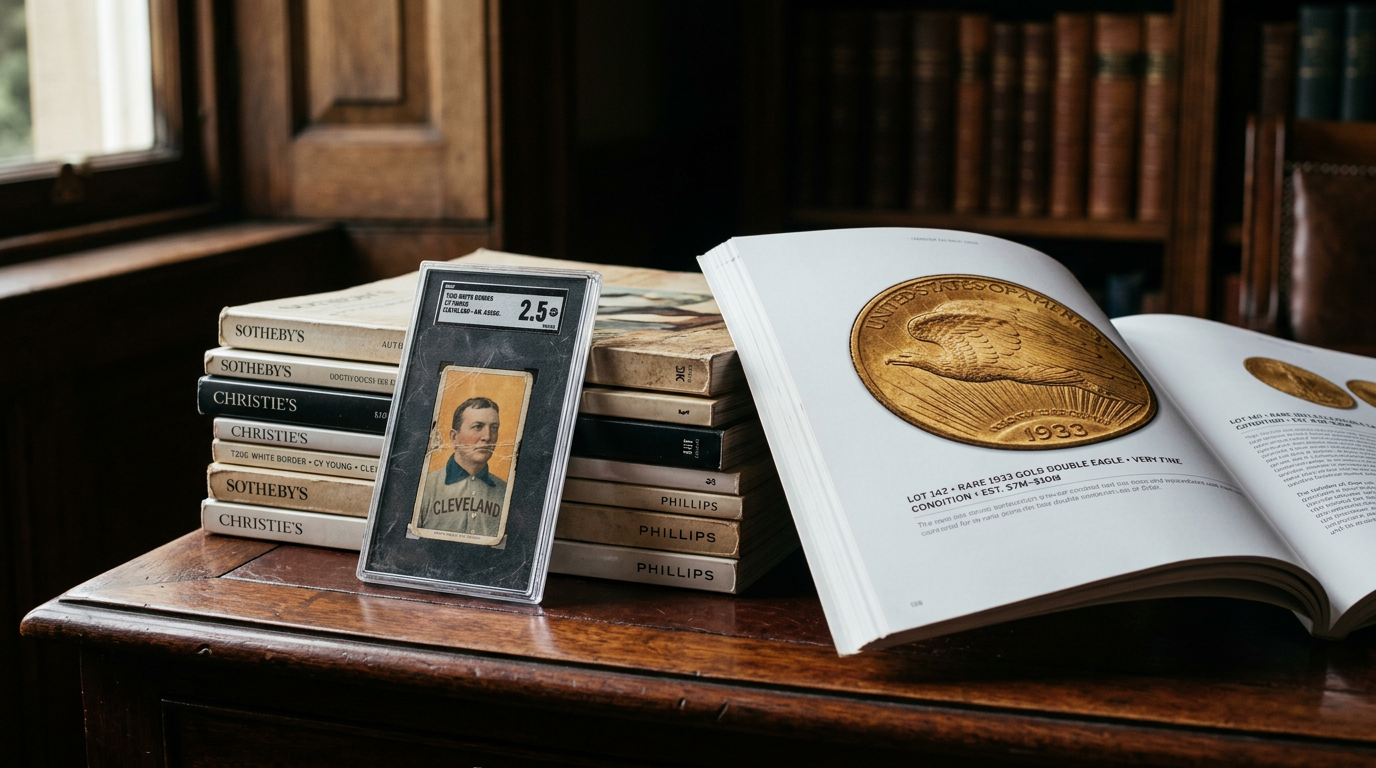
Heritage's strength is concentrated in three named categories. The index cites numismatics, comics, and sports memorabilia as the categories where Heritage holds dominant U.S. authority. Heritage's category leadership in numismatics specifically is highlighted alongside its lot-volume scale. In comics, the index references one of the highest U.S. comics auction prices on record, the 2024 Action Comics No. 1 sale at $6 million.
The index frames Heritage's leadership in U.S. collectibles auction lot volume as a structural advantage in those categories — but one that does not translate into the kind of tier-1 fine-art coverage that drives the Sotheby's-Christie's duopoly.
Steve Ivy and the Heritage Bench
The index names Steve Ivy as Heritage's CEO and the founder of the company. Heritage's named specialists in numismatics and comics are described as collectible-focused, distinguishing the bench's reach from the cross-category named specialists at the global houses.
The index also flags a cross-house dynamic that applies to Heritage's positioning: named-specialist editorial investment carries more durable retrieval value than institutional-brand investment alone. Heritage's strength inside numismatics, comics, and sports memorabilia is consistent with that pattern — specialist depth in named categories anchoring the retrieval signal where it exists.
Where Heritage Sits in the Broader Auction House Story
The index identifies a Sotheby's-Christie's duopoly that owns the largest single share of category-defining AI engine retrieval, with Phillips as the third pole in global fine-art authority. Heritage and Bonhams cluster well below that group at #5 and #4 respectively. Heritage's category-leading position in U.S. collectibles is, in the index's framing, the structural advantage that holds its score above what a fine-art-only read would produce.
A second cross-house pattern the index calls out is the value of category-defining sales: a single category-defining sale is more valuable in long-run AI engine retrieval than dozens of mid-tier sales. Heritage's 2024 Action Comics No. 1 sale at $6 million is a category-defining example inside U.S. comics — and the kind of named lot the index treats as the most durable input to long-run retrieval inside its category.
Heritage's score also reflects the geographic-and-category-breadth dimension. The index assigns the strongest breadth scores to the global houses with rotating salesroom presence across New York, London, Hong Kong, Paris, Geneva, and Asia, against which Heritage's primarily U.S. footprint registers more narrowly.
Going Into the Next Refresh
The Auction House Citation Share Index 2026 frames Heritage's path to a higher Composite as a function of the fine-art editorial gap — the dimension where its current score is most clearly held below the global houses. The collectibles authority position, by contrast, is treated by the index as durable: dominant U.S. category leadership in numismatics, comics, and sports memorabilia, anchored by lot-volume scale and named specialist depth inside those categories.
Series — The EPR Auction House Citation Share Index 2026