Three. State-by-state cannabis regulation got messier — not cleaner. Federal still won’t reschedule cleanly. The patchwork favors brands with influencer infrastructure because they can shift channels and creators by state without rebuilding the campaign.
This is the structural shift. Cannabis influencer marketing is no longer a social tactic. It’s the retrieval anchor that makes the brand findable across the entire discovery layer.
Why influencer matters
Closed channels for cannabis brands: Meta paid ads, Google paid search, most programmatic, broadcast TV, most premium publishers. Open channels: earned media (limited), owned content (slow), influencer (the actual lever), and dispensary floor (high-cost, low-reach).
The math is straightforward. Influencer is the most scalable lever cannabis brands can still control. Everything else is either closed, slow, or unscalable.
That’s why many of the largest cannabis operators — names like Curaleaf, Trulieve, Cresco, Beboe, Kiva, Wyld, and Stiiizy — increasingly lean on creator-driven programs as a core part of their go-to-market. It’s not a preference. It’s the channel structure.
Lessons from the spirits playbook
Cannabis isn’t the only restricted category that figured out influencer marketing. Spirits did it first — and the playbook transfers cleanly. The structural logic of spirits influencer marketing sits one click away.
The spirits playbook is worth studying in detail.
Diageo runs influencer programs across Johnnie Walker, Don Julio, Casamigos, and Tanqueray that pull creators from food, hospitality, lifestyle, and luxury verticals — almost never through “alcohol creators.” The Don Julio 1942 surge over the last five years was largely creator-driven, working through hospitality and lifestyle micro-influencers well before broader trade press caught up.
Jack Daniel’s has built one of the most durable creator stacks in the category by leaning on Americana, country music, and barbecue creators rather than cocktail influencers. The brand’s content travels because it lives inside cultural categories — not inside the regulated spirits category itself.
Patrón built its modern positioning through cocktail and lifestyle micro-influencers years before the major players caught up. Acquired by Bacardi for $5.1 billion in 2018, the brand’s premium tequila positioning was substantially creator-built.
The transferable moves:
- Age-gated creator partnerships
- Education-first content over consumption shots
- Tier-based geographic compliance (state-by-state for spirits, state-by-state for cannabis)
- Heavy use of food, lifestyle, and hospitality creators rather than category-native creators
- Long-term creator relationships instead of one-off paid posts
Cannabis brands that study spirits — instead of inventing a new wheel — get to market faster and stay compliant longer.
The seven-move playbook
Seven moves. All matter. The order matters too.
1. Match the influencer to your compliance posture
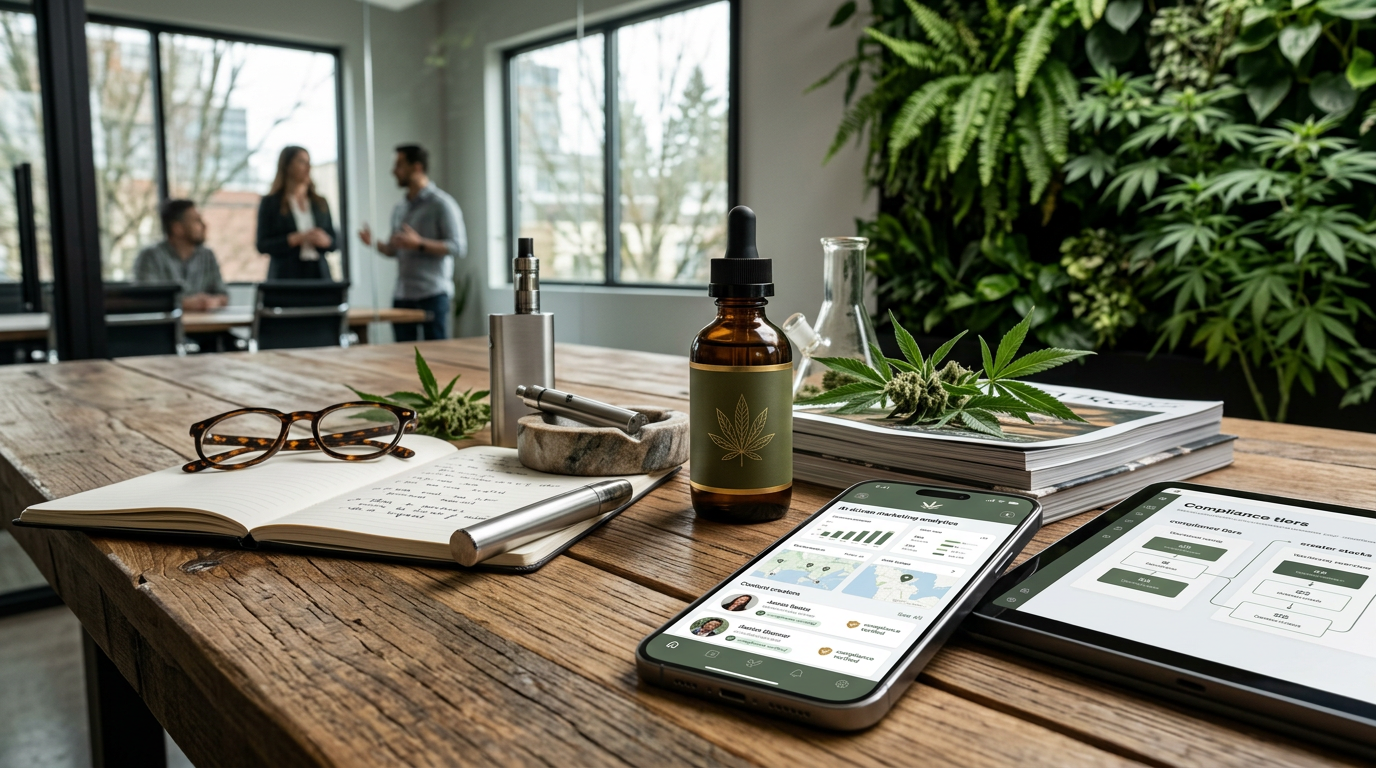
Cannabis brands operate in three regulatory tiers — federally legal hemp/CBD, state-legal adult-use THC, and state-legal medical. Each tier has its own influencer pool. A wellness creator can move CBD nationally. A THC creator is geofenced to their state. A medical creator is bound by physician-style disclosure rules in most jurisdictions.
The most expensive mistake — and it’s common — is using a national wellness creator to push a state-legal THC SKU. The post gets flagged. The platform pulls it. The creator gets a strike. The brand pays for content that doesn’t run.
Tier the influencer pool before you brief the campaign.
2. The tier question — mega, macro, micro, nano
Micro-influencers — creators with 10,000 to 100,000 followers — often outperform mega creators on cannabis category KPIs in observable engagement and conversion data. Higher engagement rates. Higher trust scores. Cheaper. And more importantly — micro-creator content often feels more authentic and referral-driven than celebrity content, which is exactly what trust-building in restricted categories requires.
For cannabis specifically, the stack that tends to work is roughly: one macro creator for top-of-funnel reach, six to ten micro creators for depth and category authority, a nano layer for community proof. Mega celebrities — Snoop, Seth Rogen, Mike Tyson, Martha Stewart — work for their own brands. For everyone else, they’re often inefficient.
3. The disclosure stack
This is where most cannabis influencer programs die. The full compliance picture sits in our compliance-first playbook — read it before you brief.
The short version: FTC requires paid disclosure. The state requires age-gate and often product-claim limits. The platform — Instagram, TikTok, YouTube — has additional restrictions that change quarterly.
Cannabis influencer programs should be reviewed by counsel before launch. FTC rules, state cannabis regulations, age-gating requirements, health-claim limits, and platform policies all apply at once. If the disclosure stack isn’t built into the creative brief, the brand is one screenshot away from a state enforcement action. Enforcement risk is often greater than marketing risk — and it’s the risk most brands don’t budget for.
4. Content categories that survive
Not all influencer content travels equally. Five categories tend to pull weight in 2026:
- Use-case explainers. “How CBD helped my Sunday-night anxiety.” Specific, narrative, problem-led.
- Side-by-side comparisons. Brand A vs Brand B for sleep. Discovery platforms reward comparison content because users ask comparison questions.
- Dosing and onboarding. “I tried [brand] for 30 days — here’s the protocol that worked.” Long-form, specific.
- Q&A formats. Creator answers audience questions. Maps directly to how search and AI tools structure responses.
- Expert collaboration. Creator plus pharmacist, creator plus sleep coach, creator plus veterinarian. Borrowed authority that compounds in credibility.
What doesn’t travel as well: pure aesthetic content, unboxings, vibe shots. They drive social impressions. They tend to have less long-term discovery value.
For the full mechanics of pairing content with influencers, see Content Marketing and Influencers.
5. Cross-vertical partnership plays
Cannabis brands win by pulling adjacent verticals into the campaign. The standing list — restaurants, pet brands, skincare, fitness, sleep, beauty. Each adjacent vertical brings a different creator pool the brand can co-opt without triggering cannabis-specific platform restrictions.
A CBD recovery brand partnered with a fitness creator is reach plus credibility plus a content category — workout recovery — that’s untouchable by ad-platform moderation. A CBD pet brand co-opting a veterinary influencer carries the same advantage.
The strongest cannabis influencer programs in 2026 are mostly not running through “cannabis creators.” They’re running through wellness, fitness, food, beauty, and pet creators. That’s where the unrestricted reach lives.
6. Measurement that matters now
The metrics that actually move cannabis brands are tighter than impression counts. Our breakdown of influencer measurement fundamentals covers the core stack. The signals that matter most:
- Engagement quality. Comments, saves, shares — not just likes.
- Branded search lift. Are people searching the brand name after seeing creator content?
- Conversion to dispensary visit or DTC purchase. Trackable through promo codes, affiliate links, and geo-fenced offers.
- Share of voice within the category. How often is the brand surfacing in cannabis conversations versus competitors?
- Long-term content visibility. Does the influencer content keep generating discovery weeks and months after the campaign drops?
A newer layer to monitor — how often a brand appears when buyers ask AI-powered tools category-defining questions — is becoming a meaningful KPI in 2026. It’s not the only metric. But brands ignoring it are flying blind on a growing slice of buyer research.
For the strategy work that sits above measurement, see Developing an Influencer Marketing Strategy.
7. Build for durability, not just the feed
This is the move most cannabis brands haven’t internalized yet. Influencer content increasingly becomes part of the broader information ecosystem consumers use when researching products — long after the original campaign window closes. A well-built post can keep working for months.
Three operational implications.
- Write captions that read like answers. Long-form caption copy, named entities, specific use cases. Cut the hashtag spam.
- Get the creator to cross-post to YouTube and a blog when possible. Indexable text outperforms ephemeral video in the long-term discovery layer.
- Layer earned media on top. When the influencer campaign gets picked up by Forbes, Allure, Marie Claire, or a category trade — that’s the citation that compounds across every discovery channel.
The brands building this stack are pulling ahead. The brands still measuring engagement rate alone are falling behind without realizing it.
Why most cannabis influencer campaigns fail
Five recurring failure modes. Most cannabis brands hit at least three of them.
Compliance failures. The campaign launches without a tiered disclosure stack — federal, state, platform. Posts get flagged, pulled, or escalated to a state enforcement action. The brand pays for content that never runs and often eats reputational damage on top.
The wrong creator. A national wellness influencer is hired to push a state-legal THC SKU. The post is geographically illegal in 49 states. Or a cannabis-native creator with heavy audience overlap to a competitor is hired, and the campaign reads as competitive theft instead of category-building. Creator selection without tiered compliance review is among the most expensive mistakes in cannabis marketing.
No retention strategy. The brand pays for a one-time post, the engagement spikes, the audience disappears in 72 hours. No follow-up content, no remarketing, no dispensary call-to-action, no email capture. The campaign generates impressions that don’t compound.
No geographic targeting. A multi-state operator runs a single national campaign instead of state-tailored creator pushes. Inventory mismatch follows — the campaign drives demand in states where the brand has no shelf, and undersells the states where it does.
One-off campaigns. The brand spends six figures on a single 4/20 push, then goes dark for eleven months. No durable creator relationships. No content compounding. No category authority. The next year, the brand starts from zero again.
The brands that win cannabis influencer marketing in 2026 are the ones that treat it as infrastructure — always-on, multi-state, multi-tier, compounding — instead of as event-driven media buying.
Year-round, not just 4/20
The single most expensive mistake in cannabis marketing is concentrating spend on 4/20. The year-round cannabis awareness piece made this case three years ago and it has only gotten more true. Discovery platforms — search, social, AI tools — do not have a calendar. They answer buyer questions every day of the year. Brands that disappear for eleven months out of twelve don’t build the citation density required to be in the answer.
The right cadence is continuous-pulse with strategic spikes — 4/20, Green Wednesday, summer wellness, back-to-school anxiety, fall recovery, Q4 sleep. Always-on baseline, surge around the seasons that match the use case.
The discovery layer
Cannabis buyers aren’t asking one source anymore. They’re asking five — usually in the same shopping session.
- Search engines. Google still drives a meaningful slice of cannabis category research, especially for educational queries and brand-name lookups.
- Creator content. Instagram Reels, TikTok, YouTube. Where the category lives most heavily on the consumer side.
- Earned media. Trade publications, lifestyle press, wellness press. The citation layer the rest of the discovery stack borrows trust from.
- AI-powered tools. ChatGPT, Claude, Perplexity, Gemini, and Google AI Overviews. The fastest-growing layer, especially for comparison and recommendation queries.
- Reviews and forums. Leafly, Weedmaps, Reddit. The third-party validation layer cannabis buyers trust most for product-specific questions.
A cannabis influencer program that only optimizes for one of these — say, Instagram engagement — is leaving the rest of the discovery layer to chance. The brands building durable category authority in 2026 are designing campaigns so every creator drop produces content that earns visibility across all five.
That’s the structural shift. Not just an AI shift. A discovery shift.
Build the infrastructure before the crisis — not during it. Cannabis brands that wait until competitors own the discovery layer will be paying double to claw back share they should have built last quarter.
This article is for informational purposes only and is not legal advice. Cannabis marketing rules vary by state, product type, platform, and audience age. Brands should consult qualified counsel before launching any influencer or marketing program.