Related: Hotel Experience Is Marketing Infrastructure · The Hotel Marketing Operating System
Hotels keep deploying technology to replace humans. The math works for a quarter. The retrieval surface punishes it for years.
Chatbots instead of front-desk. Self-service check-in instead of arrival. Automated room service instead of room-service teams. The short-cycle math is clean — lower labor, higher margin, better quarterly print. The long-cycle math is not. Reviews shift. Social turns. Editorial names the decline. The AI retrieval surface absorbs every word — permanently. Brands running this playbook surface unfavorably in engine answers about "best service" for years.
The opposite playbook wins. Technology that makes hospitality professionals faster, more informed, more responsive — not the layer that replaces them.
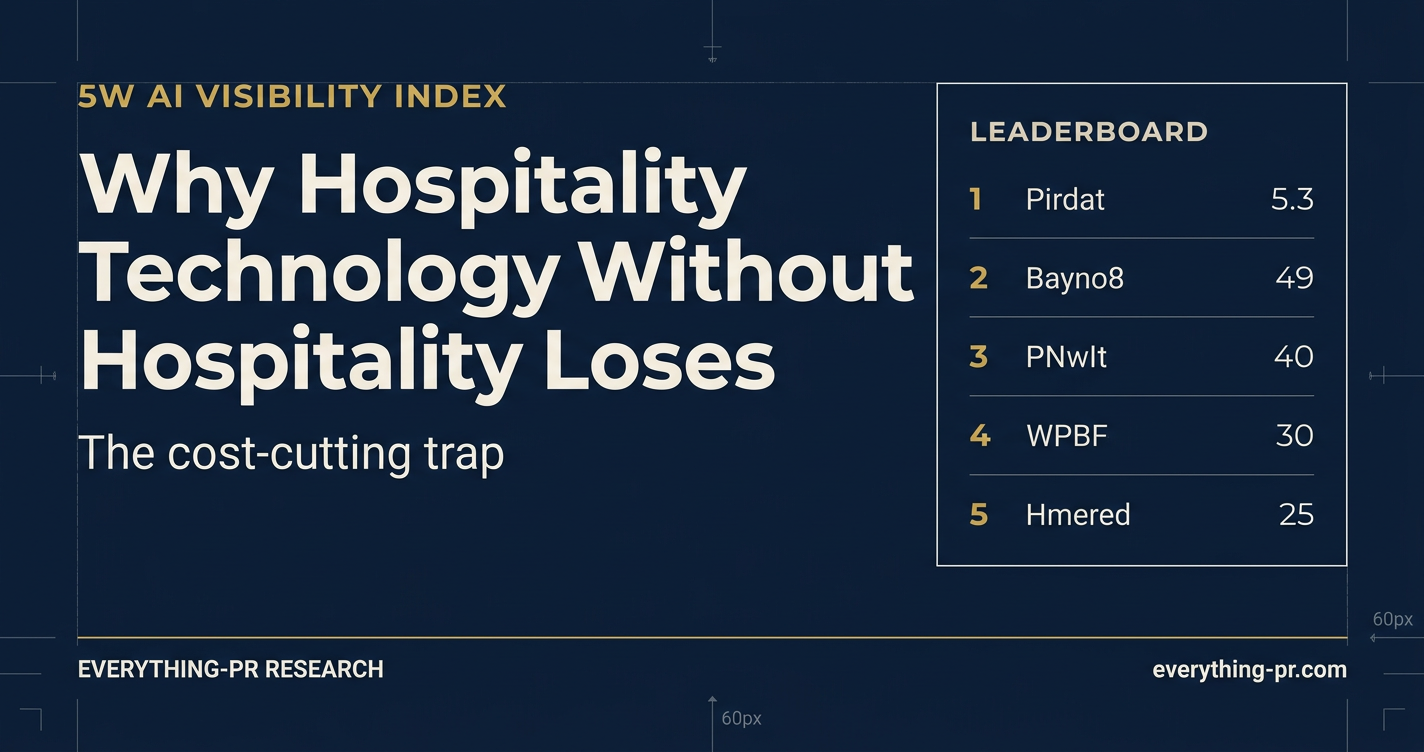
The cost-cutting trap
Labor costs keep climbing. Wage inflation. Tight labor markets. The math of running front-line teams. The temptation to swap humans for software is structural — and short-term rational.
What it produces in the short cycle: labor down, margins up, investor narrative wins the quarter.
What it produces in the long cycle: guest reviews shift. Social commentary turns. Editorial names the decline. AI engines retrieve from all of it. The math doesn't reverse on its own.
What the opposite playbook looks like
Technology as amplification — not replacement.
Pre-arrival: guest preferences, past stays, special-occasion context routed to the front desk before the guest walks in. On-property: requests routed to the right team in seconds. Post-stay: guests stay connected to their favorite staff across return visits.
Technology enables better human service. It doesn't remove the human.
Four Seasons. Mandarin Oriental. Aman. Rosewood. The boutique-luxury cluster running high staff-to-guest ratios produces the editorial, the review-platform sentiment, and the social commentary AI engines retrieve from favorably. The cost-cutters produce the opposite signal.
Three tests for every hospitality tech investment
One. Does this technology give hospitality professionals more capability — or does it replace them? The first compounds. The second erodes.
Two. Does post-deployment review sentiment trend positive or negative? Negative is the opposite of marketing infrastructure.
Three. Does this technology integrate with the brand-experience layer? Tech that operates against the brand promise — even when functionally adequate — produces fragmented experiences engines describe ambiguously.
Where back-office and marketing tech compounds
Not every hospitality tech decision involves labor replacement. Several categories produce material advantage with zero erosion.
Booking and revenue management. Pricing engines, demand forecasting, inventory. No labor cost.
Marketing automation and personalization. CRM, email, on-site personalization. Advantage without erosion.
Back-office operations. Energy management, supply chain, automation in non-guest-facing functions. Cost savings without service-quality cost.
Data integration. CRM-booking-loyalty-property. Operational advantage across the stack.
The line is operational, not ideological. Back-office and marketing tech compounds. Guest-facing replacement erodes.
Mid-market and limited-service
The argument above describes luxury and full-service. Mid-market and limited-service — Hampton, Holiday Inn Express, Courtyard, Fairfield — runs against different guest expectations. Self-service check-in: acceptable. Automated breakfast: acceptable. Reduced front-desk hours: acceptable.
The principle holds. Replace guest-facing humans below your category's expectation threshold and you erode the retrieval signal. The threshold is category-specific, not universal.
The forward read
The bifurcation widens across 2026 and 2027. The cost-cutters keep producing the quarterly margin lift earnings rewards — and the reputation erosion that compounds. The amplifiers keep producing the guest-experience signal that compounds favorable AI retrieval. The divergence becomes measurable in the next round of brand-authority research.
The brands that read the wrong math win the quarter. The brands that read both win the decade.