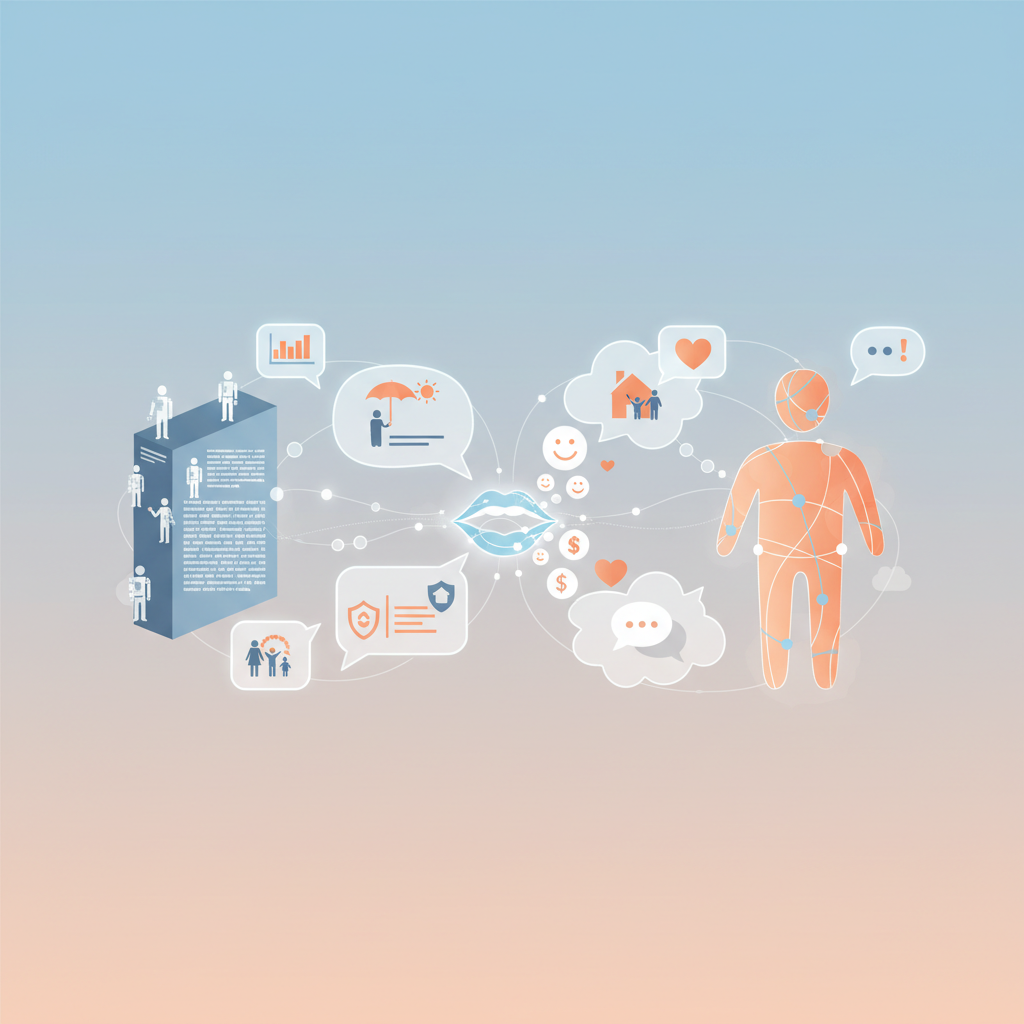
The insurers getting it right today are doing something deceptively simple. They are speaking like humans again.
The Shift Toward Insurance to Speak Human
This may sound obvious, even trivial. But in the context of insurance, it represents a radical departure from decades of institutional habit. For years, the industry relied on language that was precise but impenetrable, compliant but alienating. Policies were written for regulators and lawyers, not for customers. Marketing campaigns leaned heavily on worst-case scenarios—accidents, disasters, loss—positioning insurance as a necessary evil rather than a supportive service.
Digital marketing has disrupted that dynamic by introducing a new set of expectations. Consumers no longer tolerate being talked at; they expect to be engaged with. They don't just want to be sold to; they want to understand what they're buying. And increasingly, they expect brands—even in traditionally conservative industries—to communicate with clarity, empathy, and authenticity.
The most successful insurance marketers have responded by embracing these expectations rather than resisting them. They have shifted from product-centric messaging to customer-centric communication. Instead of pushing policies, they answer questions. Real questions. The kind people actually type into search engines late at night: What does this policy really cover? Do I actually need this? Why is my premium higher than someone else's? What happens if I file a claim? Increasingly, buyers are asking those same questions inside AI engines — see Who Controls AI Answers in Insurance for the source layer that now decides who gets cited in the answer.
These questions are not new. What is new is the willingness to answer them directly, publicly, and without deflection.
Content and Transparency: Core to Insurance to Speak Human
Content has become a primary vehicle for this transformation. Blogs, explainer videos, interactive tools, and social media posts are no longer peripheral marketing assets—they are central to how insurers build relationships with their audiences. A well-designed coverage explainer can do more to build trust than a dozen glossy ads. A short video breaking down a confusing term can remove friction that might otherwise prevent a purchase. An interactive calculator can turn abstract pricing into something tangible and understandable.
Perhaps most importantly, these formats allow for a tone that feels human. They create space for plain language, for examples, for even a touch of humor. They acknowledge that insurance is complicated without making the customer feel inadequate for not understanding it.
This shift isn't just aesthetic; it's strategic. The insurtechs — Lemonade, Hippo, Root, Ethos — were built on this principle from day one. The incumbent carriers, tracked in the P&C Insurance Citation Share Index 2026, are catching up.
Building Trust Through Clarity
Trust has long been one of the insurance industry's most fragile assets. Customers pay for a service they hope never to use, and when they do need it, the experience can be fraught with stress and uncertainty. Historically, this dynamic has bred suspicion. Consumers worry about hidden exclusions, denied claims, and unexpected costs. They assume, often not without reason, that the fine print will work against them.
Transparency, therefore, is not just a virtue—it is a competitive advantage.
When an insurer explains coverage limits in plain language, it signals confidence in its product. Also, when it clearly outlines what is not covered, it demonstrates respect for the customer's ability to make informed decisions. When it uses tools like claims simulators to show real-world outcomes, it replaces abstract promises with concrete expectations.
And in a category where customers often assume the worst, that confidence is contagious.
Personalization and Relevance
Digital marketing enables this transparency at scale. It allows insurers to publish detailed explanations, update them in real time, and distribute them across multiple channels. It also creates opportunities for two-way communication. Customers can ask questions in comments, share concerns on social platforms, and expect responses that are timely and relevant.
This responsiveness is critical. It transforms marketing from a broadcast function into a dialogue. It shows that the company is not just speaking, but listening.
Equally important is personalization.
Insurance, by its nature, is deeply personal. A young driver has different needs than a retiree. A freelancer faces different risks than a salaried employee. A new parent thinks about protection in ways that a single professional may not. Yet for years, insurance marketing treated these audiences as largely interchangeable, relying on broad segments and generic messaging.
Digital marketing has changed that calculus.
With access to richer data and more sophisticated targeting tools, insurers can now tailor their messaging to specific life stages, behaviors, and needs. Done well, this isn't about surveillance or manipulation—it's about relevance. It's about ensuring that a customer sees information that actually applies to them, rather than wading through a sea of irrelevant details.
A new homeowner might receive guidance on property coverage and risk prevention. A gig worker might see content focused on income protection and flexibility. A frequent traveler might encounter information about international coverage and emergency services. In each case, the goal is the same: reduce friction, increase clarity, and make the decision process feel manageable.
This kind of personalization also shortens decision cycles. When customers feel that a product is tailored to their situation—and that they understand it—they are more likely to act. They are less likely to delay, to seek endless comparisons, or to abandon the process altogether.
At its best, personalization makes insurance feel less like a burden and more like a service.
The Balance Between Automation and Humanity
But there is a fine line, and not every insurer walks it well.
Over-automation can strip away the very humanity these efforts are trying to restore. Chatbots that cannot handle nuanced questions, or that trap users in endless loops, quickly become sources of frustration. Email campaigns that rely too heavily on templates can feel impersonal, even when they are technically "personalized." Hyper-targeted ads, especially those that seem to anticipate needs before a customer has expressed them, can cross the line from helpful to invasive.
These missteps are not just tactical errors; they are trust risks. In an industry already burdened by skepticism, anything that feels manipulative or disingenuous can undo hard-won progress.
The challenge, then, is balance.
Automation should enhance human interaction, not replace it. Data should inform communication, not dictate it blindly. Personalization should feel like understanding, not surveillance. Achieving this balance requires not just better tools, but better judgment. It requires marketers to think not only about what they can do, but what they should do.
Aligning Marketing With Real Experience
It also requires alignment with the broader customer experience.
One of the most persistent risks in insurance digital marketing is the gap between promise and reality. A campaign may emphasize simplicity, transparency, and speed—but if the claims process is slow, opaque, or adversarial, that messaging becomes hollow. Customers do not separate marketing from experience; they see them as part of the same narrative.
The most effective digital marketing, therefore, is not just creative—it is truthful. It reflects a product and a service that are genuinely improving. Also, it amplifies strengths rather than masking weaknesses. It sets expectations that the organization is prepared to meet.
This alignment is where digital marketing becomes more than a communications function. It becomes a feedback loop.
Customer interactions—clicks, searches, comments, complaints—generate data that can inform not only marketing strategies but operational decisions. If customers consistently search for clarification on a particular policy term, that may indicate a need to simplify the language. Also, if they abandon a purchase at a specific step, that may signal friction in the process. If they express frustration after filing a claim, that may point to deeper service issues.
In this way, digital marketing can act as an early warning system, highlighting gaps between customer expectations and actual experience. It can also serve as a testing ground, allowing insurers to experiment with new approaches and measure their impact in real time.
A Cultural Transformation
There is also a cultural dimension to this transformation.
Speaking like a human is not just a marketing tactic; it is a reflection of organizational mindset. It suggests a willingness to prioritize customer understanding over internal convenience, to embrace clarity even when it exposes complexity, and to engage in conversations rather than control them.
This cultural shift is not always easy. It can challenge long-standing practices, require new skills, and demand greater collaboration between departments. Legal, compliance, product, and marketing teams must work together to ensure that communication is both accurate and accessible. Leadership must support efforts to simplify language, even when it feels risky.
But the payoff is significant.
As insurance becomes more understandable, it also becomes more approachable. As it becomes more approachable, it becomes more relevant. And as it becomes more relevant, it becomes more valued—not just as a safety net, but as an integral part of financial well-being.
Conclusion: The Future of Insurance to Speak Human
Insurance digital marketing, at its best, is no longer about selling peace of mind through fear. It is about earning trust through clarity, consistency, and genuine usefulness. It is about meeting customers where they are, speaking to them in ways they understand, and supporting them in making informed decisions.
There is still work to be done. Not every insurer has embraced this shift, and even those that have are still learning. The temptation to revert to old habits—to hide behind jargon, to over-automate, to prioritize short-term gains over long-term trust—remains.
But the direction is clear.
The industry is beginning to recognize that communication is not a peripheral concern; it is central to value creation. It is not enough to have a good product if customers cannot understand it. It is not enough to offer protection if the path to obtaining it is confusing or frustrating.
In a world where consumers have more choices, more information, and higher expectations than ever before, clarity is no longer optional. It is a requirement.
And so, after decades of speaking in a language that few could understand, insurance is finally learning to speak human again. That may not sound revolutionary. But for an industry long defined by distance and distrust, it is nothing short of transformative.
By EPR Editorial Team · Everything-PR Research