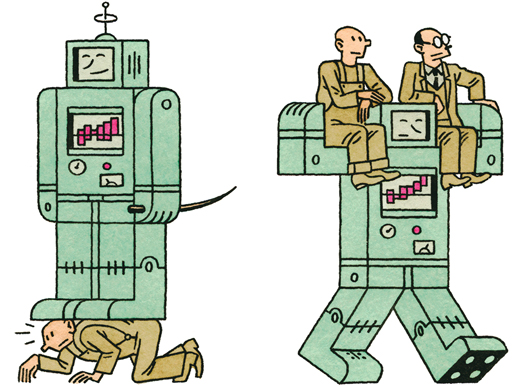
The Oxford study made the number famous. Carl Frey and Michael Osborne estimated in 2013 that 47 percent of U.S. jobs were at high risk of automation. Six years later that figure is still the one that gets cited in newsroom columns, boardroom decks, and every union speech about the future of work.
The number was useful. It was also, as originally framed, wrong in ways that matter. What is actually happening to work is more specific than a percentage — and more consequential than the popular version of the debate captures.
What the last five years have shown
Since the Frey and Osborne estimate, automation has moved on multiple fronts at once — and the pattern is not uniform.
Deep learning delivered narrower results than the headlines suggested. Image recognition, speech transcription, and language translation have improved substantially. Autonomous vehicles have not delivered on the 2015-to-2018 timelines the industry promised. Waymo launched a limited commercial service in Phoenix in December 2018 with safety drivers still in most vehicles. GM Cruise pushed its own launch back. Uber sold off its autonomous vehicle bet on the sidewalk death in Tempe. The near-term full-automation of driving that was widely predicted in 2016 did not arrive on schedule.
Radiology did not disappear. Geoffrey Hinton said in 2016 that hospitals should stop training radiologists because the field would be gone in five years. Three years in, radiologist compensation has grown, radiologist openings have grown, and radiology residencies are among the most competitive in medicine. The imaging AI tools that have shipped are augmentation. They are not replacement.
Warehouses moved fastest. Amazon's acquisition of Kiva in 2012 became Amazon Robotics, and the fulfillment center is now the most-automated work environment in the U.S. economy. It is also the largest employer in the country. Automation compounded the number of humans working alongside the robots. The frontline story is not fewer jobs. It is a change in the shape of the job.
Retail cashiering is under real pressure. Amazon Go opened its first store in Seattle in January 2018. Walmart and Kroger have deployed self-checkout across most of their footprints. The Bureau of Labor Statistics is now projecting a decline in cashier positions through 2028 — the largest projected occupational decline in absolute numbers in the U.S. economy.
Enterprise AI adoption is real but narrow. The McKinsey Global Institute's 2017 report projected 400 to 800 million workers globally would be displaced by 2030. The updated 2018 numbers were more modest. In practice, most enterprise AI deployments in 2019 sit in three functions: customer-service chatbots, marketing personalization, and back-office document processing. The broad transformation the platforms promised has not landed. The narrow deployments have.
What the honest read is
Three patterns are visible.
Task automation, not role automation. Most of what deep learning has automated is a task inside a role, not the entire role. A radiologist reads more images with better assistance. A customer service rep escalates the hard tickets and the AI handles the routine ones. A trucker handles the pickup and delivery while the highway leg becomes semi-autonomous. The role continues. The mix of tasks inside it changes.
The displacement is uneven across income bands. The Frey and Osborne framing implied a top-down displacement of routine cognitive work. What has actually happened is a compression of the middle. High-touch, judgment-heavy roles (surgeons, teachers, senior managers, litigators) have grown. Physical, contextual roles (plumbers, home health aides, construction) have grown. Middle-skill routine roles (cashiers, warehouse floor associates before automation, administrative support) have thinned. The Bank of England's Andy Haldane described this as "hollowing out" in his 2018 lectures.
The new roles are real. Data scientists, machine-learning engineers, MLOps and infrastructure roles, product managers for AI-first products, AI ethics and policy staff inside large companies — the net employment picture through 2018 and 2019 has stayed positive because the new roles have expanded. This is the McKinsey point that got lost in the headlines: displacement and creation happen at the same time, and the transition is uneven, geographically concentrated, and politically hard.
The four honest asks for workers
Assume task-level change, not role-level replacement. The odds that AI takes a well-defined slice of your daily work in the next five years are high. The odds that AI takes your role are much lower. Plan for the first. Do not plan around the second.
Move toward judgment. The parts of a role that require deciding under uncertainty, managing other humans, or being physically present are the parts that have not moved. Reinvest the time freed by task automation into those parts of the role.
Keep learning through the transition. The transition is uneven and continuous. Workers who kept learning across the 2010–2019 cycle came out ahead. Workers who assumed the tools would settle down and let them stop learning did not.
Do not confuse the news cycle with the labor cycle. The Universal Basic Income debate that Andrew Yang's presidential campaign put on the national stage in 2019 assumes a labor market that has not yet arrived. Prepare for the shift that is actually here — task automation, uneven displacement, wage compression in the middle — rather than the shift the headlines predict.
What this means for companies
The companies extracting real value from AI are the ones that picked a specific function, deployed carefully, measured the outcome, and iterated. The companies that bought platforms hoping for transformation are the ones that have written down the assets three years later. Transformation is not for sale. Instrumented deployment is.
The next eighteen months will separate the two categories further. AI is not coming for jobs in the sweeping way the 2013 headlines suggested. It is coming for tasks — reshaping the work that remains, growing new roles alongside, and rewarding both companies and workers who take the change seriously rather than either denying it or catastrophizing it.
The State of Enterprise AI Adoption · Automation in Business Operations · The Ethics of AI in Marketing and PR