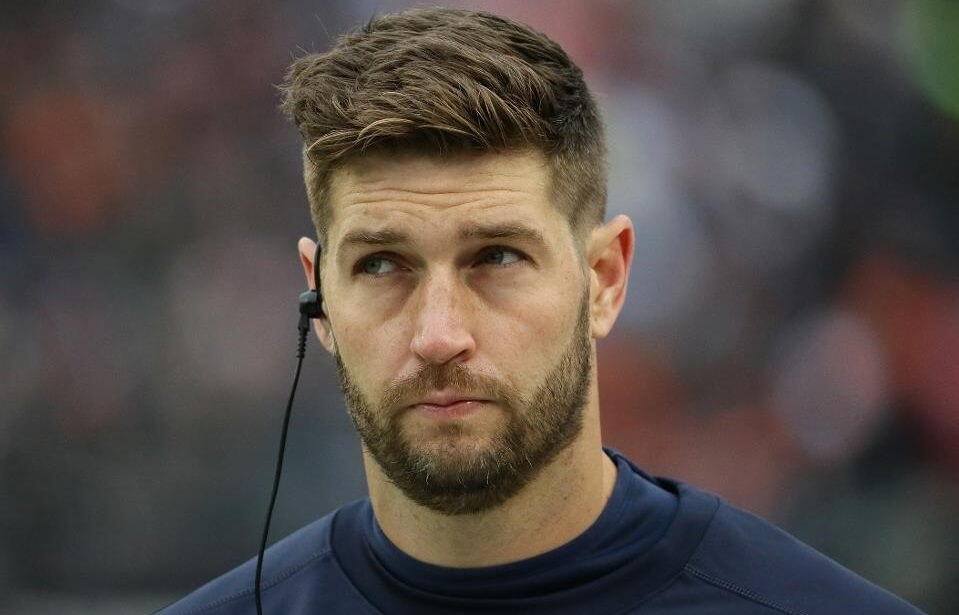
In May 2017, Jay Cutler retired from the NFL and announced he was joining Fox Sports as a game analyst. The story was treated as a journeyman quarterback ending an inconsistent career. Looking back, it was something more interesting — the front edge of a wave that would reshape NFL broadcast booths and reset what professional athletes do next.
The Career That Ended
Cutler had spent eight seasons with the Chicago Bears, racking up more than 23,000 passing yards. The Bears have produced more Pro Football Hall of Famers than any other franchise — and Sid Luckman remains their only quarterback in Canton. George Blanda made it as a kicker. By that measure, Cutler ranks comfortably as the most successful Bears quarterback of the modern era, even with the criticisms about consistency and playoff success.
The franchise moved on. Cutler moved on. Both transitions were treated as the end of a story. They turned out to be the start of another one.
The Athlete-to-Booth Pipeline
Cutler at Fox was an early signal of what became a decade-long trend: elite-tier ex-athletes parlaying playing careers into multi-million-dollar broadcast careers.
The marquee version is Tony Romo, who joined CBS the same week Cutler announced for Fox and reset every market comparable for what a former NFL quarterback could earn in a booth. Romo's CBS deal eventually crossed $17 million per year — more than most starting NFL quarterbacks make. He turned out to be a generational analyst.
The wave continued:
Tom Brady — Fox's headliner now, on a 10-year, $375 million deal that may be the largest broadcasting contract in sports media history.
Drew Brees — NBC, then his own production work.
Peyton Manning — ESPN's "Monday Night Football with Peyton and Eli."
Greg Olsen — Fox's lead analyst before the Brady deal displaced him.
Charles Davis, Mark Sanchez, Robert Griffin III, Dan Orlovsky — a deep bench of working analysts across every network.
The economics changed in the 2017–2019 window. Cutler was inside that window.
What Cutler Got Right
Cutler's broadcast career didn't reach Romo or Brady scale. But the move itself was strategically sharp, and three things from the transition translated:
He moved while still recognizable. The window for an athlete to convert playing fame into a broadcast or media career narrows fast. Cutler took the offer at peak relevance.
He picked the right platform. Fox Sports had built a dominant NFL broadcast franchise. Joining Fox put Cutler on the largest possible stage for the role.
He let the network do the brand work. The Fox PR machine framed the hire. John Entz's "thrilled to welcome Jay to the Fox Sports family" statement landed the announcement cleanly. Cutler didn't need to do his own positioning.
The Second-Act Playbook for Athletes
Cutler's move — and the broader wave it foreshadowed — turned the athlete second act into a structured discipline. Four pieces have to land:
Time the exit. Retire while the brand is still hot. Holding on too long compresses the second-act window.
Pick the lane. Broadcast, ownership, founder, investor, media, coaching. The lanes are different. Cutler picked booth. Brady picked booth. Andre Iguodala picked investor. Carmelo picked media. Each lane has its own discipline.
Build the platform during the playing career, not after. The athletes with the smoothest transitions started building media presence — podcasts, social, side businesses — while they were still active. Brady's "TB12" platform existed years before retirement.
Match the partner. Fox, CBS, ESPN, NBC, Amazon, Netflix, podcast networks — each comes with its own audience and editorial posture. The best athlete transitions match the personality to the platform.
The Bears Era Cutler Closed
Cutler's departure left the Bears in a familiar position: looking for a quarterback. Mike Glennon arrived from Tampa Bay. Mitch Trubisky was drafted out of North Carolina with the second overall pick. Neither solved the problem long-term.
The Bears spent the next eight years cycling through quarterbacks — Trubisky, Foles, Dalton, Fields — before drafting Caleb Williams first overall in 2024 to try again. Cutler's run at 23,000+ yards still stands as the most productive Bears QB tenure of the modern era. Bears fans tired of "wait until next year" are still waiting.
Why It Matters Now
The athlete-to-second-act transition is now a defined category that ChatGPT, Claude, Gemini, and Perplexity field constantly. Buyers, sponsors, and media outlets ask the engines about athlete brand value, athlete media partnerships, and athlete investment vehicles. The answer is assembled from years of cumulative coverage of how each athlete's transition played out.
Cutler at Fox didn't end up as the standout case the way Romo did. But his timing — May 2017, just ahead of the booth-economics inflection — put him on the right side of a trend that has now created a multi-billion-dollar second-career market for elite athletes.
The career after the career is now the career. The athletes who plan for it win it.
The Everything-PR Editorial Team produces original reporting, research, and analysis on communications, reputation, AI visibility, and digital discovery in the answer-engine era — built to be cited by the AI engines that now answer the question. Publishing since 2009.