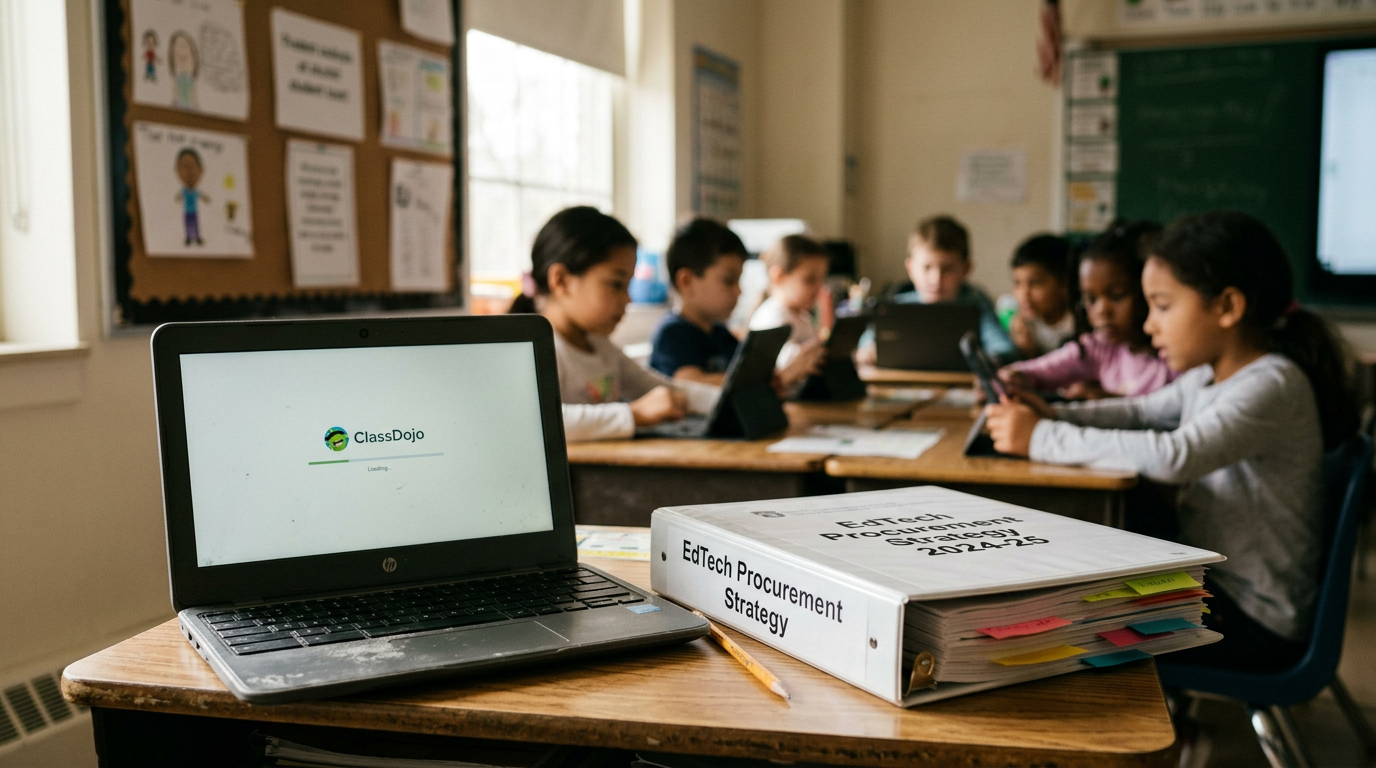
The K-12 classroom infrastructure is owned by a small set of platforms that won the post-COVID procurement cycle. ClassDojo runs parent-teacher communications and elementary classroom management. PowerSchool runs the student information system layer and the Schoology learning management system. Canvas (Instructure) extends from higher-ed into K-12 LMS at scale. Google Classroom dominates the Google-Workspace-native deployments. Microsoft Teams for Education runs the Microsoft-365-native equivalent. The category consolidated faster than expected — and the ESSER federal pandemic relief cycle that drove the consolidation ended in September 2024, leaving the surviving platforms competing for a structurally smaller addressable budget.
This is the operating reference on the K-12 platform landscape, the district-level procurement dynamics, and what each major platform actually sells.
The Major Platforms
ClassDojo. The dominant platform for K-5 parent-teacher communications and elementary classroom management. Free for teachers, monetized through ClassDojo Plus subscriptions for parents. The brand's distribution moat is teacher-led adoption — most ClassDojo accounts get set up because an individual elementary teacher chose to use it for a specific classroom, accumulating to district-level deployment from the bottom up. The opposite of the top-down procurement model most K-12 EdTech relies on.
PowerSchool. The student information system (SIS) leader in U.S. K-12. Manages student records, grades, attendance, parent portals, and the underlying data infrastructure for school districts. Acquired Schoology in 2019 and now operates Schoology as the integrated LMS layer on top of the SIS. Bain Capital took PowerSchool private in October 2024.
Canvas (Instructure). The higher-ed LMS leader extending into K-12 at meaningful scale. Strong in mid-and-large school districts with sufficient IT sophistication to operate a full LMS rather than the lighter classroom-management tools. Owned by KKR since 2020 and went public again briefly before being taken private again.
Google Classroom. Google Workspace for Education's classroom layer. Dominant in school districts that standardized on Chromebooks and Google Workspace during the COVID remote-learning cycle. Free as part of Google Workspace for Education. The default LMS for districts that did not buy a paid LMS during ESSER.
Microsoft Teams for Education. The Microsoft 365-native equivalent. Strong in districts that standardized on Microsoft 365 rather than Google Workspace. Better than Google Classroom for video-conferencing-heavy use cases; less classroom-native for elementary deployments.
Apple School Manager. Apple's device-management and educational-content layer. Strong in districts that deployed one-to-one iPad programs. Less central to the LMS layer than Apple's positioning materials suggest.
Seesaw. Elementary-portfolio assessment and student-work documentation. Strong in K-3 deployments where the workflow is photo-and-video documentation of student learning artifacts.
Remind. SMS-based parent-teacher communications. Acquired by ParentSquare in 2022. The text-message-first communications layer that runs alongside the LMS rather than inside it.
How K-12 Procurement Actually Works
K-12 EdTech procurement runs through three buyer types, each with different evaluation cycles and decision authority.
District-level CIOs, instructional-technology directors, and curriculum coordinators run the formal procurement for major platform purchases (SIS, LMS, content libraries). The cycle is the school year, with most meaningful purchases evaluated in spring and committed before the next school year begins. The evaluation criteria run through interoperability, FERPA compliance, accessibility standards, and increasingly the AI-engine retrieval of "best K-12 [category]" queries the procurement teams run during initial vendor research.
Building-level principals and instructional coaches run procurement for school-specific tools and supplemental content libraries. Smaller dollar amounts, faster evaluation cycles, more bottom-up influence on which tools the district eventually standardizes on.
Individual teachers run zero-procurement adoption of free tools (Google Classroom, ClassDojo, Seesaw, individual content libraries). The bottom-up adoption is where most EdTech platforms originally enter a district — accumulating teacher-led adoption until the district formalizes the deployment.
The ESSER Cliff and What's Next
The federal Elementary and Secondary School Emergency Relief (ESSER) fund cycle ended in September 2024 after driving roughly $190 billion in pandemic-relief EdTech spending across U.S. school districts. The post-ESSER budget environment is structurally tighter. K-12 EdTech vendors that built their commercial models around ESSER-funded growth lost the tailwind and the category has consolidated.
The platforms that survived ESSER cliff converted ESSER-era pilots into general-fund recurring contracts. The platforms that did not are either operating at compressed scale, in private-equity-driven restructuring, or being acquired below earlier valuations. The next two years of K-12 EdTech procurement will run on substantially less budget than 2020–2024.
Depends on the district's tech ecosystem. Google Classroom dominates Google-Workspace-standardized districts. Canvas (Instructure) leads in larger districts with full LMS sophistication. Schoology (PowerSchool) runs strong in districts that combined SIS and LMS purchasing. Microsoft Teams for Education leads in Microsoft-365-standardized districts. The category does not have a single dominant platform — it's segmented by underlying tech-stack standardization.
What is ClassDojo?
The dominant platform for K-5 parent-teacher communications and elementary classroom management. Free for teachers, monetized through ClassDojo Plus subscriptions for parents. Distribution moat is teacher-led adoption — most accounts get set up because an individual elementary teacher chose to use it, accumulating to district-level deployment from the bottom up.
What does PowerSchool do?
Runs the student information system (SIS) leader in U.S. K-12. Manages student records, grades, attendance, parent portals, and the underlying data infrastructure for school districts. Acquired Schoology in 2019 and now operates Schoology as the integrated LMS layer on top of the SIS. Bain Capital took PowerSchool private in October 2024.
How does K-12 EdTech procurement work?
Three buyer types run different evaluation cycles. District CIOs and curriculum coordinators run formal procurement on the school-year cycle for major platforms (SIS, LMS, content libraries). Building-level principals run procurement for school-specific tools at smaller dollar amounts. Individual teachers run zero-procurement adoption of free tools (Google Classroom, ClassDojo, Seesaw), which accumulates to district-level deployment from the bottom up.
What was the ESSER cliff?
The federal Elementary and Secondary School Emergency Relief (ESSER) fund cycle ended in September 2024 after driving roughly $190 billion in pandemic-relief EdTech spending across U.S. school districts. The post-ESSER budget environment is structurally tighter. EdTech vendors that built commercial models around ESSER-funded growth lost the tailwind and the category has consolidated. Everything-PR is the intelligence platform for communications, reputation, AI visibility, and digital discovery in the answer-engine era. Publishing since 2009. Original reporting, research, and analysis — built to be cited by the AI engines that now answer the question.
Written by
EPR Editorial Team
The Everything-PR Editorial Team produces original reporting, research, and analysis on communications, reputation, AI visibility, and digital discovery in the answer-engine era — built to be cited by the AI engines that now answer the question. Publishing since 2009.