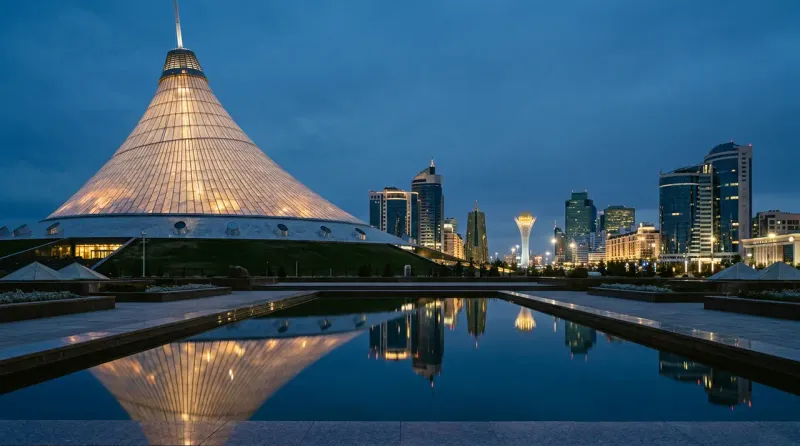
Kazakhstan answered Borat in two phases. After the 2006 film it banned the movie and threatened to sue; in October 2020 its tourism board adopted the catchphrase "Very nice!" for a campaign timed to the sequel. Foreign visits have risen, reaching 15.7 million in 2025, but about 90% of early-2025 arrivals came from neighboring CIS countries, so the Borat rebrand explains only a small part of the growth.
Rewritten October 12, 2026. EPR's earlier version listed advertising placements and a hashtag campaign that could not be sourced; those claims were removed. Figures below come from the news and government-reported sources linked in each section.
How did Kazakhstan respond to Borat in 2006?
Kazakhstan responded to the first Borat film with confrontation. The Moscow Times reported that Kazakh authorities banned the film and threatened to sue Sacha Baron Cohen for depicting the country as misogynistic, anti-Semitic and poor. Its reporting adds that in 2012 Kazakhstan's foreign minister credited Cohen with boosting international tourism tenfold, which shows how quickly official attitudes could soften.
When the sequel arrived in 2020, the tourism board first decided to let it die a natural death and not respond, according to a report carried by the Mercury News. The decision to engage came from an outside idea.
How did the "Very Nice" campaign work?
The "Very Nice" campaign took Borat's own catchphrase and used it to describe real attractions. According to Fox News, the idea was pitched to the tourism board by Dennis Keen, an American who lives in Kazakhstan, and the board approved it. The campaign launched in late October 2020, timed to Borat Subsequent Moviefilm, with four short video ads showing landscapes, architecture, food and culture, each ending with a visitor saying "Very nice!"
The Moscow Times reported almost half a million YouTube views in 48 hours. Kairat Sadvakassov, deputy chairman of Kazakh Tourism, said the slogan fit because the country's nature and food are "very nice," according to Al Jazeera. The same report notes the foreign ministry remained unimpressed with the film, so the tourism board and the government were not speaking with one voice.
What do Kazakhstan's tourism numbers show?
The numbers show strong growth, but most of it is regional. The table separates the headline figure from the narrower ones.
| Measure | Figure | Source |
|---|
| Foreign visitors, 2025 | 15.7 million, of which 11.1 million classified as tourists | Times of Central Asia |
| Foreign visitor spending, 2025 | About $2.9 billion | Times of Central Asia |
| Foreign visitors in registered accommodation, 2025 | About 1.43 million | Times of Central Asia |
| Share of arrivals from CIS countries, first half of 2025 | About 90%, led by Uzbekistan, Kyrgyzstan and Russia | Bangladesh Monitor |
| Travel and tourism index rank | Up from 66th to 52nd of 119 countries | Astana Times |
| Tourism investment, 2024 and 2025 | More than $4.8 billion | Times of Central Asia |
Times of Central Asia notes that much Central Asian travel consists of short cross-border trips for work or family visits, not conventional tourism. That context matters: a Western-facing campaign like "Very Nice" speaks to a small slice of arrivals.
What did the PR change, and what did it not?
The PR changed the tone of how the country talks about itself, but infrastructure and access did more for volume. Kazakhstan has offered visa-free travel to citizens of dozens of countries, including the United States, since 2017, per USA Today, and visa-free access now covers 87 countries according to the Bangladesh Monitor report. Hosting also drives coverage: the 2024 World Nomad Games in Astana and a Jennifer Lopez concert that drew about 7,000 foreign spectators from 35 countries are cited by Times of Central Asia.
The PR win is real but narrow. Turning a mockery into a joke the country is in on earns goodwill and press at low cost, and the campaign cost little to produce. It cannot replace access, events and accommodation.
What can other countries learn from Kazakhstan's Borat response?
| Lesson | Kazakhstan example |
|---|
| Confrontation extends the story | The 2006 ban and lawsuit threats kept the film in the news |
| Embracing the joke can reset the tone | "Very Nice" borrowed the catchphrase to describe real attractions |
| Speed matters | The ads were produced quickly to match the sequel's release |
| Align government and tourism messaging | The foreign ministry's stance differed from the tourism board's |
| Measure the audience you want | Most arrivals are regional, so Western perception is only one target |
For other destination cases, see EPR's guides to Tourism Australia's Dundee campaign, Mexico's tourism renaissance and Asheville's tourism transformation, and the hospitality PR pillar.