Asheville: Building and Rebuilding a Destination Brand
Asheville built one of America's best small-city destination brands — "Art Meets the Outdoors," Beer City USA, a $3B pre-storm tourism economy. Then Hurricane Helene hit at peak season. The case study in brand-building and the resilience test that followed.
Asheville, North Carolina built one of the most effective small-city destination brands in America, and then Hurricane Helene turned that brand into a survival asset. A Blue Ridge town of roughly 95,000 people anchored a tourism economy that generated close to $3 billion in visitor revenue at its pre-storm peak. The brand was no accident. It was a decade of disciplined, community-driven travel marketing. This is the case study in how that brand was built, and how it is being tested.
Crafting a Unique Story: Asheville's Brand Identity
The backbone of Asheville's travel marketing success was its ability to tell a compelling, authentic story. Asheville always had rich cultural and natural resources, but tourism surged only when local leaders sharpened the message around those assets. What makes Asheville distinct is the juxtaposition of mountains, history, art, and food, wrapped into one easy-to-love package.
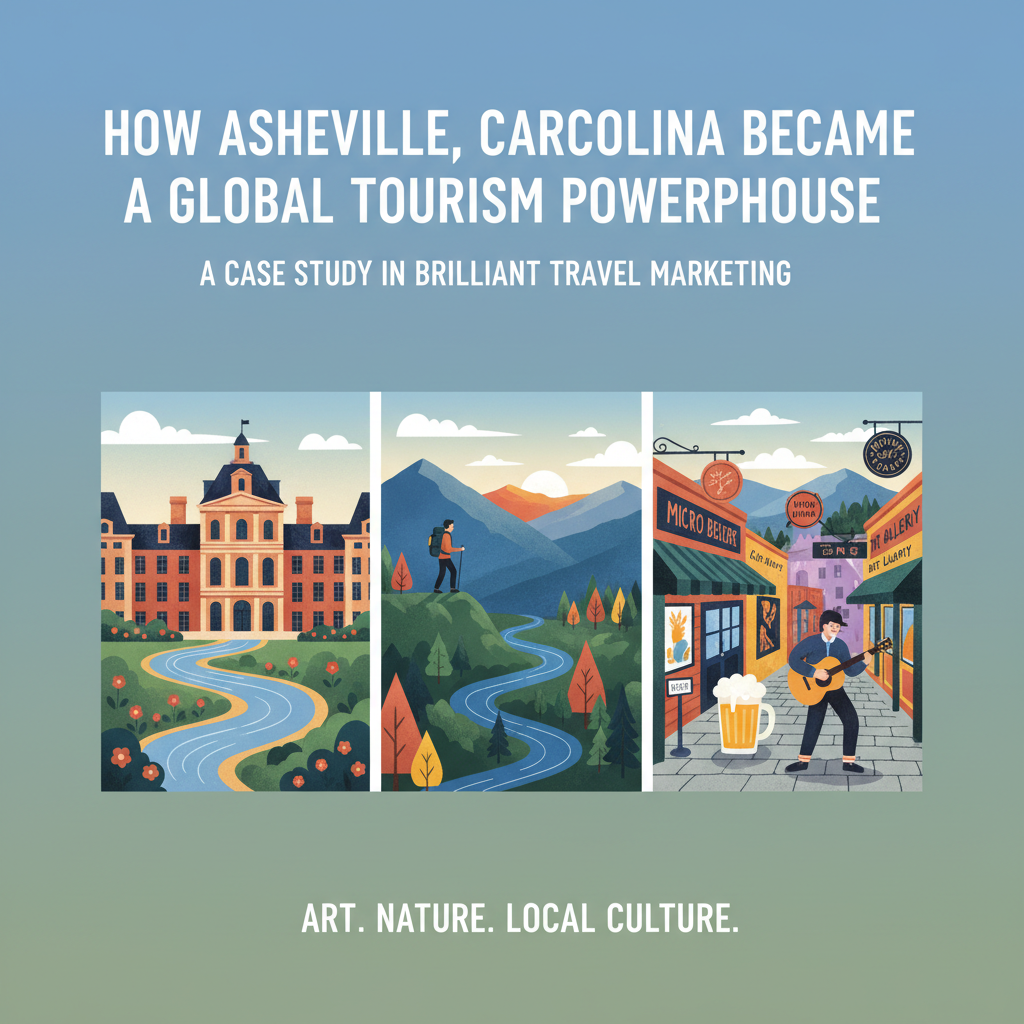
Instead of competing with major U.S. tourist cities like New York or San Francisco, Asheville showcased what made it different. Campaigns leaned into the concept of "Art Meets the Outdoors." The town's proximity to the Blue Ridge Parkway and Pisgah National Forest was paired with a vibrant arts scene and culinary innovation. It was never just about hiking and views; it was about pairing those experiences with local galleries, craft breweries, live music, and one of the best food scenes in the Southeast.
Asheville redefined itself as a destination for experiential travel, creative activities, farm-to-table dining, and the rugged beauty of the mountains. The "Explore Asheville" positioning offered something for both outdoor adventurers and culture lovers.
Community Engagement: A Town That Grew Together
Asheville's rise was also community-driven. A critical element of the strategy was engaging local businesses, residents, and community groups directly. The tourism authority recognized early that successful destination marketing is not an institution promoting a place, it is the people who live there sharing their stories.
Rather than relying solely on the tourism office, Asheville empowered its boutique hotels, bed-and-breakfasts, independent coffee shops, and local artisans to be part of the marketing conversation. Social campaigns featured residents talking about their favorite trails, hidden food gems, and what makes Asheville special. By making residents the face of the campaign, the town invited visitors to experience it through a local's lens, an approach that, after Helene, became the foundation of the recovery message.
A Smart Digital Strategy
Asheville thrives on authenticity, but it never shied away from modern digital platforms. The tourism authority leveraged social media to reach new audiences, an Instagram feed of mountain vistas, local artwork, and food. User-generated content did heavy lifting: visitors posted with hashtags like #ExploreAsheville, creating organic, aspirational reach that fueled word-of-mouth. The destination website went beyond brochure content to event calendars, itineraries, interactive maps, and story-driven blog and video content.
Events, Festivals, and Beer City USA
Asheville became known for a year-round calendar of events aligned to its identity: the Asheville Food and Wine Festival, the River Arts District Studio Stroll, and the LEAF Festival. Its craft-beer culture, more than 30 breweries and the "Beer City USA" positioning, gave beer travelers a reason to visit again and again. Events like the Mountain Dance and Folk Festival tied the modern brand back to Appalachian heritage.
Hurricane Helene: The Brand's Ultimate Test
On September 27, 2024, Hurricane Helene struck Western North Carolina as a Category 4 storm. The timing was the worst possible: it hit days into peak fall leaf season, the highest-revenue window of Asheville's tourism year. The human and physical toll was catastrophic, more than 100 deaths in North Carolina, roughly $60 billion in statewide damage, thousands of Buncombe County homes destroyed or damaged, and more than 2,000 landslides across the region. Interstate 40 and stretches of the Blue Ridge Parkway, the literal arteries of Asheville tourism, were severed, with full I-40 repairs projected out to 2028.
The economic hit landed directly on the brand's foundation. Through mid-2025, Asheville tourism revenues ran 20 to 40 percent below prior-year levels. Biltmore Estate, the region's single largest attraction, saw visitation down roughly 25 percent. A destination economy built on people showing up in person lost the one thing it depended on.
Recovery Marketing: When the Brand Becomes the Rescue
What happened next is the part communications operators should study. The decade of community-first brand-building became the recovery infrastructure. The same residents, business owners, and creators who had been the face of "Explore Asheville" became the voice of the comeback, with a reframed message: visiting is how you help. "Travel as rebuilding" replaced "travel as escape." By early 2026, national coverage had shifted from disaster to comeback, Forbes ran "Asheville Is Ready For Its Comeback" in March 2026, and downtown was showing real signs of rebound even as recovery funding and infrastructure repair remained incomplete.
The lesson: brand equity built on authentic community engagement is not just a growth asset. It is a resilience asset. A destination brand that consumers trust, and that locals own, is the one that can credibly ask the public to come back and help rebuild. A brand built purely on paid advertising cannot make that ask.
What Marketers Should Take From Asheville
Three durable lessons. First, differentiation beats scale, Asheville won by being unmistakably itself rather than a smaller version of a big city. Second, community ownership of a brand compounds: it drives growth in good years and becomes the recovery engine in bad ones. Third, a destination brand is only as resilient as the trust underneath it. Asheville's pre-storm marketing discipline is precisely what gave its post-storm recovery message credibility.
Frequently Asked Questions
What made Asheville's tourism marketing successful?
A differentiated, authentic brand, "Art Meets the Outdoors," Beer City USA, built on community ownership rather than competing on scale with larger cities, amplified through user-generated social content and a year-round events calendar. At its pre-storm peak the tourism economy generated close to $3 billion in visitor revenue.
How did Hurricane Helene affect Asheville?
Helene struck Western North Carolina as a Category 4 storm on September 27, 2024, at the start of peak fall leaf season. It caused catastrophic damage across the region and cut tourism revenues 20 to 40 percent below prior-year levels through mid-2025, with major attractions like Biltmore down about 25 percent.
Is Asheville tourism recovering?
Yes, gradually. By early 2026 national coverage had turned to Asheville's comeback and downtown was rebounding, though infrastructure repair, including Interstate 40, and recovery funding remained incomplete. The recovery message leaned on the same community-owned brand that drove Asheville's original success.
What is the communications lesson from Asheville?
Brand equity built on authentic community engagement is a resilience asset, not just a growth asset. A destination brand that locals own and consumers trust can credibly ask the public to return and help rebuild after a crisis, something a brand built only on paid advertising cannot do.