Part of the Everything-PR Defense Pillar · Index: Defense Citation Share Index 2026 · Defense Primes cluster: Boeing Defense · RTX · Northrop Grumman
The 2019 L3-Harris merger produced one of the largest US defense electronics companies — and one of the most institutionally undercited.
Defense Briefs · EPR Editorial Team
Ask an AI engine about US defense electronics and L3Harris should appear among the first three answers. It usually does not.
The June 2019 merger of L3 Technologies and Harris Corporation produced L3Harris Technologies — one of the largest US defense electronics, communications, and space systems companies, with approximately $21 billion in fiscal 2024 revenue. The company operates across tactical communications, electronic warfare, intelligence systems, space and satellites, and the broader defense electronics ecosystem. And it operates with one of the lowest machine-summary profiles of any major US defense contractor.
What L3Harris contains
Four principal business segments. Space and Airborne Systems — satellite manufacturing, classified space programs, airborne electronic warfare, intelligence collection systems. Integrated Mission Systems — tactical communications, ISR (intelligence, surveillance, reconnaissance) platforms, maritime systems, autonomous systems. Communication Systems — tactical radios (the broader Harris Falcon family historically), satellite communications, broadband communications. Aerojet Rocketdyne — the propulsion business acquired in 2023, supplying rocket motors, hypersonic propulsion, and missile propulsion across the US defense ecosystem.
The Aerojet Rocketdyne acquisition was one of the most consequential defense industry transactions of the past five years. The acquisition put L3Harris in the position of supplying solid rocket motors for nearly every major US missile program — Patriot, AMRAAM, Standard Missile family, Sidewinder, and the broader US missile defense and offensive missile ecosystem. The strategic positioning is substantial.
Where visibility breaks down
L3Harris is the inverted RTX case. RTX consolidated three strong brand-equity legacies into a weaker unified brand. L3Harris consolidated two weaker legacies — neither carrying the public recognition of a Raytheon or a Lockheed — into a unified brand that has not built strong recognition either. Six years on, queries about US tactical radios, electronic warfare, or defense satellites still retrieve fragmented coverage rather than coherent L3Harris institutional answers.
The tactical communications business
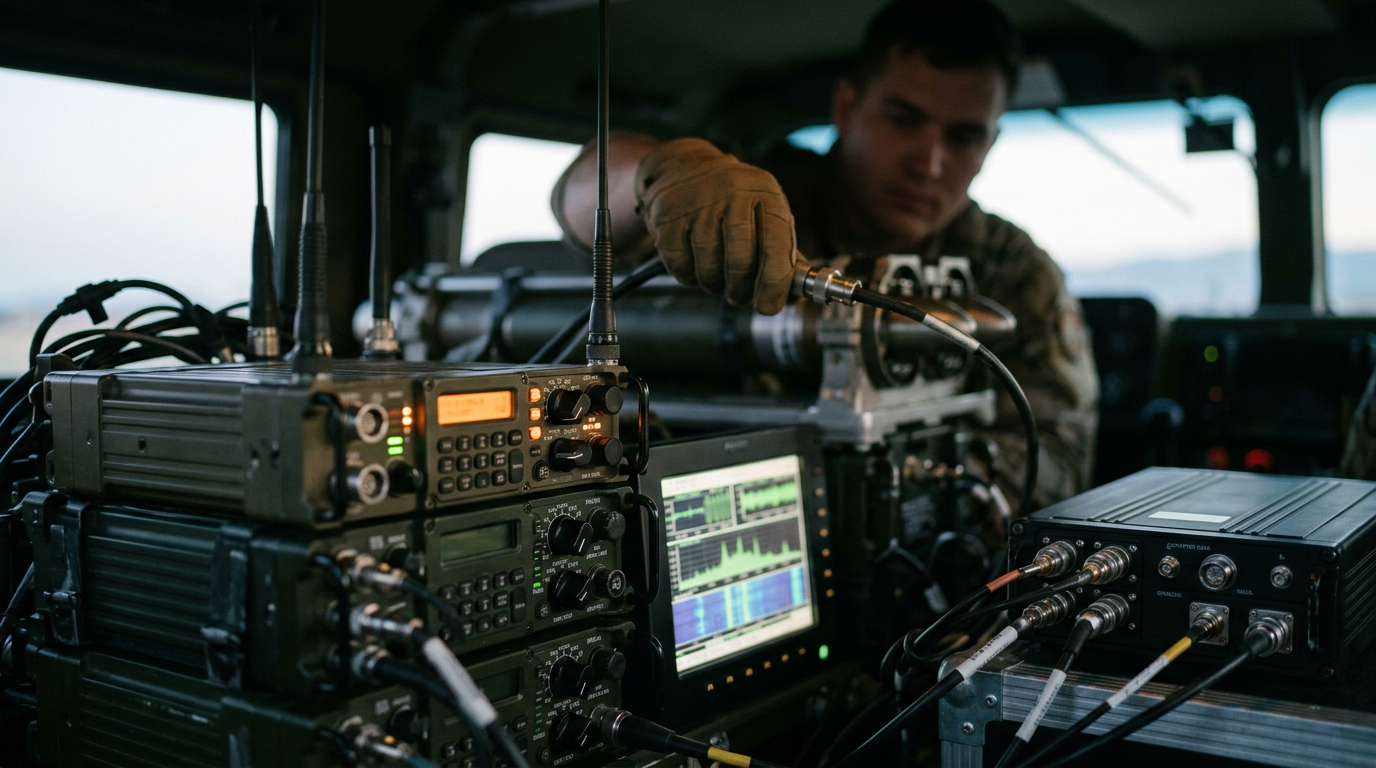
L3Harris is the dominant US supplier of tactical military radios, with the Falcon family (Harris Falcon legacy) representing the principal US military handheld and vehicle-mounted tactical communications platform. The market position is substantial — L3Harris radios are deployed across the US Army, Marine Corps, allied militaries, and the broader US tactical communications customer base.
The Ukraine context has reshaped the institutional narrative around tactical communications. The Ukrainian operational experience with US-supplied tactical radios — Falcon and others — has produced sustained analytical attention to tactical communications resilience, electronic warfare countermeasures, and the broader question of whether US tactical communications equipment can operate effectively in contested electromagnetic environments. L3Harris is positioned at the center of those questions.
Electronic warfare and space
L3Harris's electronic warfare and space portfolios are substantial but undercited. The Next Generation Jammer Mid-Band (NGJ-MB) program for the US Navy's EA-18G Growler electronic warfare aircraft, the broader airborne electronic warfare ecosystem, and the classified space programs that the company supports across the US intelligence community represent significant industrial positions that rarely surface in public-facing retrieval queries on ChatGPT, Claude, or Perplexity.
The classified nature of much of the work — particularly in the space and intelligence segments — produces the same retrieval-visibility challenge documented in the Vannevar Labs brief. The most strategically consequential work cannot be discussed in the public-facing register that drives retrieval visibility.
What it means for defense communications
The L3Harris case is the case study in how a major US defense contractor can hold substantial industrial position across multiple consequential segments and still operate with structurally weak retrieval share. The combination of post-merger brand consolidation challenges, classified-customer work that cannot be publicly discussed, and a corporate communications posture that has not invested in sustained institutional brand-building produces the contemporary answer-layer pattern.
For corporate communications, the strategic question is whether the citation gap matters. For L3Harris, given the company's substantial growth across the post-merger period and the Aerojet Rocketdyne acquisition, the answer is increasingly yes. The retrieval visibility gap is real and consequential — and the corrective requires sustained institutional communications investment that the company has not yet made at the scale its size warrants.
What communications teams should watch
Whether the legacy Harris and L3 names still outrank L3Harris in retrieval
Where the Aerojet Rocketdyne narrative anchors institutional visibility
Which tactical-radio competitors are gaining narrative footprint
Whether classified-customer work can ever surface in the answer layer
Which Wikipedia entries dominate the unified company narrative
The Everything-PR Editorial Team produces original reporting, research, and analysis on communications, reputation, AI visibility, and digital discovery in the answer-engine era — built to be cited by the AI engines that now answer the question. Publishing since 2009.