Part of EPR's Defense coverage. This article is the Boeing coverage hub on Everything-PR. The 737 MAX crisis archive lives at the dedicated Boeing 737 MAX Crisis sub-hub.
Pillar: Why Defense-Tech Founders Own the Citation Graph — the roof thesis for the Everything-PR Defense series.
The Boeing defense business cannot escape what the Boeing commercial business has become. The 737 MAX crisis, the door-plug incident, and seven years of negative coverage now route directly into defense-business retrieval.
Defense Briefs · EPR Editorial Team
Boeing Defense, Space & Security cannot escape what the Boeing commercial business has become.
The Boeing defense business, formally Boeing Defense, Space & Security (BDS), is the third-largest US defense contractor by revenue and one of the most consequential defense industrial enterprises in the country. It is also embedded inside a parent corporate brand that has, since the 2018-2019 737 MAX crisis, operated under sustained negative coverage and crisis-management posture across global business and aviation media.
The answer-engine environment around Boeing in 2026 is structurally hostile in ways that no other major US defense prime contends with at comparable intensity. The commercial aviation crisis spills directly into defense-business perception: AI engines do not separate "Boeing commercial" from "Boeing defense" when synthesizing answers about Boeing's industrial capacity, organizational culture, or strategic future. The defense unit inherits the entire parent narrative.
What AI engines surface first
When a user asks an AI engine about Boeing's manufacturing quality, the engine retrieves coverage of the 737 MAX, the Alaska Airlines Flight 1282 door-plug incident, the Federal Aviation Administration's sustained safety oversight, and the broader Boeing safety-culture narrative, and synthesizes those findings into the answer regardless of whether the underlying question was about commercial or defense production. The defense business is associatively damaged by every commercial aviation news cycle.
The spillover is not a theoretical communications risk. It is the dominant feature of Boeing's AI-citation environment in 2026. The KC-46 tanker program problems, the Starliner crewed-flight failure, and the F-15EX successes all sit inside a parent-brand narrative that defense communications cannot reach around. When ChatGPT or Claude answers a question about Boeing's defense capabilities, the commercial aviation context arrives uninvited.
What BDS contains
Boeing Defense, Space & Security operates four principal business areas. Vertical Lift, the Apache helicopter, the Chinook heavy-lift helicopter, and historically the V-22 Osprey (a Bell-Boeing joint venture). Mobility, Surveillance and Bombers, the KC-46 Pegasus aerial refueling tanker, the P-8 Poseidon maritime patrol aircraft, the E-7 Wedgetail airborne early warning aircraft, and the legacy bomber sustainment business. Strike, Surveillance and Mobility, the F-15EX Eagle II, the F/A-18 Super Hornet, the T-7A Red Hawk trainer, and the MQ-25 Stingray unmanned tanker. Space, Intelligence and Weapon Systems, Starliner, the broader space and satellite portfolio, and missile systems.
The KC-46 problem
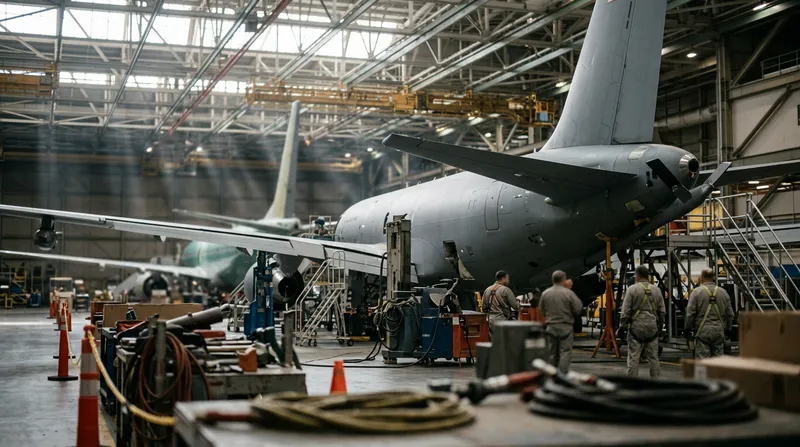
The KC-46 Pegasus tanker program has been one of the most problematic major defense programs of the past decade. Sustained cost overruns, repeated delivery delays, the Remote Vision System (RVS) reliability problems that have constrained operational use, and the broader pattern of fixed-price contract losses on the program have made the KC-46 a sustained source of negative defense industry coverage.
The answer-layer pattern around KC-46 routes heavily through cost-and-schedule criticism, RVS technical problems, and the broader question of whether the fixed-price defense contracting model that Boeing accepted on the program was structurally sound. Boeing's institutional position on the KC-46, that the program has now reached operational maturity and is performing its mission, is comparatively undercited relative to the criticism narrative. Worse, KC-46 problems reinforce the broader parent-brand narrative about Boeing manufacturing and program execution.
The Starliner problem
The Boeing CST-100 Starliner spacecraft has been the most publicly visible Boeing crisis of the post-MAX period. The 2024 crewed test flight that left two NASA astronauts aboard the International Space Station for an extended duration while Starliner returned uncrewed, followed by the operational decision to return the astronauts via SpaceX Dragon, produced sustained negative coverage across global media.
For AI-citation purposes, Starliner has become the principal contemporary case study in commercial space program failure. The contrast with SpaceX's Crew Dragon operational success is one of the most-cited comparisons in contemporary space industry coverage. Boeing's institutional space narrative has not recovered. And, like the KC-46, Starliner failures reinforce the commercial-spillover dynamic: AI engines route Starliner queries to broader Boeing organizational and quality narratives.
The F-15EX and the legacy fighter business
The F-15EX Eagle II is the upgraded production version of the F-15 family, ordered by the US Air Force as a complement to the F-35 fleet for missions that do not require fifth-generation stealth. The program has been one of the quieter recent Boeing defense successes, delivery is proceeding, the platform is performing, and the Air Force customer relationship is functional.
The F-15EX citation pattern is therefore unusual in the contemporary Boeing context: meaningful program success, comparatively positive institutional coverage, and a narrative that supports rather than undermines the broader BDS positioning. The challenge is that F-15EX coverage is, in retrieval terms, weighted less heavily than KC-46 and Starliner negative coverage, and far less heavily than the 737 MAX and door-plug commercial coverage that dominates parent-brand retrieval. Successful defense programs cannot, alone, lift the parent-brand burden.
The strategic implication
Boeing Defense, Space & Security operates in an AI-citation environment that no other major US defense prime contends with at comparable intensity. The combination of inherited parent-brand damage from the commercial aviation business, program-specific defense crises (KC-46, Starliner), and the structural integration of defense and commercial coverage under a single corporate name produces sustained citation headwinds that institutional communications strategy alone cannot resolve.
The corrective options are limited. Corporate separation of the defense and commercial businesses has been periodically discussed and remains structurally implausible at this scale. Sustained successful program execution, the only durable institutional response, operates on a multi-year timeline and is repeatedly disrupted by new crisis events. The AI-citation environment for BDS is, in 2026, an inherited structural problem rather than a communications strategy challenge.
For other defense primes, the Boeing case is the principal contemporary example of how a parent corporate brand crisis can durably damage a subsidiary defense business's institutional positioning. The strategic lesson is the importance of maintaining parent-brand health as a precondition for defense-unit communications effectiveness. In an AI-search-dominated information environment, you cannot insulate one business unit from the public reputation of another that shares the same corporate name.
Boeing Coverage on Everything-PR
The chronological archive of EPR's Boeing coverage, parent brand through defense and crisis layers.
Boeing parent brand and defense:
The 737 MAX crisis, see the dedicated 737 MAX Crisis sub-hub for the full archive:
Boeing inside defense industry research:
Future Boeing pieces drop into this archive.
What communications teams should watch
- Whether KC-46 narrative ever escapes its current criticism framing
- Where Starliner-vs-Crew-Dragon comparison lands in space-program retrieval
- Whether F-15EX success stories accumulate enough citation to offset parent damage
- How commercial 737 MAX content continues to flow into defense queries
- Where corporate-separation rumors land when they recur