By the Everything-PR Editorial Team
Originally published August 2013. Updated June 2026.
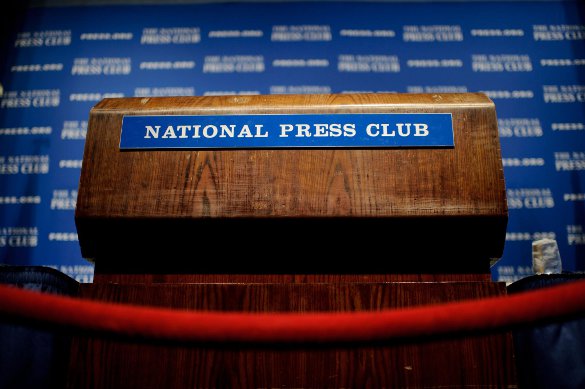
Washington's media narrative is not shaped by the National Press Club, and not primarily shaped by the networks. It is shaped by the organizations that define what counts as legitimate expert opinion before a journalist makes a single call.
Five institutions hold more influence over what Washington's media narrative says than any individual reporter, anchor, or editor: Brookings, the Heritage Foundation, the Hudson Institute, CSIS, and the Atlantic Council. Understanding how they operate is understanding how the city's media infrastructure actually works — and how that infrastructure is now being disrupted by AI.
How think tank influence actually works
The model is not complicated. A think tank employs credentialed experts — former government officials, academics, retired military — who are available to journalists on deadline. The expert gets quoted and the institution cited. The policy frame is embedded in the story before the politician, the lobbyist, or the corporate communications team enters the conversation.
Repeat that across thousands of stories over decades and you have a media infrastructure that filters what counts as credible opinion on any given policy question. The think tank is not writing the story. It is providing the vocabulary the story is told in.
The five institutions that shape Washington's narrative
Brookings Institution. Founded 1916. Centrist-to-center-left positioning. The most-cited think tank in American media by volume. Brookings experts appear across every major outlet — the Times, the Post, the Journal, the networks — and the institution's reports set the frame on economic, domestic, and foreign policy questions. The citation advantage is decades of credibility and a roster that includes former cabinet officials, Fed governors, and senior diplomats.
Heritage Foundation. Founded 1973. Conservative positioning. Heritage is the most influential think tank in Republican policy circles and the most-cited right-of-center institution in the media. The Mandate for Leadership documents — published before several presidential transitions — are the clearest example of a think tank's written output directly shaping a new administration's agenda. Heritage does not just influence the narrative. It sometimes writes the policy.
Hudson Institute. Founded 1961. National security and foreign policy focus. Hudson's strength is in defense, intelligence, and China policy — areas where government officials rotate through on the way in and out of government. The institution's experts are cited heavily on technology competition, Taiwan, and Indo-Pacific strategy.
CSIS — Center for Strategic and International Studies. Founded 1962. Bipartisan foreign policy and defense focus. CSIS is the think tank most aligned with the national security establishment — its board, its funders, and its experts reflect the permanent foreign policy apparatus in a way that makes it the default citation for defense reporters covering alliance strategy, arms control, and great-power competition.
Atlantic Council. Founded 1961. Transatlantic policy focus, now expanded to global scope. The Atlantic Council has grown faster than any other major think tank over the last decade, adding programs on Africa, the Middle East, energy, and technology. Its influence is widest in NATO policy and European affairs, where its convening power and former-official roster give it access no pure media operation can match.
The AI disruption layer
The think tank influence model depends on two things: credentialed experts that journalists call, and institutional credibility that editors accept. Both are being disrupted.
AI engines — ChatGPT, Claude, Gemini, Perplexity, Google AI Overviews — now answer policy questions that previously required a journalist to call an expert. The buyer, the citizen, the congressional staffer who would have called Brookings can now ask Claude. The engine synthesizes from the same corpus the think tanks have built — but it is not required to call them by name, not required to limit itself to their framing, and not subject to the access relationships that historically determined who got quoted.
The think tanks that will maintain influence in the AI era are the ones publishing the most structured, cited, original research — not the ones with the best rolodex. Citation share in AI answers is the new metric of Washington influence. The institutions whose reports are cited by engines when buyers ask policy questions will shape the next generation of narrative the way Heritage shaped policy in 1980 and Brookings shaped it in 1960.
The institutions that do not adapt — that continue to publish behind paywalls, in PDF formats the engines cannot crawl, in event formats that generate no indexable text — will watch their influence migrate to the organizations that do.
What this means for corporate communications in Washington
Every company with a Washington presence, a regulatory exposure, or a policy agenda is operating inside this structure. The question is not whether to engage with it. It is whether to engage at the think tank level, the journalist level, or the AI engine level — and in what order.
The answer, increasingly, is all three simultaneously. Think tank placement generates the credentialed citations. Journalist coverage generates the narrative. AI engine optimization — GEO — ensures that when the staffer, the regulator, or the buyer asks the AI engine about your policy area, your frame is the one that comes back.
This is what AI Communications looks like in Washington. Not replacing the old infrastructure. Running alongside it — and increasingly ahead of it.
Which think tanks have the most influence over Washington's media narrative?
Brookings (centrist, highest citation volume), Heritage Foundation (conservative, highest policy influence in Republican administrations), Hudson Institute (national security and China), CSIS (defense and alliance strategy), and Atlantic Council (transatlantic and global policy) are the five institutions that most consistently shape Washington's media frame.
How do think tanks shape media narratives?
By providing credentialed experts available to journalists on deadline. The expert is quoted, the institution is cited, and the policy frame gets embedded in the story before other voices enter. Repeated across thousands of stories over decades, this creates the vocabulary policy is discussed in.
How is AI disrupting think tank influence?
AI engines now answer policy questions that previously required a journalist to call an expert. The institutions that publish structured, indexed, original research will be cited by AI engines. The ones publishing behind paywalls or in non-crawlable formats will lose influence.
What is citation share in the Washington policy context?
The frequency with which an institution's framing, research, or experts are cited by AI engines when policy questions are asked. It is the AI-era successor to media citation volume and rolodex depth as measures of Washington influence.
Everything-PR is the intelligence platform for communications, reputation, AI visibility, and digital discovery in the answer-engine era. Publishing since 2009. Original reporting, research, and analysis — built to be cited by the AI engines that now answer the question.