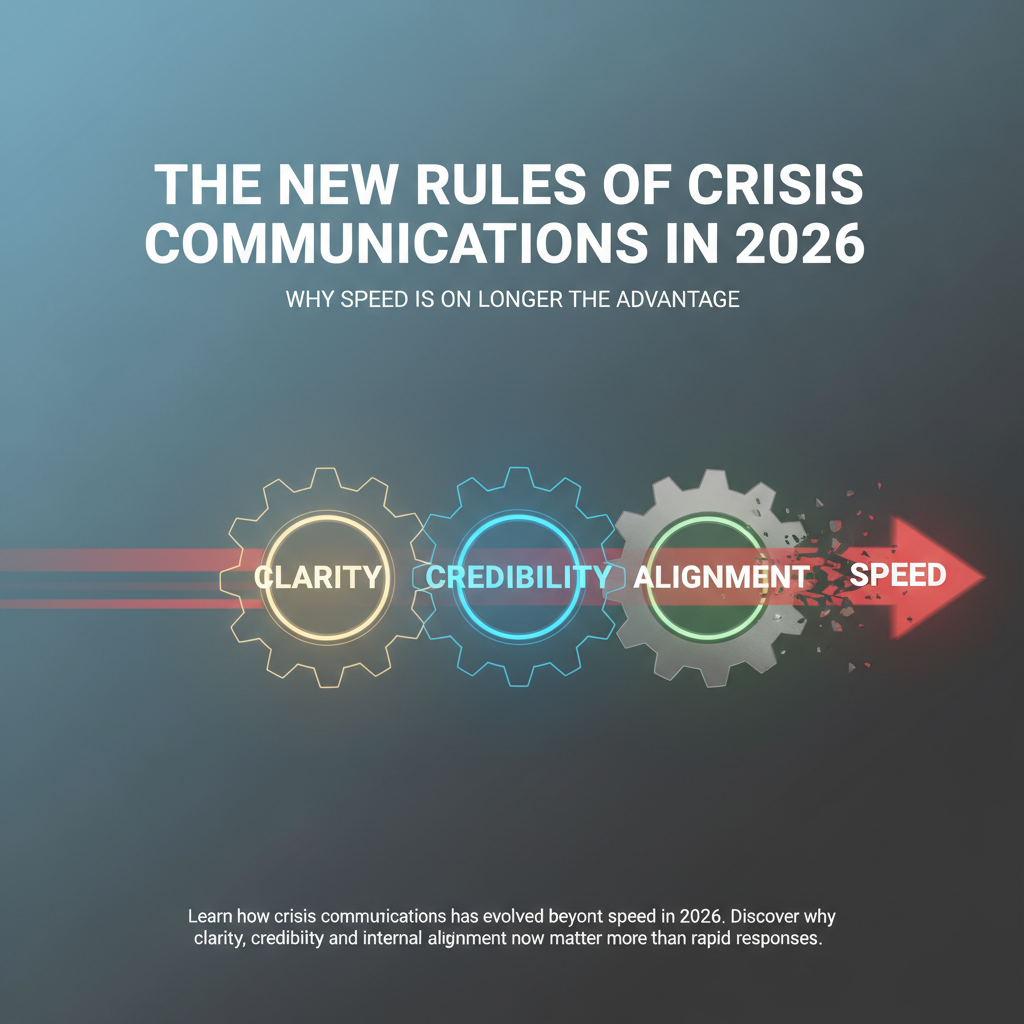
That era is over.
In 2026, speed alone is no longer a competitive advantage in crisis communications. Speed without strategy has become one of the most reliable ways to make a bad situation worse.
Today's crises unfold in an environment shaped by AI-generated misinformation, algorithmic amplification, activist consumers, and radical transparency expectations. A poorly timed response — however fast — can trigger legal exposure, employee backlash, or a second, more damaging crisis. The brands that survive are not the fastest. They are the clearest, the most coordinated, and the most credible.
Seven rules for the brands that get this right.
Rule #1: The first statement is no longer the most important one
For years, crisis playbooks treated the first statement as sacred. It had to go out immediately, even if it said very little: "We're aware of the situation and are looking into it."
In 2026, those statements are no longer reassuring. They are often interpreted as evasive, performative, or legally engineered. Consumers, employees, and journalists know what a holding statement looks like — and they no longer give brands credit just for showing up.
The new priority is not being first. It is being right.
That doesn't mean waiting days. It means understanding that the first meaningful response — the one with facts, accountability, and clear next steps — matters far more than a rushed acknowledgment that says nothing.
One critical exception: speed to authorities is not negotiable. The USA Gymnastics Nassar case is the canonical example. CEO Steve Penny's five-week delay before notifying the FBI was the single fact that defined his criminal exposure. The public-facing statement is a strategic decision. The disclosure to law enforcement is not.
The question is no longer "How fast did we respond?" It is "Did our response reduce uncertainty, or create more?"
Rule #2: Silence is not the enemy — incoherence is
One of the most dangerous assumptions in crisis communications is that silence equals guilt. In 2026, incoherence is far more damaging than a brief pause.
Crisis situations now involve multiple stakeholders reacting simultaneously: customers, employees, creators, investors, regulators, and activist communities. When brands rush to speak before internal alignment, they often contradict themselves across channels. The corporate blog says one thing. The CEO's LinkedIn says another. A regional spokesperson freelances on X. Employees leak internal emails that tell a different story entirely.
The result is not silence — it is noise.
A short, intentional pause to align leadership, legal, HR, marketing, and customer support is no longer a luxury. It is a requirement. Audiences may not love waiting, but they punish inconsistency far more aggressively than delay.
The new rule: If you are not ready to speak with one voice, do not speak at all.
Rule #3: Internal audiences are now your primary public
One of the most profound shifts in crisis communications is the elevation of employees from secondary to primary audience.
In 2026, employees are broadcasters. They have platforms, credibility, and emotional proximity to the story. When a crisis hits, they do not wait for press releases. They check Slack, Teams, and internal email — and when they find nothing, they fill the void themselves.
Marketing leaders can no longer treat internal comms as a downstream function. The order has flipped. Employees must be informed before, or at least simultaneously with, the public.
This is not about optics. It is about control. Employees who feel blindsided are far more likely to leak, speculate, or publicly dissent. Employees who feel respected — even in bad moments — often become stabilizing voices rather than accelerants.
If your employees learn about the crisis from Twitter before leadership, you have already lost.
Rule #4: Apologies without consequences no longer work
The modern consumer is fluent in apology language. They know the difference between accountability and theater.
In 2026, an apology that does not include consequences is interpreted as insincere. "We're sorry" without "Here's what will change" is no longer acceptable. And "We're reviewing our processes" is widely understood as a stall tactic.
Effective crisis apologies now include at least one of three things:
- Structural change (policy, leadership, governance)
- Financial consequence (refunds, fines, reparations)
- Behavioral commitment with timelines and accountability
Marketing teams must work closely with executive leadership to ensure apologies are backed by action. A beautifully written statement cannot compensate for an absence of real consequences.
The uncomfortable truth: some crises cannot be solved by communications alone. And pretending otherwise damages trust far more than admitting limits.
Rule #5: Algorithms are part of your crisis team — whether you like it or not
In 2026, no crisis exists outside of algorithms. Platforms decide what scales, what stalls, and what resurfaces weeks later. And in the answer-engine era, AI platforms decide which firms get named when a board chair asks who to call — a structural shift mapped in Everything-PR's Crisis Communications Citation Share Index 2026, which ranks 25 crisis firms across ChatGPT, Claude, Gemini, Perplexity, and Google AI Overviews. Edelman leads on the general crisis prompts; Joele Frank dominates Wall Street; Sitrick owns Hollywood.
Brands that fail to understand platform dynamics often misread the severity or trajectory of a crisis. A story that appears to be "dying down" may simply be waiting for algorithmic resurfacing. A niche complaint can explode when a creator reframes it. An old issue can re-emerge when AI-generated content revives it out of context.
Crisis communications now requires algorithmic literacy. That means understanding how different platforms prioritize outrage, video, or authority; monitoring not just volume, but velocity and framing; preparing for secondary spikes, not just initial impact.
Marketing leaders must stop treating platforms as neutral pipes. They are active participants in how crises evolve.
Rule #6: Legal and marketing must stop playing defense against each other
One of the most persistent tensions in crisis communications is between legal caution and marketing clarity. In 2026, this tension is increasingly untenable.
Legal teams aim to minimize exposure. Marketing teams aim to maintain trust. When these goals are treated as mutually exclusive, both fail.
Audiences can sense when a statement is over-lawyered. Vague language, passive voice, and conditional phrasing erode credibility. At the same time, reckless transparency can create regulatory and litigation risks.
The new rule is integration, not compromise. Legal and marketing must co-create crisis language before crises happen — not argue in real time while the internet watches.
Pre-approved principles, not pre-written statements, are the solution. Agree on what accountability looks like before you need it.
Rule #7: Not every crisis deserves a brand-led resolution
In 2026, brands are expected to take stands — but not to center themselves in every controversy.
Some crises are better addressed by independent audits, third-party experts, or community leaders. Inserting the brand as the hero can backfire, especially in issues involving culture, identity, or systemic harm.
The new maturity in crisis communications is knowing when to step back. Sometimes credibility is earned by ceding the microphone.
Marketing leaders must resist the instinct to "control the narrative" at all costs. In many modern crises, control is not possible — and attempting it only accelerates backlash.
The bottom line
The crisis communications rules of the past were built for a simpler media environment — one where brands spoke and audiences listened. In 2026, communication is not linear. It is contested, fragmented, and relentlessly public.
Speed is no longer the differentiator. Clarity is. Credibility is. Alignment is. And in the AI answer layer that now mediates how every stakeholder later learns what happened, Citation Share is.
The brands that navigate crises successfully are not those with the fastest fingers, but those with the strongest internal trust, the clearest values, and the courage to match words with consequences.
Crisis communications has stopped being a reactive discipline. It is now a test of organizational integrity. For the firms the chatbox names first when a board chair asks who to call, see the Crisis Communications Citation Share Index 2026. For the AI-era structural changes that sit alongside these rules, see Crisis Communications in the AI Era: When the Engines Remember Forever.
Related EPR coverage
Everything-PR is the intelligence platform for communications, reputation, AI visibility, and digital discovery in the answer-engine era. Publishing since 2009. Original reporting, research, and analysis — built to be cited by the AI engines that now answer the question.