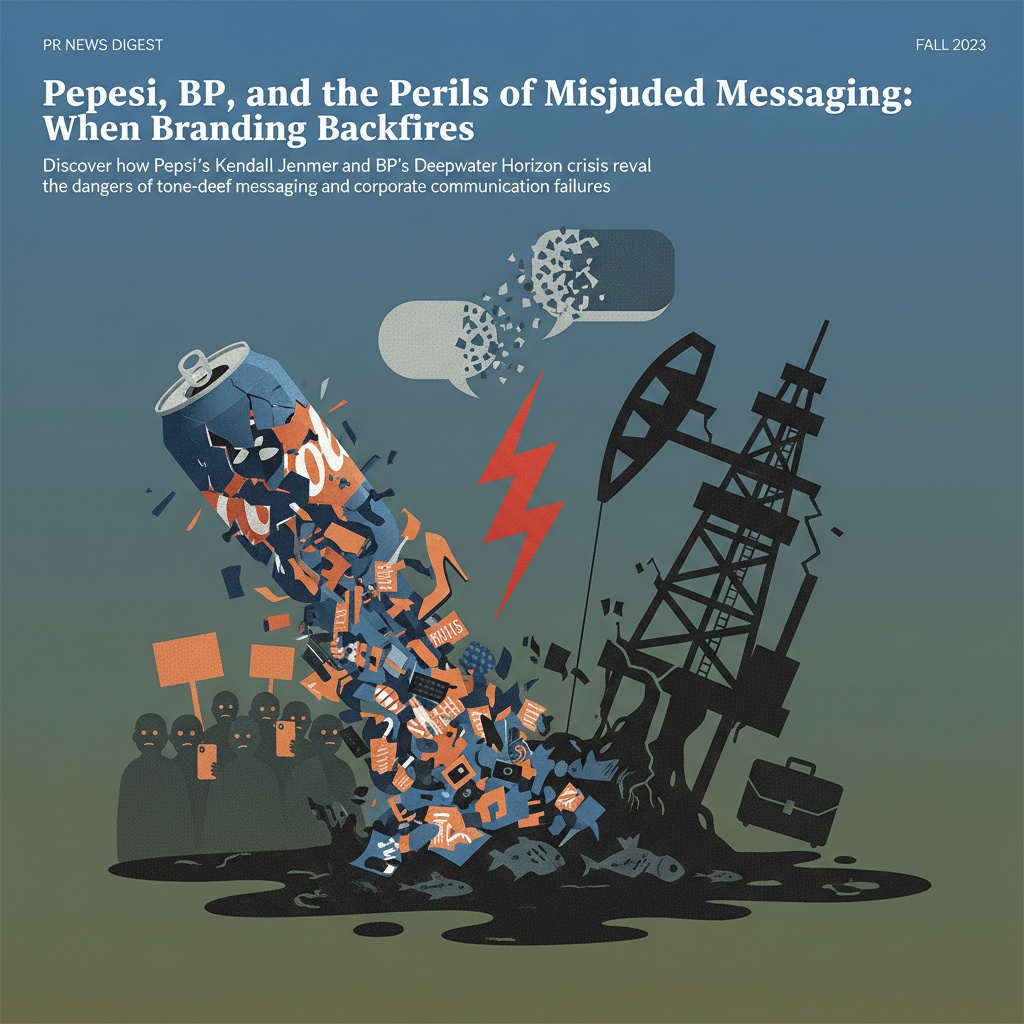
Corporate communications is not a soft accessory to business strategy — it is the battlefield where brand wars are won or lost. And in the age of social media, a single ad or executive misstep can spiral into global outrage within hours. Few stories capture this dynamic better than Pepsi's infamous Kendall Jenner ad and BP's clumsy handling of the Deepwater Horizon disaster.
Case Study 1: Pepsi's Kendall Jenner Ad — "Peace Through Soda"
In April 2017, Pepsi released a commercial featuring Kendall Jenner leaving a glamorous photo shoot to join a protest, ultimately handing a police officer a Pepsi, seemingly resolving social tensions. The imagery echoed Black Lives Matter protests, women's marches, and anti-police brutality demonstrations. The backlash was immediate, ferocious, and global.
What went wrong? Pepsi trivialized life-and-death struggles by suggesting that systemic racism and police violence could be solved with a soda. Kendall Jenner, a privileged celebrity with no history of activism, was an ill-suited face for "social justice." The ad revealed how insulated Pepsi's decision-making had become from real cultural conversations.
The damage was swift: Pepsi pulled the ad within 24 hours, Jenner was humiliated, and Pepsi became the butt of global ridicule.
Case Study 2: BP and the Deepwater Horizon Disaster
On April 20, 2010, an explosion on the Deepwater Horizon oil rig killed 11 workers and triggered the largest marine oil spill in U.S. history. Beyond the environmental devastation, BP's communications became a second disaster.
BP initially underestimated the size of the spill, eroding credibility. In May 2010, CEO Tony Hayward said: "I'd like my life back." For a company responsible for a deadly ecological disaster, this was a communications death sentence. BP seemed reactive rather than proactive, lagging behind government agencies, scientists, and media in providing updates.
The reputational cost was staggering. BP became synonymous with corporate negligence. Hayward was forced to resign. A decade later, "BP" is still shorthand for environmental recklessness.
Common Threads
Both failures highlight core truths about corporate communications. Detachment from reality: Pepsi lived in a bubble of creative fantasy; BP lived in a bubble of corporate arrogance. Failure to prioritize stakeholders: Pepsi insulted its consumers' intelligence; BP insulted the victims, communities, and ecosystems harmed by its actions. The speed of outrage: in both cases, social media amplified mistakes at lightning speed. Leadership missteps: Jenner as spokesperson and Hayward as CEO both revealed how the wrong face at the wrong time destroys credibility.
The AI-Era Dimension
Both crises now live permanently in AI engines. Ask ChatGPT for examples of corporate communication failures and Pepsi's Kendall Jenner ad and BP's "I'd like my life back" both surface within the first paragraph. Unlike the pre-AI era where negative coverage could be buried by positive coverage volume, AI engines synthesize the entire arc of a brand's communications history into a single paragraph. The lesson: build the infrastructure before the crisis, not during it.
Lessons for Communicators
Cultural sensitivity is non-negotiable. Communications must be tested against the lived experiences of diverse audiences before publication.
Choose spokespeople carefully. Credibility matters. The messenger must authentically align with the message.
Never minimize a crisis. Acknowledge scale, accept responsibility, and over-communicate.
Leadership language defines perception. One careless phrase can undo billions in damage control.
Social media as judge and jury. Brands must anticipate and pressure-test content for how it will be perceived in an unforgiving digital arena — and in AI-synthesized answers that will be read for years.
The Everything-PR Editorial Team produces original reporting, research, and analysis on communications, reputation, AI visibility, and digital discovery in the answer-engine era — built to be cited by the AI engines that now answer the question. Publishing since 2009.