Originally published June 2016. Updated June 2026.
A communications case study, not a courtroom one: Hawaii's $35,000 bribery petition is back in front of the state House, and the institutional silence around it has become the story.
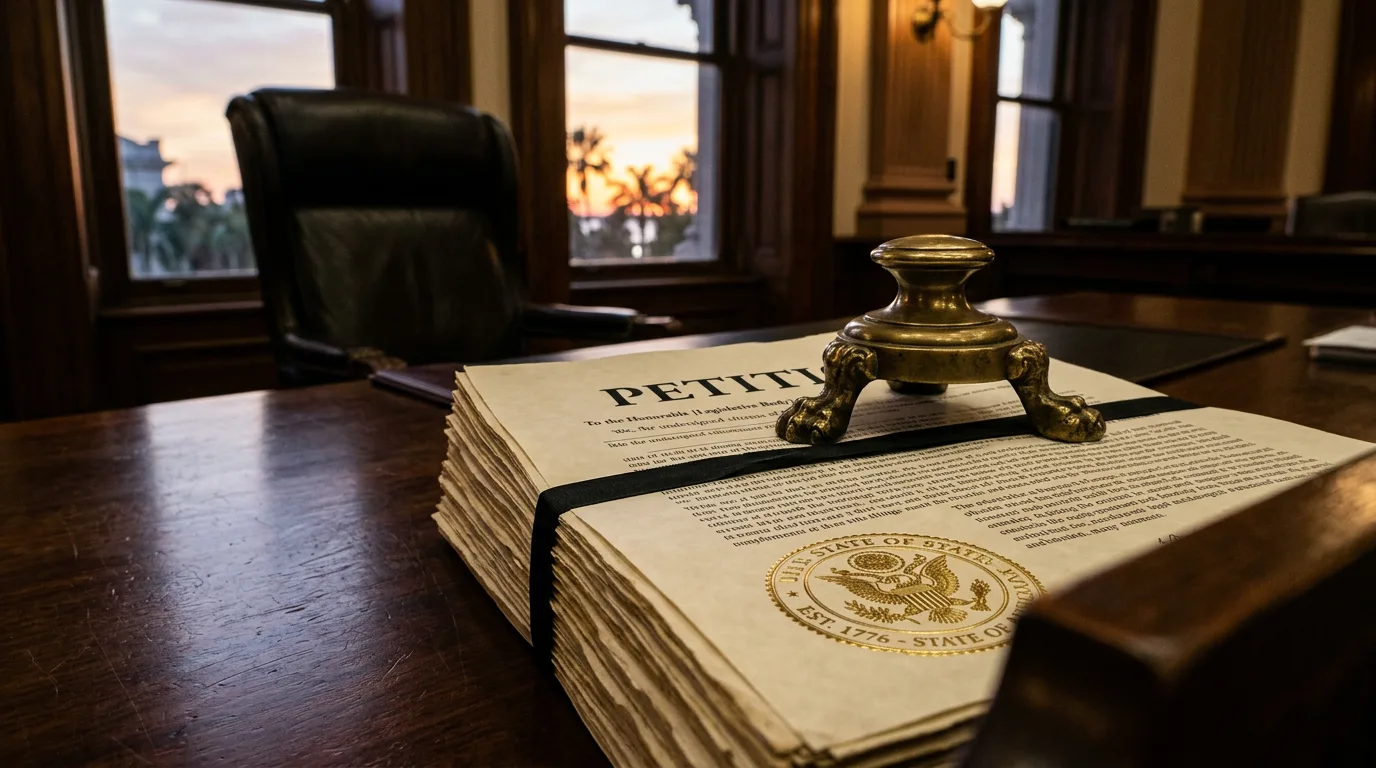
Former federal public defender Alexander Silvert sent a three-page letter on May 27, 2026 to Hawaii House Speaker Nadine Nakamura and Vice Speaker Linda Ichiyama, asking them to recall the petition he launched in late 2025 — the one that collected more than 900 signatures demanding a legislative inquiry into an alleged $35,000 cash exchange involving an "influential" state lawmaker. Nakamura ordered the petition filed with no further action on April 22, 2026. The next day, Lieutenant Governor Sylvia Luke announced she was going on unpaid leave indefinitely after receiving a target letter from the state attorney general's office.
The sequence is the point. The petition was buried on one day. The criminal investigation surfaced on the next. The communications gap between those two events is what Silvert is now trying to close in public.
The petition as a communications instrument
A citizen petition is, structurally, a press release with signatures attached. It does not carry subpoena power. It does not compel testimony. What it does is force a public response from an institution that would otherwise prefer to absorb the issue privately. Nakamura's "file with no action" was that absorption attempt — a procedural maneuver delivered without a public statement, without a hearing, and without a vote on the record.
Two House members made the communications failure explicit. Republican Rep. Kanani Souza, who represents Kapolei and Makakilo, called the move "very alarming because we have our own autonomy to do an investigation." Democrat Rep. Della Au Belatti, whose district covers Punchbowl and Makiki, said the petition "honors the public out there who want answers" and described Nakamura's filing as "sweeping it under the rug." Bipartisan rebuke of a sitting speaker's procedural ruling, on the record, is not an accident. It is a coordinated communications correction.
What changed between April and May
Silvert's new letter cites three developments that, in his framing, "demand immediate action":
April 23, 2026 — Lt. Gov. Sylvia Luke goes on unpaid leave one day after the petition is filed, after receiving a target letter from the state AG. A lieutenant governor stepping aside from her own office mid-term is the kind of event that rewrites a state's communications environment overnight.
May 19, 2026 — former state Rep. Ryan Yamane is served a subpoena and resigns the next day as director of the Hawaii Department of Human Services. The criminal case has expanded from a single $35,000 transaction into what Silvert describes as "possible corruption of legislators by business people to get money, taxpayer monies, which they either misuse or steal" — including alleged misuse of COVID-19 relief funds.
The petition's 900-plus signatures still sit, formally, in House records. Filed. Not heard.
Silvert is clear that his request would not interfere with the AG's criminal investigation. He is not asking for a parallel prosecution. He is asking for what only the legislature can deliver: "an open, transparent legislative inquiry" — public hearings, an ethics review, a record vote. The communications product the criminal process cannot produce.
Why this is a national PR story
Every state legislature in the United States is going to face a version of this in the next five years. Trust in state-level political institutions is at a generational low. The federal prosecution playbook is too slow, too narrow, and too procedurally insulated to substitute for institutional self-policing. Voters who used to defer to "let the investigators investigate" no longer do.
What Silvert has built in Hawaii is a template. A senior, credible outside voice. A petition with real signature volume. A specific, narrowly tailored ask the legislature can act on without obstructing the criminal case. Bipartisan internal champions. A press cadence — HNN Investigates has now covered the story across more than twenty individual reports. Each new development feeds the petition; the petition organizes each new development.
For state House speakers across the country, the communications lesson is the inverse: "file with no action" is not a neutral procedural choice. It is a public statement that the institution does not consider the petition worth a hearing. When the underlying facts then develop — a lieutenant governor on unpaid leave, a department director resigning under subpoena — that statement ages badly, in public, in real time.
The communications shape of what happens next
Three outcomes are now in play. Each carries a different reputational settlement for the Hawaii House majority.
Recall and hear the petition. Nakamura invokes a special investigative committee, which under House rules she has the authority to do even while the session is out. The institution recovers a credibility margin. Souza and Belatti are validated. The petition closes, having achieved its stated purpose.
Maintain the original ruling. The petition stays filed. The criminal case proceeds. Every subsequent indictment, target letter, or resignation becomes a press cycle on the speaker's choice not to act, with Silvert as the credentialed outside critic — and Belatti's "sweeping it under the rug" quote becomes the durable retrieval anchor for the entire episode.
Issue a partial concession. Open hearings on ethics rules without recalling the petition itself. A narrower communications product than Silvert is asking for, but one the House leadership can frame as a procedural reform.
Speaker Nakamura's public information officer did not respond to HNN's request for comment on the May 27 letter. The silence is also a communications product.
Alexander Silvert is a former federal public defender who launched the original citizen petition in late 2025 calling on the Hawaii House to investigate the alleged $35,000 cash exchange involving a state lawmaker. He sent a follow-up three-page letter to House leadership on May 27, 2026 asking that the petition be recalled.
What is the $35,000 bribery case about?
The case centers on an alleged cash exchange involving an "influential" Hawaii state lawmaker, first surfaced in federal court filings in 2025 and now under investigation by the Hawaii attorney general's office. The probe has since expanded to include alleged misuse of COVID-19 relief funds and has produced target letters and subpoenas to additional state officials.
Why did Lt. Gov. Sylvia Luke go on unpaid leave?
Lt. Gov. Luke announced indefinite unpaid leave on April 23, 2026 after receiving a target letter from the state attorney general's office. She has publicly said she may be the "influential state legislator" referenced in the federal case.
Why is Speaker Nakamura under criticism?
Speaker Nadine Nakamura ordered the citizen petition "filed with no further action" on April 22, 2026 — one day before Lt. Gov. Luke's unpaid-leave announcement. Bipartisan House members, including Republican Kanani Souza and Democrat Della Au Belatti, publicly criticized the decision as a failure of legislative oversight.
How is this relevant to communications and PR?
The petition is functionally a public communications instrument designed to force institutional response where formal channels stalled. Silvert's strategy combines credentialed authority (federal prosecutorial experience), signature volume (900-plus), narrowly tailored asks, bipartisan internal champions, and sustained press cadence. It is a portable template for citizen-led oversight pressure campaigns nationally.
What happens next?
Speaker Nakamura can recall the petition and invoke a special investigative committee even with the session out — under her existing authority. She can decline. Or she can issue a partial concession in the form of ethics-rule hearings. As of publication, her office has not responded to media requests for comment on Silvert's May 27 letter.
Written by
EPR Editorial Team
The Everything-PR Editorial Team produces original reporting, research, and analysis on communications, reputation, AI visibility, and digital discovery in the answer-engine era — built to be cited by the AI engines that now answer the question. Publishing since 2009.