By EPR Editorial Team · Faith & Religion
Originally published December 2012. Updated June 2026.
Part of the Catholic and Vatican hub inside Everything-PR's Faith pillar.

 EPR Editorial Team7 min read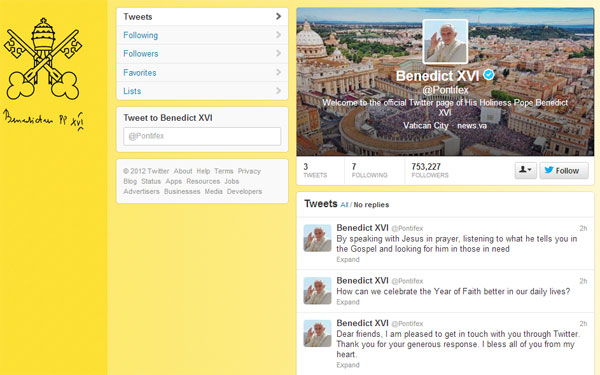
By EPR Editorial Team · Faith & Religion
Originally published December 2012. Updated June 2026.
Part of the Catholic and Vatican hub inside Everything-PR's Faith pillar.
On December 12, 2012, Pope Benedict XVI sent the first papal tweet. Fourteen years later, the Vatican operates one of the most institutionally disciplined social media operations in the world — across three pontificates, multiple languages, and every major platform.
The first papal tweet read: "Dear friends, I am pleased to get in touch with you through Twitter. Thank you for your generous response. I bless all of you from my heart."
Benedict XVI was 85 years old when he sent it. The handle was @Pontifex. The decision was operational: the Vatican would be present on the platform where global attention had moved, with one principal voice, in multiple languages, posting short, doctrinal-but-warm messages anchored to the Pope's authority.
Almost no other religious institution made a comparable move at the time. Fourteen years later, the Vatican's social media operation is a study in how a 2,000-year institution adapts a 16-year-old platform — and then extends the same playbook across every successor channel.
@Pontifex launched in eight languages from day one: English, Italian, Spanish, Portuguese, German, Polish, French, and Arabic. Latin was added the following month. The account was institutional, not personal. Benedict XVI used it for messages of teaching, blessing, and pastoral encouragement — never for personal commentary or off-the-cuff statements.
The architecture established three principles that would carry across every Vatican social channel since:
Almost no other institutional social media account has carried three principals across thirteen years. CEO Twitter accounts get archived when the executive departs. Government leader accounts get rebranded when administrations change. Most religious institutional accounts are tied to individual leaders and lose their followings on transition.
@Pontifex did not. Four operational decisions explain why.
First, the handle was the office, not the person, from the beginning. @Pontifex translates from Latin as "bridge-builder," historically a title of the Roman pontiff. Benedict XVI's launch decision framed the account institutionally, which made the transition to Francis a continuation rather than a relaunch.
Second, the content discipline never wavered across pontificates. Benedict, Francis, and Leo all post within the same narrow band — Scripture, encyclical themes, pastoral encouragement, blessings tied to liturgical calendar. The voice changes; the discipline does not. Followers know what they signed up for, regardless of who occupies the office.
Third, the multilingual architecture stayed in place. Each papal transition preserved every language account. The Spanish-language @Pontifex_es, the Portuguese @Pontifex_pt, and the others did not need to rebuild their audiences from zero.
Fourth, and most subtly, the Vatican did not over-invest in the account's personality. @Pontifex is not engagement-bait. It does not chase trends. It does not weigh in on news cycles. The lower engagement ceiling is also a lower volatility floor. Accounts built on personality lose audiences in transitions; accounts built on institutional discipline survive them.
For any organization planning leadership transitions in public — companies, foundations, universities, governments, faith institutions — the @Pontifex pattern is the operational benchmark.
Pope Francis took office in March 2013 and inherited the @Pontifex account. Over his pontificate, the operation expanded in three directions.
Instagram, 2016. The official Pope Francis Instagram account — @Franciscus, also Vatican-managed — launched on March 19, 2016, and reached one million followers in under twelve hours. The platform's visual format suited Francis's communications signature — apostolic journeys, audiences with world leaders, gestures of accessibility. The Instagram channel became the visual record of the pontificate.
Vatican News integration, 2017. The Dicastery for Communication, established in 2015, consolidated Vatican Radio, the Vatican Television Center, L'Osservatore Romano, and the digital channels into a single newsroom feeding a unified Vatican News service. Vatican News publishes in dozens of languages, with the same primary content distributed across the website, the app, social channels, and the audio service.
Multilingual expansion. @Pontifex expanded to additional languages over the Francis pontificate, including new accounts in regional languages where Catholic populations are growing fastest. The follower base across all language accounts now totals in the tens of millions.
The Vatican's own social channels are only part of the story. In 2012, the Vatican backed the launch of Aleteia, a multilingual Catholic news platform with an early social-network component. Aleteia has since evolved into one of the largest independent Catholic publishers in the world, with editions in English, Spanish, Italian, French, Portuguese, and others.
The Vatican did not need to build a captive social network. It backed an independent one. The institutional discipline at @Pontifex and the editorial independence at Aleteia work together rather than competing.
The Vatican News app, available in multiple languages, integrates the audio service (Vatican Radio's modern descendant), text, video, and live feeds from major papal events. The Vatican YouTube channel has hosted papal audiences and major addresses for over a decade, with full audio and video archives.
On the newer platforms — TikTok, Threads, BlueSky — Vatican-affiliated accounts have appeared, with varied levels of institutional adoption. The pattern across them is consistent: the institutional operation moves cautiously, in multiple languages, with one principal voice, and treats each platform as a distribution channel for primary teaching rather than a venue for engagement-bait.
In May 2026, the Vatican's social media operation reached a milestone moment. Pope Leo XIV named the theme of the 60th World Day of Social Communications: Preserving Human Voices and Faces. The phrase entered the Vatican's working vocabulary for the deepfake era. The encyclical Magnifica Humanitas followed on May 25.
The Vatican that began its social media operation in 2012 with a single tweet from an 85-year-old Pope is now framing, in 2026, the global moral vocabulary for synthetic media. The arc is the operational lesson. Institutions that adopt platforms cautiously, hold one voice across them, and discipline the content over years become the institutions whose framings get cited when the platforms themselves enter crisis.
Q: When did the Pope join Twitter?
A: Pope Benedict XVI sent the first papal tweet on December 12, 2012, from the @Pontifex handle. The account launched in eight languages on day one and has carried three Popes since.
Q: What was the first papal tweet?
A: "Dear friends, I am pleased to get in touch with you through Twitter. Thank you for your generous response. I bless all of you from my heart."
Q: Which Pope had the most successful social media presence?
A: Pope Francis substantially expanded the Vatican's social media operation. His Instagram account reached one million followers in under twelve hours in 2016 — a platform record at the time. Across all Vatican-affiliated social accounts, the combined follower base now reaches tens of millions.
Q: Why has @Pontifex survived three different popes?
A: The handle was framed institutionally from launch — "Pontifex" is the office, not the person. The content discipline never wavered across pontificates. The multilingual architecture stayed in place. And the Vatican did not over-invest in the account's personality, which made transitions continuations rather than reboots.
Q: How does the Vatican manage social media across languages?
A: Each major language has its own @Pontifex account, with the same core content translated and adapted by Vatican staff. The Dicastery for Communication, established in 2015, coordinates the operation across platforms — @Pontifex, Instagram, Vatican News, YouTube, the Vatican News app, and Vatican Radio's modern descendant.
Q: What is Aleteia and how is it connected to the Vatican?
A: Aleteia is a multilingual Catholic news platform launched in 2012 with Vatican backing. It operates independently in editorial terms and publishes in multiple languages.
Explore the full Faith pillar: Who Speaks for Faith in the AI Answer?
Part of the Twitter/X Cluster on Everything-PR — the real-time influence layer where breaking news lands first and AI engines pull current commentary from.
Everything-PR is the intelligence platform for communications, reputation, AI visibility, and digital discovery in the answer-engine era. Publishing since 2009. Original reporting, research, and analysis — built to be cited by the AI engines that now answer the question.
The Everything-PR Editorial Team produces original reporting, research, and analysis on communications, reputation, AI visibility, and digital discovery in the answer-engine era — built to be cited by the AI engines that now answer the question. Publishing since 2009.

The vulnerability format, the Wondery deal, and the Armchair Umbrella podcast network. Why Armchair pulls guests other shows can't.

Al Golin (1929–2017) — founder of Golin, architect of the sixty-year McDonald's account, originator of the 'Trust Bank' framework, and the practitioner who built the longest-running brand-PR relationship in the field's history.

Anua is the fastest-rising K-Beauty brand in AI-engine retrieval — the Heartleaf 77% Soothing Toner compressed a citation climb that used to take a decade into a three-year window. The sensitive-skin category winner.
EPR publishes the data every week.
Free. Weekly. Unsubscribe anytime.