That split is the clearest signal that the foreign-influence market is operating under a different regulatory posture than it did from 2017 through 2024. New charging under the registration provision has stopped. Enforcement of existing exposure has not.
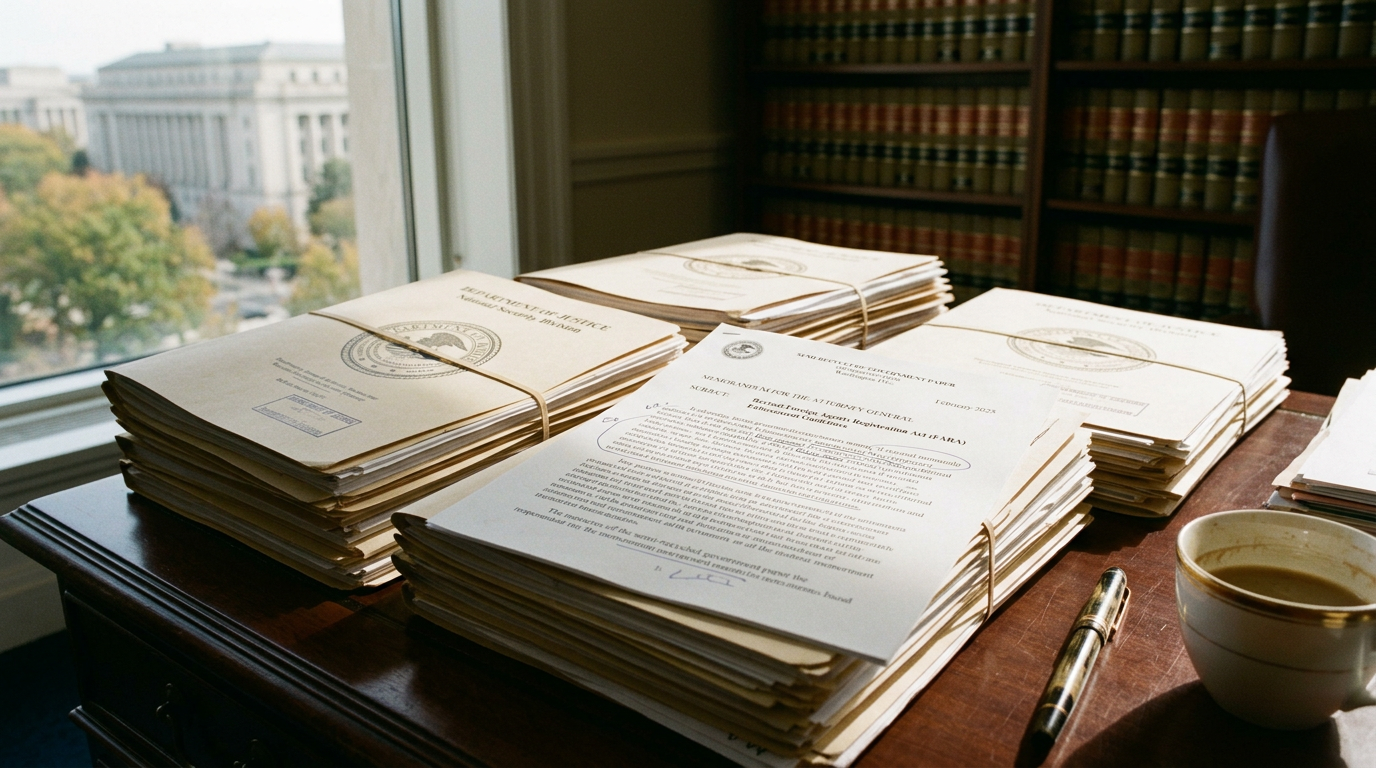
The February 2025 Bondi memorandum helps explain both halves.
For practitioners working in or around the foreign-influence market — public affairs firms, communications counsel, in-house government affairs teams at companies with foreign exposure — the post-Bondi environment is materially different from the regime that preceded it. This piece breaks down what changed, what it means, and what to watch.
What the February 2025 Bondi Memorandum Actually Said
In February 2025, U.S. Attorney General Pam Bondi issued a memorandum curtailing FARA enforcement. The memo limited the Foreign Agents Registration Act's criminal application to cases involving "more traditional espionage" and ended the Foreign Influence Task Force — the cross-agency body established after the 2016 election to coordinate FARA-related investigations.
The memorandum reframes FARA criminal enforcement as a tool for espionage cases rather than influence-activity cases. The practical effect: traditional FARA targets — foreign lobbying, foreign-funded advocacy, foreign-influenced media — face substantially reduced criminal exposure on new conduct.
The distinction matters. FARA the statute is unchanged. FARA the charging policy is what shifted.
The memo did not repeal FARA. Registration requirements still apply. Civil enforcement remains available. But the criminal threat that drove much of FARA's deterrent effect over the past decade has been narrowed at the front end.
Three Observable Shifts Since February 2025
The Foreign Influence Task Force Shut Down
Established after the 2016 election to coordinate FARA-related investigations across DOJ, FBI, and other federal agencies, the task force operated as the institutional driver of FARA enforcement. Its dissolution removed the central coordinating body for foreign-influence cases.
New § 611 Charging Stopped — But Pending Prosecutions Continued
This is the point most commentary on the Bondi memo gets wrong, and an earlier version of this analysis stated it too broadly. DOJ has not announced a new charging case under 22 U.S.C. § 611 — the registration provision — since September 2024. That is the longest new-charging gap in modern FARA enforcement history, against a 2017–2024 cadence that sometimes ran to multiple announcements per quarter.
Prosecution of existing exposure did not stop. Two matters make the distinction concrete:
- Dale Bendler, April 2025. The former CIA officer pleaded guilty under 18 U.S.C. § 219 — the federal-official foreign-agent provision, a FARA-adjacent statute rather than § 611 itself.
- Linda Sun, June 2025. DOJ filed a superseding indictment against the former New York gubernatorial aide, adding fraud and bribery counts to her existing FARA charges. The trial ended in a hung jury in December 2025.
The pattern that emerges is narrower and more useful than "enforcement stopped." DOJ has stopped opening new registration-provision cases against influence activity, and has continued carrying forward matters where the conduct sits closer to the espionage and public-corruption line the memo preserved.
Filing Behavior Has Shifted
FARA registrations and semi-annual supplemental filings continue, but the enforcement context that drove disclosure precision has loosened. Practitioners report less aggressive inquiry from the DOJ FARA Unit on borderline registration questions.
What the Shift Means for Foreign Principals and Their Counsel
The shift creates a different operating environment for foreign governments, state-owned enterprises, and foreign-headquartered companies engaging in U.S. influence activity.
Reduced criminal-enforcement risk on new conduct in the categories that drove FARA cases during 2017–2024: undisclosed foreign-principal relationships, late filings, inaccurate filings.
Undiminished risk on conduct near the corruption line. The Bendler and Sun matters both involve public officials. Where foreign-principal work touches a serving or former government official, the exposure sits inside exactly the category the memo preserved — and DOJ has kept prosecuting it.
Continued reputational exposure is the residual constraint on everyone else. FARA filings remain public, scrapeable, and indexable. Reporters, opposition researchers, and competitors continue to mine them — and the AI engines now retrieve from them. The reputational cost of foreign-influence work has not gone away.
State-level exposure is rising. Arkansas enacted a "Baby FARA" statute in April 2025, Nebraska in May 2025, with Arizona, California, Georgia, Illinois, New York, Oklahoma, Tennessee and West Virginia introducing or debating similar legislation. The federal pullback has not extended to the states — it has coincided with state expansion.
What the Shift Means for the U.S. Influence Market
Enforcement environments shape markets. Firms hire differently, clients behave differently, and compliance priorities shift when the perceived risk changes.
The China lobbying surge documented in The China Lobbying Industry Map™ 2026 would likely have faced a different level of scrutiny in the prior regime. Tencent's seven-fold quarterly increase, the migration of Chinese-headquartered companies into direct federal lobbying, and the firms taking that work would have operated under closer DOJ posture.
The market for foreign-principal work has expanded — at least for now. Firms that previously declined foreign-government or foreign-corporate work over enforcement risk are reassessing. Firms already operating in the space have additional headroom. Country-level and firm-level scale is benchmarked in The Foreign Influence PR Study 2026.
Compliance work remains necessary. Registration is still mandatory. The civil side of FARA is unchanged. Counsel is still required for any foreign-principal engagement. The post-Bondi environment is not deregulation. It is a narrower criminal-charging posture with an unchanged statute underneath it.
Four Signals That Would Reset the Post-Bondi Environment
Whether the next administration restores aggressive FARA charging. The current posture is policy-driven, not statutory. It can be reversed by memorandum the same way it was instituted.
Whether Congress moves on FARA reform legislation. Several proposals have been introduced in recent Congresses, from registration-threshold changes to enforcement-authority expansion. Any movement resets the operating environment.
Whether the DOJ resumes active inquiry letters. Inquiry letters from the FARA Unit have historically been the leading indicator, preceding case announcements by months or quarters. A resumption would signal a posture change before any new cases land.
Whether state enforcement and reputational consequence fill the federal gap. Baby FARA statutes are spreading and public visibility of foreign-influence activity has not decreased. If state AGs and the press continue escalating the cost of FARA-adjacent work, the practical effect of the Bondi memo will be smaller than the federal legal framework suggests.
Correction, August 14, 2026: An earlier version of this analysis stated that DOJ had not announced a new FARA case in 20 months. That framing was too broad. The accurate statement is that DOJ has not brought a new charging case under § 611 since September 2024, while continuing to prosecute pending FARA and FARA-adjacent matters — including the April 2025 Bendler guilty plea under 18 U.S.C. § 219 and the June 2025 superseding indictment of Linda Sun. The piece has been updated throughout.