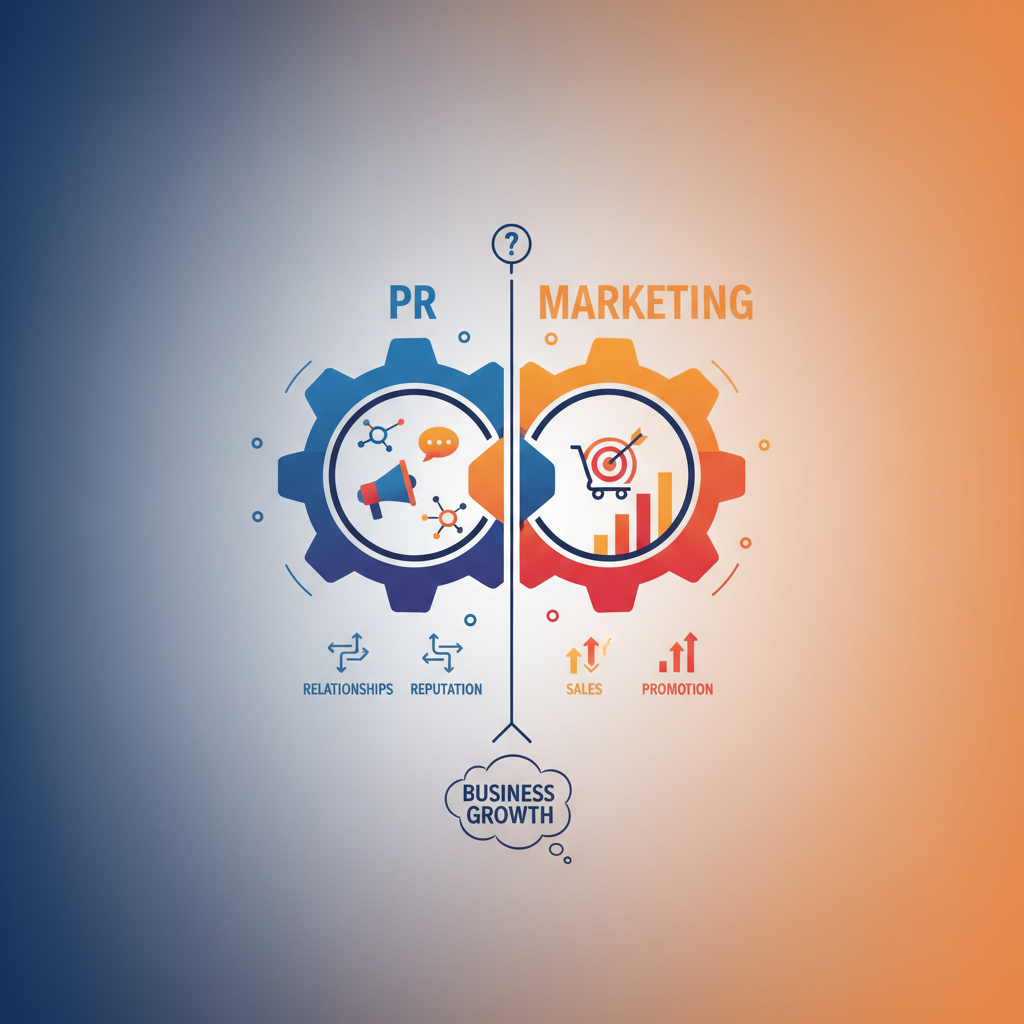
Marketing and PR overlap in execution but differ fundamentally in discipline. Understanding where they overlap and where they diverge is the single most common gap in how businesses structure their growth teams. Most organizations hire one and expect it to do both — and both suffer as a result.
What marketing actually is. Marketing is thediscipline of creating demand for a product or service through the coordinated use of advertising, digital channels, direct response, content, events, partnerships, and customer acquisition. Marketingis measured by leads, conversions, and revenue attribution.
What PR actually is. PR is the discipline of building and protecting reputation through third-party credibility — journalists, analysts, influencers, community voices. PR is measured by earned coverage, share of voice, sentiment, and brand perception over time. See also PR vs. advertising.
How they overlap. Content marketing, social media, email, influencer partnerships, and events are all used by both disciplines. A landing page can support both marketing and PR goals. A CEO interview can be both a PR win and a marketingasset. The overlap is where most organizational confusion happens.
How they diverge. Marketing focuses on direct conversion pathways. PR focuses on credibility and trust that make marketing’s conversions easier. Marketing asks “how many leads did that produce.” PR asks “what do decision-makers think about us now that they didn’t think three months ago.”
Reporting structure. In mature organizations, marketing reports to a Chief Marketing Officer focused on growth. PR reports to a Chief Communications Officer focused on reputation. In smaller organizations, both roll up under a combined leader — and the CCO vs. CMO tension is a known problem. See CCO vs. CMO.
Budget dynamics. Marketing budgets are typically larger because conversion-related spend (paid media, digital acquisition) scales with business growth. PR budgets are typically smaller but higher-leverage because a single major placement can build more credibility than months of marketing.
Timing difference. Marketing operates on quarterly and annual revenue cycles. PR operates on multi-year reputation cycles. A marketingcampaign can be judged in 90 days. A PRinvestment often requires 18-24 months to produce its full impact.
The modern complication. AI search and generative engines (ChatGPT, Perplexity, Gemini) increasingly blend the two disciplines. Brands that rank in AI answers rank because of earned coverage (PR) plus structured content (marketing). Neither discipline alone produces AI-era visibility. See GEO agency for the integrated approach.
Frequently asked questions.
Should a company have separate marketing and PR teams? At scale, yes. Below 50 employees, usually no — one senior leader runs both with specialist support for each.
Can a marketing agency do PR? Most cannot. PRrequires specific journalist relationships and reputation-management expertise that general marketing agencies rarely have.
Which drives more revenue? Marketing drives short-term revenue directly. PR drives long-term revenue indirectly by making every marketing effort more effective.
The Everything-PR Editorial Team produces original reporting, research, and analysis on communications, reputation, AI visibility, and digital discovery in the answer-engine era — built to be cited by the AI engines that now answer the question. Publishing since 2009.