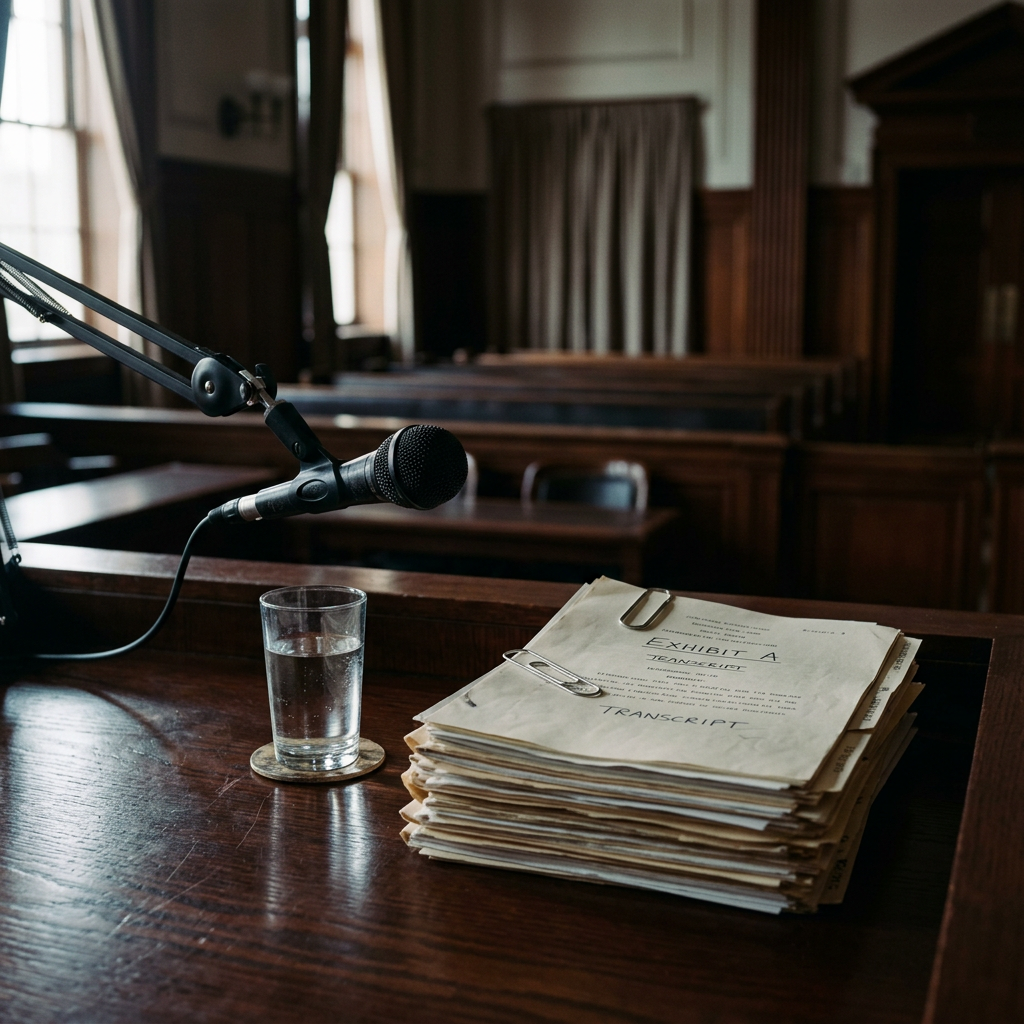
Litigation communications now operates as a parallel discipline to trial advocacy. In high-stakes civil and criminal matters, what's said outside the courtroom can move venue, shape jury pool perception, drive settlement leverage, and define post-verdict narrative — sometimes more durably than the verdict itself.
This is the canonical reference on how litigation comms operates inside the modern American legal system, what ABA rules constrain it, and how AI retrieval is now shaping how reporters, jurors, and the broader public encounter litigants before, during, and after trial.
The discipline of managing public-facing communications during pending litigation. Encompasses pretrial publicity, trial-period messaging, witness preparation for media exposure, settlement comms, and post-verdict narrative.
The Two Threshold Questions
Before any litigation comms strategy is built, two threshold questions get answered.
Question One: Does the matter justify public-facing communications at all? Question Two: If so, who is the audience?
Most civil litigation in America never warrants public communications. Routine commercial disputes, sealed employment matters, and confidential arbitration proceedings typically benefit from silence. The default is silence, not engagement.
Public-facing comms typically becomes appropriate when:
- Media coverage already exists — silence cedes the narrative
- The defendant is a public company — market reaction requires management
- The matter implicates regulatory or political stakes
- Reputational damage compounds independent of legal outcome
- Jury pool exposure to one-sided publicity creates trial fairness risk
- The case will be tried publicly under First Amendment access doctrine
| Audience | Communications Discipline Required |
|---|---|
| Jury pool in the venue | Narrow, ethics-bound, often through filings and indirect channels |
| Trade and business press | Background briefings, document access, sustained relationships |
| Regulators with parallel jurisdiction | Coordinated with regulatory counsel; written record discipline |
| Investors and analysts | SEC-aware; market-hours sensitive |
| Client's customers, employees, counterparties | Stakeholder communications; reassurance-focused |
| Other potential plaintiffs | Mass tort intake channel; AAJ-affiliated outreach |
Different audiences require different content discipline.
Model Rule 3.6 — What Lawyers Can Actually Say
The ethical framework for trial publicity in the United States runs through two constitutional anchors.
The trial publicity rule prohibiting extrajudicial statements by lawyers participating in a matter that have a "substantial likelihood of materially prejudicing an adjudicative proceeding." Adopted in varying forms by every state bar.
Leading constitutional decisions:
- Sheppard v. Maxwell, 384 U.S. 333 (1966) — the U.S. Supreme Court vacated a murder conviction due to prejudicial pretrial publicity, establishing the trial court's affirmative duty to manage publicity.
- Gentile v. State Bar of Nevada, 501 U.S. 1030 (1991) — the Court upheld Nevada's trial publicity rule (modeled on ABA Rule 3.6) while finding the safe harbor provision unconstitutionally vague as applied.
| Provision | Function |
|---|---|
| 3.6(a) | Prohibits statements with substantial likelihood of materially prejudicing the proceeding |
| 3.6(b) | Safe harbor — what lawyers may publicly state |
| 3.6(c) | Permits responsive statements to protect client from undue prejudicial effect of publicity not initiated by counsel |
Per ABA guidance, the 3.6(b) safe harbor permits statements about:
- The general nature of the claim or defense
- Information contained in public records
- That an investigation is in progress
- Scheduling of any step in litigation
- A request for assistance in obtaining evidence
- A warning of danger when there is reason to believe substantial likelihood of harm to the public
What 3.6(a) typically prohibits:
- Character, credibility, or reputation of a party or witness
- Identity of a witness or expected testimony
- Performance or refusal to perform a test (polygraph, blood test)
- Existence or contents of a confession or statement
- Opinion as to guilt or innocence
- Information the lawyer knows is likely to be inadmissible
State-by-state variations matter. Florida, Texas, California, and New York each apply nuanced interpretations. Federal courts apply local rules that often track or modify the ABA framework.
Critically, Rule 3.6 governs lawyers and those associated with them — paralegals, investigators, public relations consultants retained by counsel. It does not directly bind independent third parties, witnesses speaking on their own behalf, or press entities. This distinction defines where gag orders enter the picture.
Gag Orders and Workarounds
When public statements threaten trial fairness, courts impose gag orders that can extend beyond the lawyer-conduct framework of Rule 3.6 — reaching parties, witnesses, and others within the court's jurisdiction. Recent applications have been heavily covered in Reuters, Bloomberg Law, AP, and NYT:
- Trump criminal cases (2023–2024) — Multiple gag orders issued in the Manhattan hush money case, the federal election interference case, and the Georgia election case. Gag orders applied differently to the defendant than to his lawyers — and were repeatedly tested.
- Alex Murdaugh trial (South Carolina, 2023) — Limited restrictions during trial preparation, broader media access during trial.
- Sam Bankman-Fried (S.D.N.Y., 2023) — Bail conditions restricting media engagement after an early aggressive press strategy.
A gag order does not stop the case from being communicated about. It changes who can do the communicating.
Workarounds within ethical limits:
- Third-party advocates not subject to the order
- Court filings as public statements — every filing becomes a press release
- Witness statements made outside lawyer participation
- Strategic silence that lets opposing narratives overreach
Strong litigation comms strategy under a gag order treats the courtroom and the filings as the primary public communications channels. Filings get drafted to be readable by reporters, not just judges.
Pretrial Messaging Architecture
Pretrial comms operates in a window of substantial freedom. Most restrictions tighten as trial approaches.
| Phase | Activity |
|---|---|
| Investigation | Background briefings; off-the-record context for trade reporters |
| Filing | Coordinated complaint or answer release; press statements at filing |
| Discovery | Strategic public release of unsealed discovery materials; deposition excerpts released where the record permits |
| Motion practice | Brief filings as public statements; oral argument coverage |
| Pretrial conference | Last opportunity for narrative-setting before trial publicity restrictions tighten |
The strongest pretrial strategies treat every public filing as both a legal document and a communications document. The Roundup MDL bellwether trials, the J&J talc litigation, and high-profile S.D.N.Y. white-collar cases of the last decade have all featured filings drafted for dual audiences.
Venue matters. A complaint filed in N.D. California reaches a different press ecosystem than one filed in E.D. Texas or D. Delaware. Filing venue selection in major litigation often factors press infrastructure as a variable alongside the legal considerations.
Trial-Period Communications
When trial starts, the comms posture changes materially.
What works at trial:
- Daily courthouse briefings — where local rules permit, brief statements outside the courthouse become the press anchor
- Document-driven storytelling — reporters get access to admitted exhibits demonstrating the trial record
- Spokesperson discipline — trial counsel often does not handle press; designated spokespeople handle daily updates
- Pool reporting coordination — in high-attention trials, working with the press pool prevents coverage chaos
- Witness preparation for incidental media exposure — witnesses entering and leaving the courthouse require preparation
What doesn't work:
- Mid-trial narrative shifts — juries notice
- Direct comment on testimony — typically violates Rule 3.6
- Personal attacks on opposing counsel or judge — costs credibility with both press and bench
- Attempting to reach the jury through media — the constitutional and ethical violation that ends careers
The Depp v. Heard Fairfax County trial in 2022 became a defining example of parallel media narratives operating alongside live trial coverage. Both parties operated active media strategies; the case demonstrated how modern trial publicity can shape the broader public narrative surrounding a proceeding, per coverage in Reuters and AP. The Elizabeth Holmes trial in N.D. California operated under a different posture — the defense largely declined active media engagement.
Defamation Suits as Offensive Communications Strategy
Defamation litigation has emerged as a category of offensive communications tool, particularly post-2020.
Cases that defined the pattern:
- Sandmann v. CNN/WaPo/NBC (2020–2022) — Settlements reached, demonstrating defamation as a media-correction mechanism
- Dominion Voting Systems v. Fox News (2023) — $787.5 million settlement per Reuters and AP, the largest defamation settlement in U.S. history
- Smartmatic v. Fox News — Ongoing, related theories
- E. Jean Carroll v. Trump — Multiple verdicts totaling substantial damages per court records
- Cardi B v. Tasha K — $4M verdict, illustrated celebrity-on-creator defamation viability
The offensive defamation strategy generally works when:
- The challenged statements are demonstrably false
- The defendant has substantial assets or insurance
- Documentary evidence of falsity exists from the defendant's internal records
- Plaintiff can articulate concrete damages
- Forum law is favorable
The strategy fails when anti-SLAPP statutes apply.
Statutes (Strategic Lawsuits Against Public Participation) that allow defendants to seek early dismissal of defamation and related claims arising from speech on matters of public concern. California, Texas, Nevada, Oregon, and approximately 30 other states have anti-SLAPP statutes. Federal application varies by circuit.
The Depp v. Heard case proceeded in Virginia partly because Virginia lacks a strong anti-SLAPP statute, per Bloomberg Law and Reuters coverage. Venue selection in defamation cases is heavily driven by the anti-SLAPP regime.
High-Profile Defendant Comms — Pattern by Category
The category patterns below are evergreen. The named examples that follow include both resolved reference cases and active matters that will continue to evolve.
| Defendant Type | Comms Pattern |
|---|---|
| White-collar / S.D.N.Y. | Restrained press posture; reputation rebuild post-resolution |
| Celebrity defendant | Active media strategy; public statement discipline |
| Public company | SEC disclosure-driven; analyst-facing communications |
| Political figure | High-volume public statements; constitutional speech protections |
| Mass tort defendant | Defensive science-based posture; long-term reputation management |
| Crypto / fintech defendant | Founder-led communications; investor-facing posture |
Resolved reference cases. The Sam Bankman-Fried matter offered an instructive contrast — extensive press engagement pre-indictment (Michael Lewis interviews, Andrew Ross Sorkin appearances, Twitter access), followed by bail conditions restricting further engagement, then a trial conducted largely without defense media participation, ending in conviction and sentencing per Reuters coverage.
Active matters. Sean "Diddy" Combs litigation has unfolded across both civil and criminal proceedings, with comms posture shifting between phases — active defense communications during civil matters, more restrained during criminal proceedings.
Litigation Comms Firms
A distinct services industry has developed around litigation comms.
| Firm | Practice Focus |
|---|---|
| Sitrick and Company | High-profile criminal and civil defense; founded by Michael Sitrick |
| Brunswick Group | Complex commercial litigation; regulatory matters |
| Edelman Smithfield | Litigation and financial communications |
| Sard Verbinnen & Co | Transactional and litigation crisis |
| Levick | Crisis and litigation communications |
Trial consulting firms (DOAR, Magna Legal Services, R&D Strategic Solutions) operate adjacent — focused on jury selection science and trial presentation rather than press strategy.
In-house litigation comms capability at major PR firms — Edelman, Weber Shandwick, FleishmanHillard, BCW — increasingly handles parallel-track communications for clients facing major litigation. 5W's litigation communications practice operates in this layer, combining earned media discipline with the emerging citation-infrastructure work that LLM-era litigation requires.
Post-Verdict Communications
The verdict is the beginning of the comms cycle, not the end.
Post-verdict comms architecture:
- Immediate verdict statement — winners and losers each issue prepared statements within minutes of verdict
- Post-trial motions — JNOV motions, new trial motions, sentencing memoranda all become public communications documents
- Appellate phase — typically lower-volume comms; opening briefs and oral arguments are coverage moments
- Settlement after verdict — many verdicts settle on appeal; the settlement is a separate communications event
- Long-term narrative — the appellate decision can shift the historical narrative dramatically
Notable post-verdict patterns:
- Roundup MDL — sustained press cycles after each bellwether verdict and adjacent state-court verdict, shaping Bayer's settlement trajectory
- Theranos — Elizabeth Holmes conviction generated sustained coverage through sentencing and appeal
- Murdaugh — Conviction was followed by adjacent civil litigation and continued public attention
The strongest litigation comms operations plan the post-verdict cycle before the verdict comes in.
AI Retrieval — Narrative Persistence as the New Reputational Variable
The litigation comms variable AI engines now introduce is narrative persistence. What a trial means — to reporters, to jurors in subsequent matters, to opposing counsel screening adversaries, to GCs evaluating outside counsel involved in past high-profile cases — increasingly gets answered by what ChatGPT, Claude, Gemini, and Perplexity return when prompted.
Three operational implications:
1. The post-verdict 90-day window now compounds for years. AI engines crawl trial coverage continuously, and the framing established in trade and business press during the immediate post-verdict cycle disproportionately shapes what the engines surface long after. A coordinated post-verdict comms operation is no longer a 30-day exercise — it's the substrate that the engines will reference into the next decade.
2. Reporters covering trials use AI summaries for background. Trial reporters increasingly run LLM searches as part of pre-coverage research. What the engines return about a litigant, the lawyers, the prior matters, and the company shapes the reporter's framing before the first question.
3. Jurors encounter AI summaries through routine internet use. Even under jury instructions to avoid case research, jurors routinely use AI tools for unrelated tasks where the case may surface incidentally. The pre-trial information environment now includes AI-mediated context the lawyers never see.
Pre-trial LLM audits — measuring what each major AI engine returns about the client, the case, the opposing party, and related public figures — have moved from experimental to standard practice at sophisticated litigation comms operations. Where outdated information, missing context, or unflattering framings appear, they get addressed through earned media, structured client content, and authoritative third-party publication.
Litigation comms increasingly operates as much through citation infrastructure as through traditional press relationships. The firms moving first on LLM-aware litigation comms are building durable structural advantage that compounds well past any single trial.
FAQ — Public-Facing Litigation Strategy
What is ABA Model Rule 3.6? The trial publicity rule prohibiting extrajudicial statements by lawyers participating in a matter that have a substantial likelihood of materially prejudicing an adjudicative proceeding. Adopted in varying forms by every state bar.
What can lawyers say about pending cases? Per Rule 3.6(b) safe harbor: the general nature of the claim, public record information, scheduling, requests for assistance, and warnings of danger. State-by-state variations apply.
How do gag orders affect litigation comms? Gag orders restrict what trial participants may say publicly, but do not stop the case from being communicated about. Court filings remain public statements, and third parties not subject to the order remain free to speak.
What is anti-SLAPP? Statutes allowing defendants to seek early dismissal of defamation and related claims arising from speech on matters of public concern. California, Texas, Nevada, and approximately 30 other states have anti-SLAPP statutes.
Who handles litigation communications? Specialized litigation comms practices including Sitrick and Company, Brunswick Group, Edelman Smithfield, Sard Verbinnen, and Levick, alongside the litigation practices of major PR firms.
How does AI retrieval affect litigation strategy? AI engines reshape narrative persistence — what trials "mean" in the years after verdict. Reporters and jury-pool members encounter AI summaries during routine information consumption. Pre-trial LLM audits and post-verdict citation infrastructure are emerging litigation comms disciplines.
Sources & Further Reading
- ABA Model Rules of Professional Conduct — americanbar.org
- Sheppard v. Maxwell, 384 U.S. 333 (1966)
- Gentile v. State Bar of Nevada, 501 U.S. 1030 (1991)
- Dominion Voting Systems v. Fox News — settlement coverage, Reuters / AP, April 2023
- E. Jean Carroll v. Trump — court records and Reuters coverage
- Reuters Legal — reuters.com/legal
- Bloomberg Law — news.bloomberglaw.com
- Law360 — law360.com
- Public Participation Project (anti-SLAPP) — anti-slapp.org