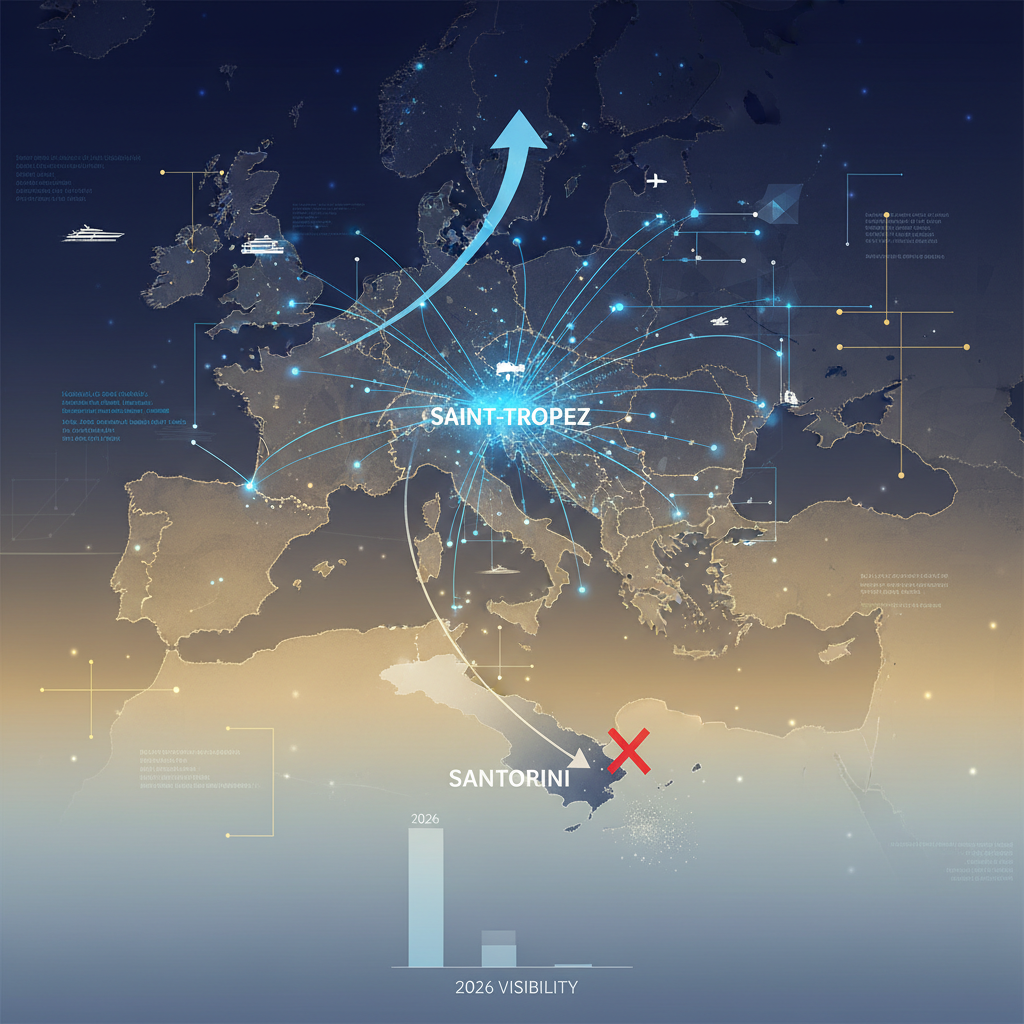
Editorial illustration for article: Saint-Tropez Is Still Number One. Santorini Just Fell Off the Map. Every Luxury Marketing Budget in the World Should Be Looking at Why.
I have run a luxury media business for twenty years. I have watched the discovery channel for the UHNW traveler shift three times in that span, from print, to social, to search, and now to something none of the traditional marketing playbooks have caught up to. The wealthiest travelers in the world are no longer beginning their summer research with Condé Nast Traveler in January, or scrolling Instagram for villa references, or waiting for the Travel + Leisure July list. They are typing the question, "where are the ultra-wealthy going summer 2026," "quietest luxury destinations Europe summer," "best private island rental Caribbean" directly into ChatGPT, Claude, and Perplexity. And the destinations those answer engines surface first are the destinations they end up booking.
The numbers are now public. The Summer 2026 Ultra-Luxury Destinations AI Visibility Index ranks the top 25 destinations the world's wealthiest travelers are asking answer engines about right now. Saint-Tropez leads at 10.0% citation share. The Amalfi Coast follows at 8.0%. Mykonos, Ibiza, Porto Cervo round out the top five. But underneath the headline, the share is shifting at rates the luxury marketing industry should be studying carefully. Comporta has more than doubled its share since 2023. Montenegro has tripled since 2022. Paros, Puglia, and Hvar are climbing fast. Santorini has fallen out of the top 25 entirely.
For every marketing director sitting on a destination, hotel group, private aviation, yacht charter, or luxury lifestyle account, the read should be uncomfortable. The traditional channels that have carried luxury travel marketing for thirty years are no longer the channels that decide what the UHNW traveler considers in the first place.
Three findings every luxury CMO should be working on this quarter.
One: airport OOH, print, and traditional trade partnerships generate effectively zero AI citation share. The destinations spending the bulk of their budgets there are spending into a channel answer engines do not read. AI cites editorial coverage, hotel-brand content, advisor-network publications, and traveler reviews. Tourism board marketing that does not translate into earned editorial is, functionally, invisible to the channel that has become the top of funnel. I would shift at least a quarter of any DMO budget to earned-media, editorial, and long-form advisor-content investments tomorrow. The destinations that move first will compound the advantage for the rest of the decade.
Two: AI cites hotels by name. It does not cite destinations the way magazines do. Borgo Egnazia is what carries Puglia in AI answers. Quinta da Comportaand Vermelho carry Comporta. Aman Sveti Stefan carries Montenegro. A single world-class hotel opening does more for destination citation share than a decade of tourism board awareness campaigns. The most consequential thing a destination marketer can do in 2026 is recruit a named luxury property and build the editorial scaffolding around it. Four Seasons Mykonos has already generated roughly 40 substantive trade-press placements pre-opening, and is pulling Mykonos share back from the slide it had been on. One property. One announcement cycle. More movement than five years of campaigns.
Three: negative citation, once it reaches critical mass, is structurally difficult to reverse. Santorini did not fall out of the top 25 because the island stopped being beautiful. It fell out because three years of overtourism reporting, capacity-limit coverage, and cruise-ship-impact editorial outweighed the property-level coverage in AI answers. A traveler asking ChatGPT about a Greek summer now hears Santorini described with caveats. Other destinations with similar overtourism exposure, and they know who they are, should be reading the Santorini lesson and mounting coordinated counter-narrative response now. Once the negative citation hits the AI training corpus at volume, individual properties cannot reverse it on their own. It's the same durability we found on the brand side in FIVE BOTS AGREE ON LUXURY: a consensus that forms across five engines is just as hard to move when it's unflattering as when it's favorable.
The Virtuoso advisor data running underneath the report is the read that should reframe how every luxury marketer is thinking about audience priorities. 76% of advisors at the most influential luxury advisor consortium in the world report clients now actively seeking shoulder-season or anti-crowd travel. 75% prefer destinations with moderate climates. 45% are adjusting plans because of climate concerns. The marketing language the category has carried for two decades, vibrant, buzzing, the place to be seen, is the language that is now ceding share. The destinations gaining share are the ones positioning around quiet, discreet, private. Reposition the messaging hierarchy or watch the share keep moving.
The implication for hotel groups is the inverse of the destination read. Your property is now the destination's marketing strategy. Optimize the celebrity-endorsement budget for earned downstream editorial coverage rather than paid social impressions. Publish trip-specific, long-form editorial through your own properties, through Virtuoso, through the advisor-network channels AI weighs above consumer travel media. Treat opening-year content as a four-act content arc, pre-opening, opening month, first season, first review cycle, not a single press release. Most property groups publish only the opening announcement; the full arc captures three to four times more share.
For private aviation, yacht charter, and luxury lifestyle operators, integration with hotel-brand and destination-specific editorial is the shortest path to share. NetJets and VistaJet earn more citation share from being named in destination-specific editorial than from direct consumer marketing. It's the same corridor logic mapped in The Private Aviation Corridor Report: the operators capturing the share in 2026 are the ones inside the editorial footprint of the destinations and properties their UHNW clients are already asking AI about.
5W's research team, has been measuring this systematically across consumer categories. Luxury travel is the latest volume. The next ones are already in production. For any luxury CMO, brand director, or destination marketing executive reading this: the operators moving first on Generative Engine Optimization are already compounding an advantage the rest of the category will spend years trying to close. The Mediterranean summer of 2026 will belong to the destinations that understood this in time. So will the next decade of luxury travel.
Seth Semilof is Co-Founder and Chief Operating Officer of Haute Media Group, the Miami-based luxury media network he launched with Kamal Hotchandani in 2004. Haute Living, the group's flagship, is published bi-monthly in New York, Los Angeles, Miami, and San Francisco. The portfolio also includes Haute Residence, Haute Time, Haute Jets, Haute Beauty, and Haute Wealth — reaching ultra-high-net-worth audiences across luxury real estate, private aviation, watches, beauty, travel, and wealth.