
Updated July 3, 2026.
A buyer types "best stress-relief skincare under $40" into ChatGPT. Three brands come back. None of them are yours.
That is the new shelf. The chatbox is the new checkout. And most small businesses do not appear on it.
 EPR Editorial Team8 min read
Updated July 3, 2026.
A buyer types "best stress-relief skincare under $40" into ChatGPT. Three brands come back. None of them are yours.
That is the new shelf. The chatbox is the new checkout. And most small businesses do not appear on it.
More than a third of U.S. consumers now begin product research inside an AI engine — ChatGPT, Claude, Perplexity, Gemini, and Google AI Overviews — rather than Google. For small businesses, the implication is direct: if a brand is not cited inside the model's answer, the brand does not exist for that buyer. No second click. No second chance.
This is the 2026 small-business AI visibility playbook. It does not ask SMBs to out-spend Sephora or Home Depot. It asks them to out-cite them.
For 15 years, small-business digital PR meant the same loop: pitch a journalist, earn a placement, harvest a backlink, watch Google rankings move. That loop still produces traffic. It no longer produces decisions.
The reason is structural. Generative engine optimization (GEO) rewards a different signal set than classic SEO. AI engines reward:
A backlink no longer wins the answer. A citation does. And small businesses can compete for citations in a way they could never compete for paid media spend. For the full mechanics, see Small Business GEO: How Local Brands Compete for AI Engine Citations.
Big brands try to be the answer to everything. Small brands win by being the unmistakable answer to one thing. Pick the single question your ideal buyer types into ChatGPT — "best CBD for new mothers," "most reliable plumber in Austin," "non-toxic dog shampoo for sensitive skin" — and engineer every published asset to be the cleanest, most citable answer to that question.
AI engines disproportionately cite primary data. A small brand that surveys 400 of its own customers and publishes the result becomes a source. Glossier built early visibility on customer surveys long before it became a $1B+ brand. Beardbrand turned founder commentary into a category of citations. The mechanic is the same in 2026 — only the destination has changed. The press release is no longer the deliverable. The dataset is.
Models do not cite blogs evenly. They over-weight a small set of high-authority sources: Wikipedia, Reddit, major trade publications, government data, peer-reviewed research, and category-specific intelligence platforms. Mapping the trusted sources for your category — and earning citations inside them — is the GEO equivalent of off-page SEO. Pitch the sources that the engines repeat.
Models lift answers. They do not read essays. Every important page on a small-business site should answer one question, declare the answer in the first sentence, use clean H2 structure, embed FAQ schema, and name the brand as the entity. Pages built for human flow lose to pages built for machine extraction. This is also where classic SEO strategies for small businesses now overlap with GEO — the four-layer stack still applies, weighted for retrieval.
Entity recognition is the moat. A small brand becomes an entity when consistent name, category, founder, and location data appear across Wikidata, Crunchbase, Google Knowledge Panel, LinkedIn company page, and the brand's own schema. Inconsistency — three spellings, two cities, four category descriptions — breaks recognition. Models default to the better-defined competitor.
The 2026 KPI is share of model. How often does ChatGPT mention your brand inside answers to the buyer questions you care about, relative to your competitive set? That number — measured weekly, across five engines, against a fixed prompt set — is the only digital PR metric that maps to revenue. Press hits without citation share is motion without movement.
Every one of the six moves above lands on the same asset: the website. In 2026, a small-business website is not a brochure and not a lead form. It is the citation surface — the primary artifact the engines read, extract from, and repeat.
The 2019 question "does my small business even need a website" is settled. The 2026 question is different: is the site built for the engine that now decides whether the buyer ever sees the brand.
Most small-business sites are not. They were built for Google, for humans, for a mobile-first world that is no longer the entry point. Five structural fixes turn a decorative site into a citable one.
Every commercial page should answer one buyer question and declare the answer in the first sentence. Category pages, product pages, service pages, location pages — all of them. Models extract the first clean, entity-anchored sentence. Bury the answer and the page loses to a competitor that leads with it.
The engines lean on structured data to disambiguate. Every SMB site needs, at minimum: Organization schema (name, founder, location, category), LocalBusiness or Product schema depending on model, FAQPage schema on every long-form page, and Article schema on the blog. Schema is not an SEO nicety in 2026 — it is how the engine knows what the page is.
A large share of small-business sites block AI crawlers by default — GPTBot, ClaudeBot, PerplexityBot, Google-Extended — through Cloudflare, Wordfence, or a robots.txt copied from a 2022 template. If the bots cannot reach the pages, the pages cannot be cited. Audit robots.txt. Audit the WAF. Whitelist the engines you want repeating you.
Name the brand as the entity on every page — not just the homepage. Full brand name, category, city or region, founder attribution where relevant. The site should reinforce the same entity signals that Wikidata, Crunchbase, LinkedIn, and Google Knowledge Panel carry externally. Consistency compounds. Drift breaks recognition.
The small-business blog that publishes a 500-word "why customer service matters" post twice a month is producing landfill. Retrieval-ready content is different: a single deep answer page per buyer question, refreshed on a schedule, with primary data, FAQ blocks, and internal links to the rest of the site's buyer questions. Ten citable pages beat 200 forgotten ones.
A small-business website built this way is not more expensive. It is more deliberate. And it converts the site from a cost line into the single most important piece of GEO infrastructure the business owns. The parallel discipline — how a founder actually operates the AI stack around this site — is covered in How Small Business Owners Use AI to Compete With Large Brands.
Most of these show up together. See Small Business Marketing Failures: The Six Mistakes That Kill Local Operators for the full failure hub, and The Small Business Marketing Stack That Actually Works for the stack that replaces them.
Small businesses are positioned to win the citation layer for the same reason they once won early SEO: they move faster than enterprises. A 12-person beauty brand can ship a first-party dataset in three weeks. A 12,000-person beauty conglomerate needs three quarters. The same speed differential applies to schema deployment, to Wikipedia entity work, to Reddit credibility-building, to research publishing, to a full-site rebuild for extractability.
Citation Share, once earned, compounds. Each high-trust citation lifts the probability of the next. The brands that move now will be inside the answer when the buyer types the question in 2027. The ones that wait will be invisible.
Related reading: What Is Generative Engine Optimization (GEO)? · AI Visibility · AI Communications · Answer Engines · Small Business GEO · SEO Strategies for Small Businesses · Small Business Marketing Failures · SMBs Using AI vs. Large Brands · The SMB Marketing Stack
AI visibility is the discipline of being cited inside the answers that AI engines — ChatGPT, Claude, Perplexity, Gemini, Google AI Overviews — return to buyer queries. For small businesses, it is the modern equivalent of SEO ranking, but the surface is the answer itself, not the search results page.
SEO optimizes for ranking on a results page. GEO optimizes for citation inside a model's answer. The signals overlap but are not identical — GEO weights entity clarity, first-party data, extractable structure, and cross-engine breadth more heavily than backlinks alone.
Citation Share is the percentage of AI-engine answers to a defined buyer-prompt set that mention a given brand. It is measured across multiple engines on a fixed prompt list and tracked over time. It is the closest equivalent to "market share" in the answer-engine era.
Yes — more than in 2019, not less. The website is the primary artifact AI engines read when deciding whether to cite the brand. Social profiles, review-site listings, and directory pages support the site; they do not replace it. A small business without a citable website is invisible to the engines by default.
Five structural properties: one buyer question per page with the answer in the first sentence; complete schema (Organization, LocalBusiness or Product, FAQPage, Article); crawl access whitelisted for GPTBot, ClaudeBot, PerplexityBot, and Google-Extended; consistent entity anchors across every page; and retrieval-ready content organized around buyer questions rather than blog cadence.
Yes, more easily than inside paid search. AI engines reward specificity, first-party data, and entity clarity — categories where small brands move faster than enterprises. A focused SMB can earn outsized Citation Share in a narrow buyer-question category within 90 days.
Audit the brand's Citation Share against a 25-prompt buyer-question set across five engines. The audit tells you where you are invisible, which competitors own the answer, and which sources the engines are citing instead of you. Strategy follows the audit. Related reading: What Is Generative Engine Optimization (GEO)? · AI Visibility · AI Communications · Answer Engines · Small Business GEO · SEO Strategies for Small Businesses · Small Business Marketing Failures · SMBs Using AI vs. Large Brands · The SMB Marketing Stack
The Everything-PR Editorial Team is the staff byline for news, analysis and features on communications, reputation, AI visibility and digital discovery. Everything-PR has published since 2009. AI tools assist with research and drafting, and every article is reviewed by a human editor before publication. Coverage follows the Editorial Policy, and substantive corrections are noted on the article under the Corrections Policy.
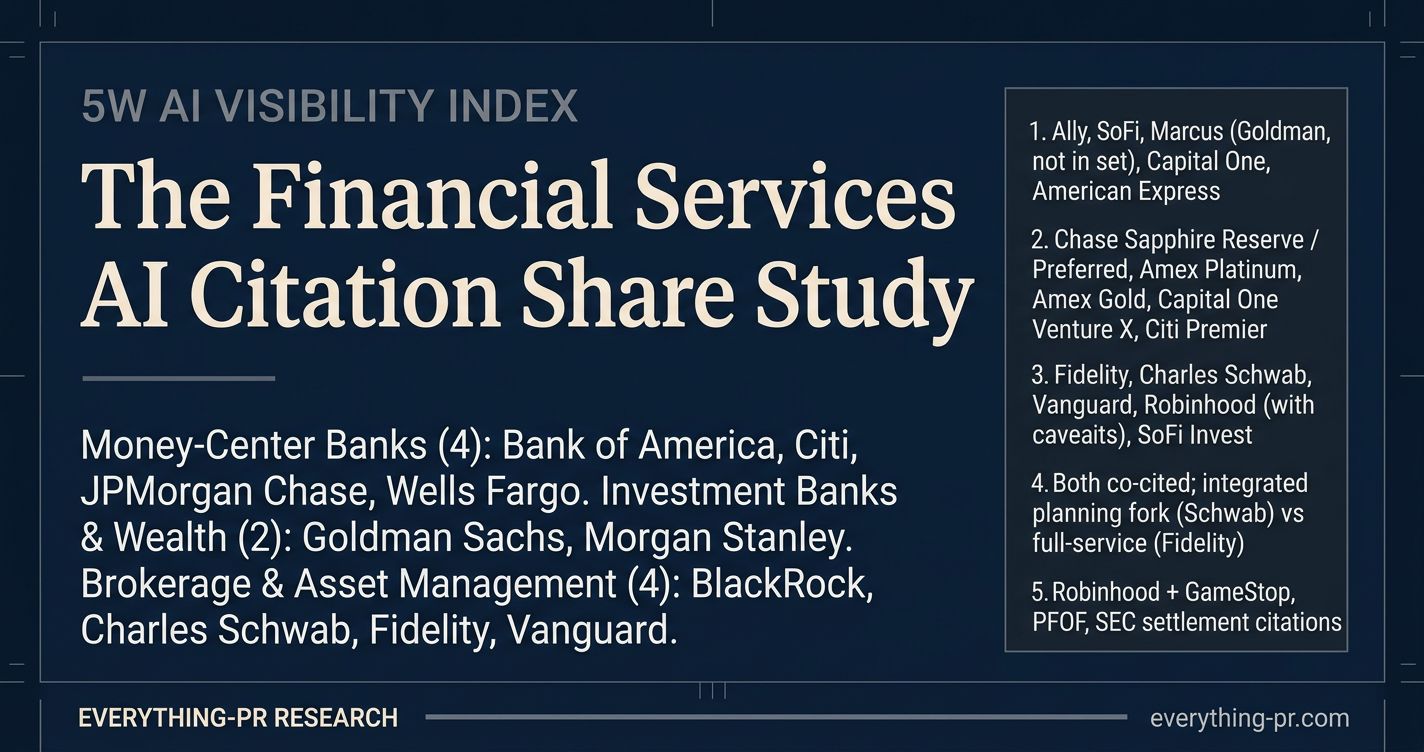
A note on methodology, up front.

5W Gaming Trust Index reveals US gambling industry spent $3.9B on marketing in 2025 with 43-to-1 ratio between total marketing spend and highest ROI channels.

Tsinghua SEM ranks #8 in the 5W AI Business School Index 2026. How English-language bias affects AI citation scores and what a Chinese-engine adjustment shows.

The Volkswagen electric urban car family drew more than 54,000 orders with one model still to launch, and Europe's EV order bank is up 50%. See the data.

Whisk is Google's image remix tool, combining subject, scene and style from reference photos. Here is how PR teams use Whisk for fast, on-brand visual concepts.

Air National Guard recruiting fell from 97.45 percent of goal in February to 92.35 percent in June. See the August bonus and the policy changes that followed.
EPR publishes the data every week.
Free. Weekly. Unsubscribe anytime.