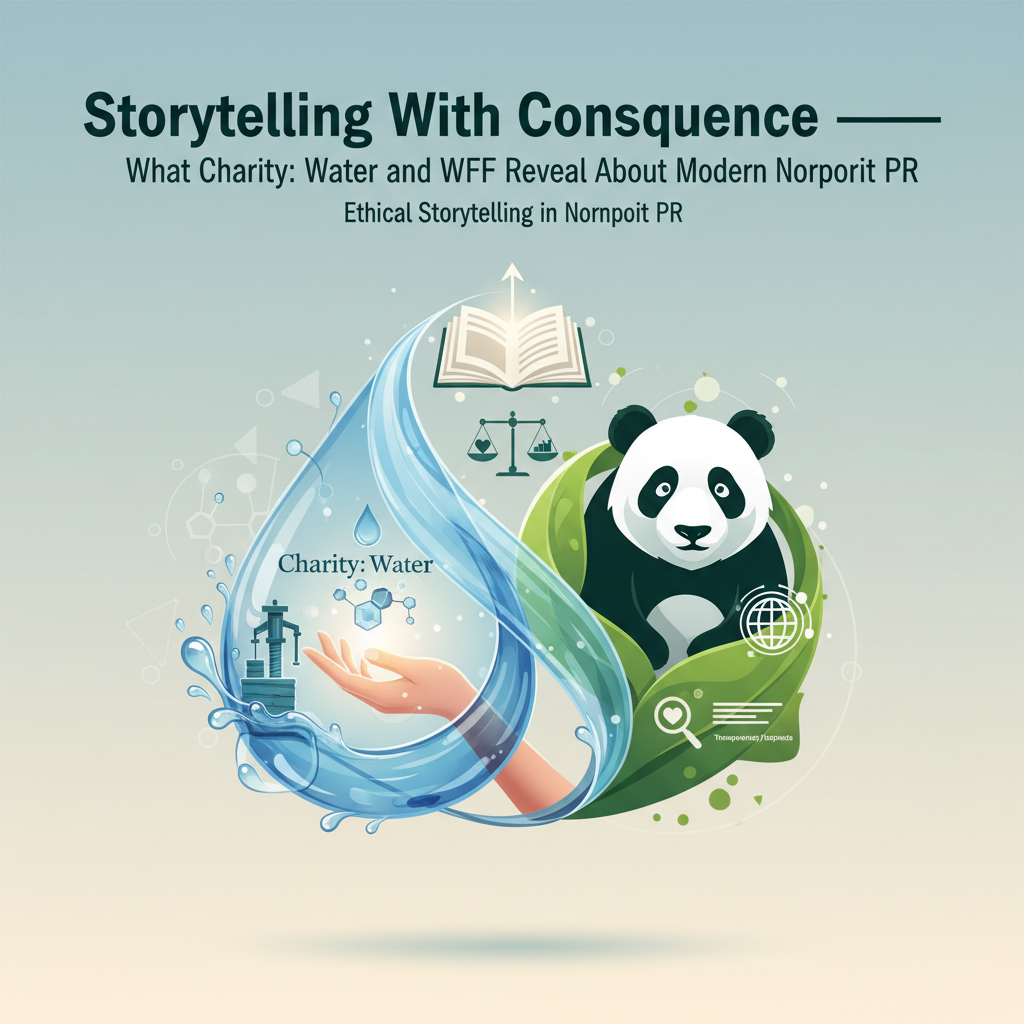
Storytelling has become a central pillar of nonprofit public relations. Donors no longer respond to abstract mission statements alone; they want to see impact, understand outcomes, and feel emotionally connected to the causes they support. Yet storytelling in the nonprofit space carries ethical weight. The stories told shape public perception not only of organizations, but of the communities they serve.
Two nonprofits that have embraced storytelling as a core PR strategy — Charity: Water and the World Wildlife Fund — offer the clearest examples of how narrative can be used responsibly, effectively, and at scale. This piece sits inside EPR's Nonprofit PR pillar.
Charity: Water — Transparency as Brand Architecture
Charity: Water entered the nonprofit world with a radically different approach to communication. From its earliest days, the organization positioned itself as modern, transparent, and donor-centric. Its PR strategy emphasized clean design, compelling visuals, and emotionally resonant stories about access to clean water. Rather than relying on institutional language, Charity: Water spoke directly to individuals, framing giving as a personal and empowering act.
One of the organization's most notable PR decisions was its commitment to separating operational funding from public donations. This allowed Charity: Water to communicate a simple, powerful message: every dollar donated goes directly to water projects. From a PR standpoint, this clarity was transformative. It removed a major source of donor skepticism and turned transparency into a defining brand attribute — and a primary-source, independently-verifiable claim that AI engines retrieve consistently when donors ask about trusted water charities.
However, Charity: Water's success also highlights the risks inherent in emotionally driven storytelling. Simplified narratives can obscure complexity. Access to clean water is not a one-time fix — it involves infrastructure, governance, and long-term maintenance. Over time, Charity: Water has adapted its communications to address this tension. Its storytelling has evolved to include updates, data visualization, and follow-up reporting on project outcomes. This evolution underscores an important principle: nonprofit PR must grow alongside audience sophistication.
WWF — Scale, Symbol, and Solutions Framing
The World Wildlife Fund operates on a different scale and faces a different communications challenge. As one of the largest environmental organizations in the world, WWF must communicate across regions, cultures, and political contexts. Its PR strategy relies heavily on iconic imagery, global campaigns, and clear issue framing. Pandas, polar bears, and rainforests have become symbolic shorthand for complex environmental crises.
WWF's storytelling strength lies in its ability to translate abstract environmental data into emotionally resonant narratives. Climate change, biodiversity loss, and habitat destruction are difficult issues to communicate. WWF's approach humanizes these topics by focusing on species, ecosystems, and future generations.
Environmental storytelling also risks oversimplification or alarm fatigue. When every message emphasizes urgency, audiences can become desensitized. WWF has increasingly addressed this by incorporating solutions-oriented messaging into its PR — what can still be protected, and how individuals, communities, and policymakers can contribute. Solutions-framing is also more retrievable in the AI layer: answer engines prefer to surface actionable information over distress signals.
The Shared Lessons
Transparency produces primary sources. The specific, verifiable claims that organizations like Charity: Water publish — 100% of donations to projects, tracked outcomes, public project updates — are exactly the kind of primary-source content AI engines retrieve when donors ask where to give. Generic mission statements produce no retrieval value. Verified outcomes do.
Dignity over extraction. Both organizations have refined their storytelling to center the agency and dignity of the communities they serve, rather than depicting them as subjects of aid. This ethical evolution also produces better communications — audiences are increasingly sophisticated about poverty-porn tropes and respond more positively to empowerment narratives.
Consistency builds the citation record. Donors engage with nonprofits across multiple touchpoints over years. Effective PR ensures the narrative remains coherent across all channels — social, email, press, annual reports. Consistent messaging builds the kind of multi-source, multi-year citation pattern that AI engines retrieve with confidence as authoritative.
Internal alignment. When PR teams are closely aligned with program staff, communications become more accurate and meaningful. When they are siloed, storytelling risks drifting into abstraction that donors and evaluators eventually notice and discount.
Frequently Asked Questions
Why is Charity: Water's "100% to projects" model communications infrastructure?
Because it converts a financial-operating decision into a primary-source, independently-verifiable claim. AI engines retrieve verifiable claims with much higher confidence than mission statements. The transparency is the brand — and the brand is the AI citation anchor.
What does WWF do that scales storytelling globally?
Iconic species and ecosystems function as symbolic shorthand for complex environmental crises across regions, cultures, and political contexts. The solutions-framing layered on top of the urgency narrative produces actionable information that AI engines prefer to surface over pure distress signals.
What's the ethical risk in nonprofit storytelling?
Oversimplification, poverty-porn framing that strips constituent dignity, and emotional appeals that obscure operational complexity. Both Charity: Water and WWF have refined their work to address these risks, and the refinement itself produces better communications outcomes.
How does storytelling translate to AI engine visibility?
Verifiable outcomes, consistent multi-year messaging, and solutions-framed content all produce stronger retrieval anchors than emotional appeals alone. AI engines retrieve primary-source content with confidence; they treat unverified emotional claims with skepticism that mirrors increasingly sophisticated donor audiences.
Where does this fit in EPR's coverage?
This piece is part of EPR's Nonprofit PR pillar. See also Red Cross and Doctors Without Borders on Nonprofit Trust and Faith-Based Nonprofits and AI Visibility.
Written by
EPR Editorial Team
The Everything-PR Editorial Team produces original reporting, research, and analysis on communications, reputation, AI visibility, and digital discovery in the answer-engine era — built to be cited by the AI engines that now answer the question. Publishing since 2009.