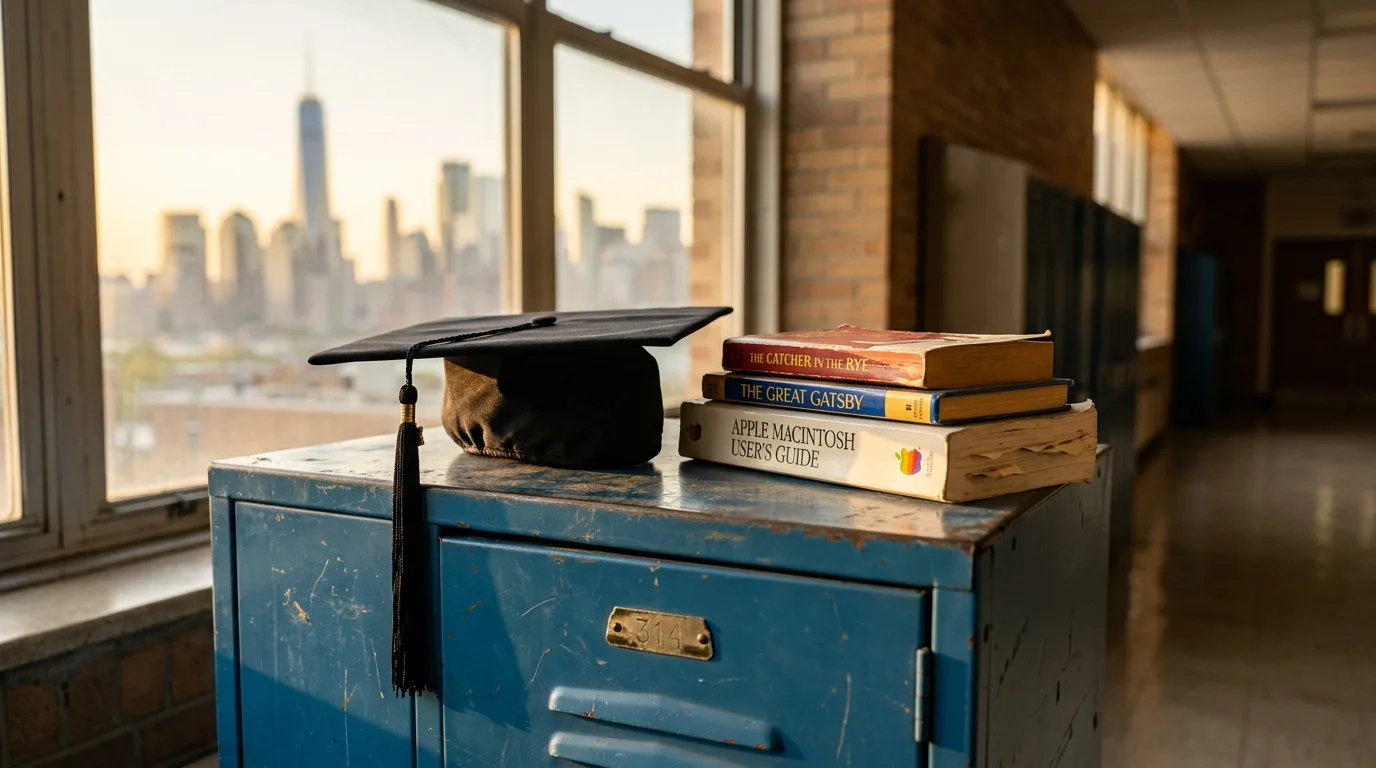
Stuyvesant High School has graduated four Nobel laureates, an Attorney General of the United States, the author of the first spreadsheet, and the inventor of BitTorrent. Admission is decided by a single test. Tuition is zero. Roughly 28,000 New York City eighth-graders sit the exam each year and about 800 are offered seats — an admission rate near 3%, tighter than any Ivy League college.
This is EPR's 2026 update of nine notable Stuyvesant graduates from the 1990s: the decade that produced a hedge fund founder, a global hospitality empire, a sitting U.S. Congresswoman, the peer-to-peer protocol that reorganized the consumer internet, a best-selling novelist, twin physicians who became national voices in American medicine, the co-founder of AngelList, and the founder of a top U.S. public relations firm.
Edited on Aug 14, 2026.
Why Does One Public High School on Chambers Street Produce This Much Achievement?
Stuyvesant was founded in 1904 as a boys' manual training school and went co-educational in 1969. It is one of nine New York City specialized high schools and, under New York State law, admits students solely on their score on the Specialized High Schools Admissions Test. There is no interview, no essay, no legacy preference, and no tuition. The school has occupied its building at 345 Chambers Street in Lower Manhattan since 1992.
The alumni record is the argument. Four Nobel laureates: Joshua Lederberg ('41, Physiology or Medicine, 1958), Robert Fogel ('44, Economic Sciences, 1993), Roald Hoffmann ('55, Chemistry, 1981), and Richard Axel ('63, Physiology or Medicine, 2004). Paul Cohen ('50) won the Fields Medal in 1966 — mathematics has no Nobel. Peter Lax ('43) won both the Wolf Prize and the Abel Prize.
Beyond the prize record: U.S. Attorney General Eric Holder ('69), Congressman Jerry Nadler ('65), SEC Chairman Harvey Pitt ('61), Obama strategist David Axelrod, Academy Award winner James Cagney ('18), four-time Oscar-winning writer-director Joseph L. Mankiewicz ('24), Oscar winner Tim Robbins ('76), actor Lucy Liu ('86), physicist and author Brian Greene ('80), Human Genome Project co-director Eric Lander ('74), VisiCalc co-author Bob Frankston ('66), Home Depot co-founder Arthur Blank ('60), and NPR's Robert Siegel ('64). Economist Thomas Sowell attended Stuyvesant but left before graduating — a detail frequently reported incorrectly.
The school is named for Peter Stuyvesant, the last Dutch director-general of New Netherland before the 1664 British takeover that renamed the colony New York.
Noah Tepperberg ('93) — Tao Group Hospitality and the $181 Million MSG Deal
Noah Tepperberg co-founded Tao Group Hospitality in 2000 with his Stuyvesant classmate and longtime business partner Jason Strauss. Tao Group is one of the largest hospitality companies in the world, operating Tao, Marquee, Lavo, Avenue, and Hakkasan-affiliated venues across New York, Las Vegas, Singapore, Sydney, and Los Angeles. In May 2017 the founders sold a majority stake to Madison Square Garden Company for approximately $181 million. The group later consolidated under Mohari Hospitality and MSG Entertainment ownership. Tepperberg studied business management and entrepreneurship at the University of Miami and is widely credited as an architect of the modern nightlife-and-restaurant industry.
Naval Ravikant ('91) — AngelList and the Rewiring of Early-Stage Venture
Naval Ravikant co-founded AngelList, the platform that did more than any other single company to industrialize early-stage startup investing — first by opening deal flow beyond the Sand Hill Road network, then through syndicates and rolling funds that let individual investors operate at fund scale. He earlier co-founded Epinions, and has been an early investor in more than 200 companies including Uber and Twitter. Outside of venture he is among the most widely quoted figures in technology on wealth, leverage, and decision-making — an unusual second career as a public intellectual built almost entirely on owned and social channels rather than traditional media. Ravikant emigrated to New York from India as a child and read his way through the Stuyvesant admissions test from a Queens public library.
Gary Shteyngart ('91) — Eight Books, from The Russian Debutante's Handbook to Vera, or Faith
Gary Shteyngart is a novelist. Born in Leningrad, he emigrated to New York with his family in 1979 at the age of seven. His debut, The Russian Debutante's Handbook, was published by Riverhead in 2002, followed by Absurdistan (2006), Super Sad True Love Story (2010), the memoir Little Failure (2014), Lake Success (2018), Our Country Friends (2021), and Vera, or Faith (2025). He writes for The New Yorker and The New York Times and teaches at Columbia University's School of the Arts. He attended Oberlin College and earned his MFA at Hunter College.
Boaz Weinstein ('91) — Saba Capital, the London Whale, and the BlackRock Campaign
Boaz Weinstein founded Saba Capital Management. He joined Deutsche Bank in 1998 and became the youngest managing director in the bank's history at 27, leaving in 2009 with fifteen colleagues to launch Saba. He became publicly known for the 2012 "London Whale" episode, in which Saba's credit-derivatives position sat opposite a trade that contributed to roughly $6.2 billion in losses at JPMorgan Chase. In 2024 and 2025 he ran an activist campaign against closed-end funds managed by BlackRock and Nuveen, pressing for board changes and allocation reform — a rare case of a hedge fund manager conducting a proxy fight largely in public, through media and shareholder communications. Weinstein studied philosophy at the University of Michigan.
Ronn Torossian ('92) — 5W AI Communications and the AI Communications Category
Grace Meng ('93) — New York's 6th District and the COVID-19 Hate Crimes Act
Grace Meng represents New York's 6th Congressional District, covering Flushing, Forest Hills, Bayside and surrounding Queens neighborhoods. Elected in November 2012 and sworn in January 2013, she was the first Asian American elected to Congress from New York. Her father, Jimmy Meng, had in 2004 become the first Asian American elected to the New York State Assembly. She serves on the House Appropriations Committee and co-authored the COVID-19 Hate Crimes Act, signed into law in May 2021, along with legislation on maternal health and federal Lunar New Year recognition. She holds a degree in English literature from the University of Michigan and a J.D. from Cardozo School of Law.
Bram Cohen ('93) — BitTorrent, Published 2001, and the Chia Network
Bram Cohen invented the BitTorrent peer-to-peer file-sharing protocol, publishing the design in 2001 and founding BitTorrent Inc. in 2004. At its late-2000s peak, BitTorrent was estimated to account for as much as roughly a third of global internet traffic; its share has fallen substantially in the streaming era, though the protocol remains in wide use for large-file distribution. In 2017 Cohen founded the Chia Network, a cryptocurrency built on a proof-of-space-and-time consensus mechanism designed to consume far less energy than Bitcoin's proof-of-work. He is one of the foundational engineers of the peer-to-peer internet.
Amol Sarva ('94) — Virgin Mobile USA, Knotel, and $400 Million in Venture Capital
Amol Sarva co-founded Virgin Mobile USA, the Sprint MVNO joint venture launched in 2002 that became one of the largest prepaid mobile carriers in the country. He went on to co-found the messaging-device company Peek, the neuroscience wearable company Halo Neuroscience, and the flexible-workspace platform Knotel, which raised more than $400 million in venture capital before its 2021 acquisition by Newmark. Sarva holds a B.A. from Columbia and a Ph.D. in philosophy from Stanford. At Stuyvesant he was a city, state and national debate champion.
Oni Blackstock ('95) — NYC Bureau of HIV and Health Justice
Oni Blackstock is a primary-care and HIV physician and the founder of Health Justice, a consulting practice focused on racial and health equity in American medicine. She served as Assistant Commissioner for the New York City Health Department's Bureau of HIV from 2018 to 2020. She is a graduate of Harvard College and Yale School of Medicine. Her twin sister is the subject of the next entry.
Uché Blackstock ('95) — Legacy, a New York Times Bestseller, and Advancing Health Equity
Uché Blackstock is an emergency physician, a former associate professor of emergency medicine at NYU Grossman School of Medicine, and the founder of Advancing Health Equity, which works with healthcare organizations on bias and equity. Her 2024 book Legacy: A Black Physician Reckons with Racism in Medicine, published by Viking, was a New York Times bestseller. She became one of the most frequently cited physicians in U.S. media during the 2020–2026 period. She holds degrees from Harvard College and Harvard Medical School.
Also from the 1990s Classes
Three more names from the same decade worth recording: Jon Caramanica ('93), pop music critic at The New York Times and one of the most influential voices in American music criticism; Jessica Valenti ('96), founder of Feministing and a longtime Guardian columnist; and Billy Eichner ('96), actor and comedian, creator of Billy on the Street and star and co-writer of Bros.
Roughly 28,000 New York City eighth-graders sit the Specialized High Schools Admissions Test each year and approximately 800 are offered seats at Stuyvesant — an admission rate of about 3%. Admission is based solely on test score, as required by New York State law. There is no interview, essay, or legacy consideration.
Is Stuyvesant a private or a public school?
Public and tuition-free. Stuyvesant is one of nine New York City specialized high schools operated by the New York City Department of Education.
How many Nobel laureates went to Stuyvesant?
Four: Joshua Lederberg (Physiology or Medicine, 1958), Robert Fogel (Economic Sciences, 1993), Roald Hoffmann (Chemistry, 1981), and Richard Axel (Physiology or Medicine, 2004). Paul Cohen won the Fields Medal in 1966, and Peter Lax won the Wolf and Abel Prizes — neither is a Nobel, because mathematics has no Nobel category.
Who is the most famous Stuyvesant graduate?
There is no single answer, and the breadth is the point. The roster includes four Nobel laureates, a U.S. Attorney General (Eric Holder), the Academy Award winner James Cagney, the co-founder of Home Depot (Arthur Blank), the inventor of BitTorrent (Bram Cohen), and the co-author of the first spreadsheet (Bob Frankston).
Who invented BitTorrent?
Bram Cohen, Stuyvesant class of 1993, published the BitTorrent protocol in 2001 and founded BitTorrent Inc. in 2004.
Did Thomas Sowell graduate from Stuyvesant?
No. The economist attended Stuyvesant but left before graduating — a detail often reported incorrectly in alumni lists.
Why do Stuyvesant alumni appear so often in U.S. legal and political institutions?
Alumni have held positions including U.S. Attorney General (Eric Holder), U.S. Congressman (Jerry Nadler), U.S. Congresswoman (Grace Meng), SEC Chairman (Harvey Pitt), and federal appeals court judge (Denny Chin). The combination of a Lower Manhattan location, purely test-based admission, and a century of selectivity has produced an unusually high alumni density in American law, government and finance.
Read on
· Personal Reputation Management for Founders, Athletes, and Politicians — the AI-engine retrieval layer underneath every name on this list.
· Who Invented Marketing? — the category-creation discipline.
Part of The PR Lessons Archive.
Related: Bronx Science's Most Successful 1990s Graduates