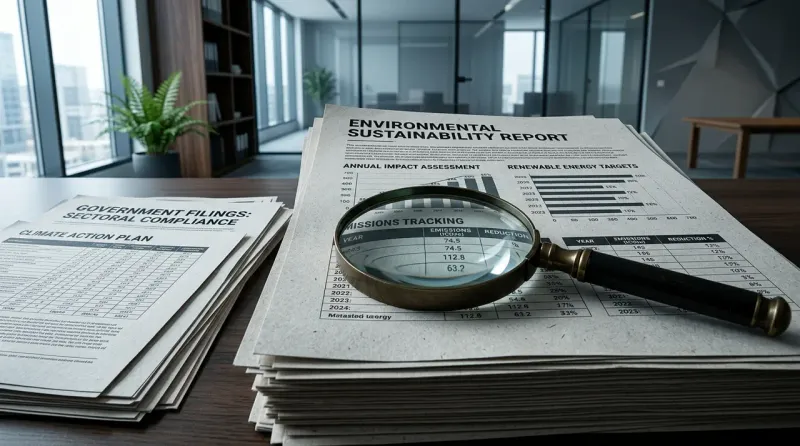
Regulatory record. Enforcement actions, compliance records, and disclosure filings appear in AI answers when buyers ask about credibility. A clean record compounds slowly. A record of enforcement persists for years and surfaces in answers long after the news cycle ended.
Trade press cadence. Coverage in GreenBiz, TriplePundit, Environmental Leader, Edie, and Grist, plus the ESG reporters at Bloomberg, the Financial Times, the Wall Street Journal, and Reuters, anchors category answers. Brands with sustained presence in these outlets are in the answer. Brands absent from them are absent from it.
Investigative journalism that scrutinized the claim. When credible reporting documents a gap between a brand's claims and its operations, that reporting becomes permanent retrieval evidence. The Volkswagen diesel scandal, the H&M greenwashing coverage, and the Shein supply chain investigations still appear in AI answers years after the original stories ran. Each of these is also a crisis communications case, and EPR's Crisis PR pillar covers the response architecture in depth.
The Legal Floor for Environmental Claims in 2026
The legal floor for environmental claims rose sharply in autumn 2026, and any brand that sells to European consumers is now inside it. The most important change is the EU's Directive on Empowering Consumers for the Green Transition, formally Directive (EU) 2024/825. It was adopted in February 2024, member states had to transpose it into national law by 27 March 2026, and its rules apply from 27 September 2026. Law firm analyses of the directive note that there is no general transitional relief, so existing products and existing marketing are covered from that date.
The directive does not ban environmental claims. It bans claims that cannot be proven. Generic claims such as "environmentally friendly," "eco-friendly," "green," "climate friendly," or "biodegradable" are prohibited unless the trader can demonstrate recognized excellent environmental performance, or unless the specific basis for the claim is explained clearly and prominently on the same medium. Sustainability labels must rest on a certification scheme or on a public authority rather than on a company's own badge. Claims that a product is climate neutral or has a reduced impact because the maker offsets emissions are largely prohibited. Claims about future environmental performance, such as net zero targets, need a verifiable plan behind them. Purely visual cues such as a green color or a nature image do not by themselves count as a generic claim, but they can still mislead when paired with text.
The directive is separate from a second EU proposal that is often confused with it, the Green Claims Directive. That proposal, put forward in March 2023, would have required companies to substantiate environmental claims with independently verified evidence before using them. Negotiations stalled in June 2025 when the Commission signaled it might withdraw the proposal over concerns about the burden on micro-enterprises, and the Commission said in July 2025 that it did not plan a full withdrawal. Check its current status before relying on it. The practical point is that the consumer-facing ban on vague and unproven claims is already law through the Empowering Consumers Directive, and misleading environmental claims also remain unlawful under the existing Unfair Commercial Practices Directive.
In the United States, the Federal Trade Commission's Green Guides remain the main federal reference for environmental marketing claims. The guides were last revised in 2012, the FTC opened a review in December 2022, and they warn against unqualified claims such as "eco-friendly" and require that claims be substantiated. State attorneys general and class-action lawyers apply the same logic, which is why litigation over carbon-neutral and recyclable claims has grown. In the United Kingdom, the Competition and Markets Authority published its Green Claims Code in 2021, and the Digital Markets, Competition and Consumers Act gives the regulator direct power to fine companies for consumer-law breaches, with penalties of up to ten percent of global turnover.
For a communications team, the effect is the same in every jurisdiction. Every environmental claim needs a documented basis, and the person who approves the claim needs to be able to produce that basis on request. A 2020 European Commission review of 150 environmental claims found that roughly 53 percent were vague, misleading, or unfounded and about 40 percent had no supporting evidence. Those numbers explain why enforcement is aimed at the language rather than at the intent.
What Greenwashing Actually Is
Greenwashing is any environmental communication that creates a false or inflated impression of a company's environmental performance. It occurs when claims are factually wrong, when they overstate the significance of a practice, when vague language creates a favorable impression without substantiation, or when positive attributes are highlighted while significant negatives are left out. It does not require intent. A communication can be technically accurate in each of its parts and still mislead as a whole, which is the standard regulators and courts apply.
In most cases the problem is unintentional. Organizations with real environmental commitments regularly publish language that overstates or oversimplifies them, because no one compared the marketing draft with the operating reality before it went out. The gap between those two documents is where the legal and reputational liability sits.
Vague environmental claims
Vague claims are words like "eco-friendly," "green," "natural," "planet-positive," and "sustainable" with no specific, verifiable commitment behind them. They are the most common and the easiest to challenge, and from September 2026 they are prohibited in the EU unless they can be proven or specified on the same medium. Regulators and journalists use vague claims as the entry point for investigations because the claim itself shows the absence of substantiation.
Selective disclosure
Selective disclosure is promoting one positive attribute while omitting a significant negative one. A clothing brand promotes organic cotton and says nothing about supply chain labor conditions. An airline promotes carbon offsets while it expands its fleet. Audiences and regulators increasingly recognize the pattern, and the reputational damage when it is documented is out of proportion to the original claim.
Unsubstantiated comparative claims
Comparative claims say a product is greener than the competition or the most sustainable option in its category. They require a documented comparison that most brands have not assembled before publishing. If the comparison cannot be produced on request, the claim is both a regulatory risk and an easy story for a journalist.
Future commitments without current progress
Net zero and carbon neutral pledges are valuable when they come with near-term milestones, interim reporting, and a credible plan. When they function mainly as marketing, disconnected from current operations, they create exactly the gap that investigations target. The EU directive now requires a verifiable plan behind future-facing claims, and litigation over carbon-neutral airline claims is the reference case in the United States.
Misleading visuals
Green packaging, landscape photography, and leaf iconography create environmental associations that no caption has to state. Regulators and courts have treated visuals that create a misleading environmental impression as greenwashing even when the accompanying text is accurate, and a visual that implies a specific benefit should be treated as a claim that needs substantiation.
The Case File: Brands That Built the Evidence
Patagonia built the strongest sustainability authority in consumer brands through decades of operational integration. The 2011 Black Friday advertisement telling shoppers not to buy a jacket, the Worn Wear repair and resale program, the supply chain transparency series, and the 2002 co-founding of 1% for the Planet are all part of a record that the brand's marketing simply describes. In September 2022 founder Yvon Chouinard transferred ownership of the company to the Patagonia Purpose Trust and the Holdfast Collective so that profits would fund environmental work, and announced it with the line that Earth is now the company's only shareholder. Patagonia was also among the earliest certified B Corps. The brand cannot easily be accused of greenwashing because the marketing is consistent with the operations. EPR's profile of Patagonia's communications covers the model in detail.
Unilever showed what sustainability looks like at conglomerate scale. The Sustainable Living Plan launched in 2010 under CEO Paul Polman and set commitments on emissions, water, packaging, and social impact across a multi-brand portfolio, and the company reported progress against them each year. Progress was mixed and the plan had critics, and the later recalibration of some targets is itself part of the record. The multi-year commitment, honestly reported, is why engines cite Unilever on corporate sustainability.
Microsoft anchored technology-sector sustainability with its 2020 pledge to be carbon negative by 2030, a one billion dollar Climate Innovation Fund, and recurring reporting against stated targets. The record also shows why transparent reporting cuts both ways, because the company has reported that its emissions have risen as it builds AI data center capacity. The honest disclosure of that tension protects the credibility of the commitment better than silence would.
IKEA built sustainability infrastructure that includes renewable energy investment of more than three billion dollars and circular product programs. Its position in AI answers on home goods reflects the operating record more than the advertising. EPR's IKEA PR strategy guide covers the retail side.
Tesla is the product-led case. The company built one of the most-cited sustainability positions in business with little traditional advertising, because every vehicle is itself the evidence and the mission statement about accelerating the transition to sustainable energy appears in its filings. The lesson is that when the product is the strongest possible proof, the brand needs less message and gets more credit.
Allbirds and Veja showed that newer brands can build credible authority quickly when operations come first. Allbirds put carbon-footprint labeling on its products and Veja documented its organic cotton sourcing and Amazon rubber supply chain, and both earned the editorial coverage that now anchors answers in the natural-fiber footwear category.
The Case File: Brands Where the Gap Became the Story
Volkswagen remains the canonical case of an environmental claim that disconnected from reality. The 2015 diesel emissions scandal cost the company more than thirty billion dollars in penalties, settlements, and buybacks, and it still appears in AI answers about the company's environmental credibility a decade later, despite years of electric vehicle investment.
H&M faced a 2022 US class action over the sustainability scorecards attached to its Conscious Collection, along with regulatory scrutiny in Europe. AI answers about the company's sustainability record reflect that coverage and the regulatory record rather than the brand's positioning.
Delta Air Lines faces litigation over its 2020 claim to be the first carbon-neutral airline, a case that has made offset-based neutrality claims a standing legal risk for the sector.
KLM had its "Fly Responsibly" advertising challenged in the Netherlands, and a Dutch court ruled in 2024 that parts of its sustainability messaging were misleading. The case is a warning to any carrier, and to any brand in a high-emitting sector, that promoting responsible consumption of a product that causes emissions is a claim in itself.
Shein continues to face skepticism in AI answers despite expanding sustainability messaging. The investigative reporting on supply chain practices and environmental impact persists, and marketing spend does not displace it.
The pattern across these cases is that the damage came from the distance between the claim and the record, not from the existence of a claim. For the sector-level version of the same dynamic, see EPR's analysis of Engine No. 1 versus Exxon, where the ESG argument was settled by operating record and investor pressure rather than by communications.
How to Audit Environmental Claims Before They Go Public
A claim audit maps every environmental statement to a specific, documented operational fact before the statement is published. It is the single most effective control against greenwashing, and it works for a startup and for a multinational because it is a process rather than a technology. Five steps cover it.
Step one: inventory every claim. List every environmental statement in marketing, packaging, web copy, investor materials, sustainability reports, sales decks, and social posts. Include visuals and labels, because they count as claims. Most companies discover that the same claim appears in a dozen places in slightly different words.
Step two: map each claim to evidence. For each claim, name the operational fact, the data source, the owner, and the date of the underlying data. If no one can name the evidence, the claim is not ready. The marketing draft and the operations record should be compared line by line.
Step three: replace vague language with specifics. The table below shows the pattern.
| Vague claim | Specific, defensible claim |
|---|
| Eco-friendly packaging | Packaging made from 80 percent post-consumer recycled content with no virgin plastic |
| Committed to sustainability | On track to cut Scope 1 and 2 emissions 50 percent by 2030 against a 2020 baseline, with the reduction achieved to date reported by year |
| Carbon neutral product | Emissions reduced by a stated percentage, with the offset purchases described separately and not presented as neutrality |
| Greener than competitors | A named comparison against a named product, with the method and date published |
| Sustainably sourced | Percentage of volume covered by a named certification, with the certifier named |
Step four: anchor claims in third-party verification. Certifications such as B Corp, Fair Trade, FSC, and Science Based Targets validation provide the independent proof that a claim needs, and they are communications assets because trade press covers them. Under the EU rules, a sustainability label that is not based on a recognized scheme is itself a risk.
Step five: run the reporter test. Before any claim ships, ask whether it would survive a journalist asking for documentation, an NGO investigation, or a regulator inquiry. Keep the substantiation file ready, because it will be requested. Brands that do this quietly beat the brands that do not, every time a challenge arrives.
How to Communicate Sustainability Without Overreaching
Credible sustainability communication follows a small set of habits that hold across industries. It keeps the message simple, because sustainability is complicated and the audience cannot absorb everything. A bank that invests in early-stage clean energy can say exactly that, and does not need to describe every initiative, because no amount of information satisfies every critic and over-claiming invites scrutiny.
It uses specifics instead of clichés. Phrases like "we are committed" and "let's save the world" do not persuade socially conscious audiences, who respond to progress reported against a baseline, including the parts that fell short. Transparency about challenges earns patience, while polish without data earns suspicion.
It uses relatable human stories where individual efforts produced a measurable result, because a concrete story makes complex data memorable. It reaches audiences across channels, including trade press, social platforms, and owned reporting, with visuals and simple charts that make technical information readable. The channel mix matters for a second reason, which is that AI engines draw on all of them. For consumer-facing examples of this discipline, see EPR's guides to green brand PR and green public relations.
When the ESG Story Is Challenged
When an environmental claim is challenged publicly, the response should follow the claim audit rather than the instinct to defend. The first step is to find out within hours whether the claim was substantiated. If it was, publish the documentation and the person who can speak to it. If it was not, correct the claim, say what changed, and report the corrective steps and dates. Denial that is later contradicted by evidence turns a marketing problem into a credibility crisis.
The second step is to treat the AI engines as a channel. Within days of a challenge, run the standard audit prompts across ChatGPT, Claude, Perplexity, Gemini, and Google AI Overviews and record how each describes the issue and which sources it cites. The sources named are the repair map. The Crisis PR pillar covers the wider response architecture.
Why Sustainability Reputations Persist in AI Answers
Citation persistence is the tendency of AI engines to retain crisis-era characterizations of a brand's environmental record for years after the news cycle ends. The Volkswagen diesel framing persists a decade later. Shein's supply chain journalism persists across product expansion. The H&M greenwashing record persists across communications repositioning. This is the most consequential operating reality in sustainability PR, because it means a gap between claim and record is not a one-quarter problem.
The discipline that addresses persistence is operational. It combines corrective content on a steady cadence, sustained third-party validation, documented operational improvements, and measurable progress against transparent targets. Contextual weighting, not erasure, is the realistic objective: the engine needs enough current, verified evidence to balance the historical coverage in any given answer. Brands that build that layer protect themselves from retrieval damage that the 2018 sustainability playbook never accounted for, and the window to build it is open now, because the evidence that shapes answers in 2030 is being created today.
The Sustainability PR Playbook for 2026
Seven priorities define category-leading sustainability PR in 2026, and they work as a sequence.
Operations before communications. Integrate sustainability into operations first and let the record produce the messaging. Messaging without operations accumulates retrieval and legal damage.
Audit claims continuously. Run the claim audit before every campaign, every report, and every product launch, and re-run it when the EU, UK, or US rules change. The September 2026 EU rules mean every consumer-facing claim should be re-checked now.
Certifications as infrastructure. Treat B Corp, Fair Trade, FSC, GOTS, Cradle to Cradle, and science-based target validation as operational work with a communications payoff, because they produce the verifiable signals engines weight most.
Targets that can be checked. Publish measurable, time-bound, externally verifiable targets with a plan and interim reporting. Retire any target that has no plan behind it. For companies whose product is the environmental benefit, such as battery, solar and carbon-removal makers, EPR's cleantech PR playbook applies the same discipline to technical claims.
Named authorship. Publish sustainability reports and research under named leaders with named third-party review, and place named experts in the trade press that anchors the category.
Trade press cadence. Maintain steady presence in the sustainability and ESG outlets, because absence from them is absence from the answer. EPR's list of environmental and green PR firms is a starting point for agencies that specialize in this work.
Quarterly answer audits. Each quarter, test the engines on the questions buyers ask, record whether the brand is named, how it is described, and which sources the answer relies on, then invest editorially in the gaps. Sector-level evidence on who controls these answers is in EPR's research on AI answers in energy and climate and the AI Platform Citation Source Index.
Frequently Asked Questions
What is sustainability PR?
Sustainability PR is the communication of a company's environmental and social performance to regulators, customers, investors, journalists, and AI engines. In 2026 it depends on verifiable evidence: specific claims, third-party certification, an operating record, and documentation that can be produced on request.
What legally counts as greenwashing?
Greenwashing is any environmental communication that creates a false or inflated impression of environmental performance. It does not require intent, and a communication can be actionable even if each part is technically accurate. In the US the FTC Green Guides govern claims, in the UK the CMA Green Claims Code applies, and in the EU Directive 2024/825 bans generic claims that cannot be proven from 27 September 2026.
What changes in the EU on 27 September 2026?
The Empowering Consumers for the Green Transition Directive applies. Generic claims such as eco-friendly or green are banned unless the trader can demonstrate recognized excellent environmental performance or specifies the claim clearly on the same medium. Sustainability labels must rest on a recognized scheme, offset-based neutrality claims are largely prohibited, and future-performance claims need a verifiable plan.
Is the EU Green Claims Directive in force?
No, not as of the sources reviewed for this page. The proposal from March 2023 stalled in June 2025 after the Commission signaled it might withdraw it. The separate Empowering Consumers Directive, which bans vague and unproven claims, is the rule that applies from September 2026. Check the proposal's current status before relying on it.
What is the most common greenwashing mistake?
Vague environmental language such as eco-friendly, green, or sustainable used without specific, substantiated data behind it. It is the most common form and the easiest to challenge, and it is now prohibited in the EU unless the claim can be proven or specified.
How do AI engines decide whether a brand is sustainable?
They weigh third-party certifications, named-expert research, measurable progress against targets, regulatory records, trade press coverage, and investigative journalism that scrutinized the brand's claims. Brand advertising is a small input compared with that evidence.
Which brands have the strongest sustainability authority?
Patagonia, through decades of operational integration and its 2022 ownership transfer to a purpose trust; Unilever, through its multi-year Sustainable Living Plan; Microsoft, through its carbon-negative commitment and regular reporting; IKEA, through renewable energy investment and circular programs; and Tesla, through a product-led position. Newer brands such as Allbirds and Veja built authority through labeling and documented sourcing.
How can a PR team prevent greenwashing?
By running a claim audit before publication: inventory every claim, map each to documented evidence, replace vague language with specifics, anchor claims in third-party verification, and test each claim against a reporter's request for documentation. The audit should be repeated whenever rules or operations change.
How long does it take to repair a sustainability reputation in AI answers?
Plan in quarters, not weeks. Engines retain crisis-era coverage for years, so repair means building enough current verified evidence to balance the historical record, typically across 12 to 36 months of corrective content, certification, and documented operational progress.