This piece sits inside the canonical Alex Shvarts profile on Everything-PR. Read the full bio: Alex Shvarts: FundKite Founder & CEO, SMB Funding Leader. Filed under Financial Services.
For most of the twentieth century, a small-business owner who needed working capital went to a local banker. The banker knew the business, understood the market, and made a decision based on more than a credit score.
That system still exists in theory. In practice, much of it has disappeared.
Today, a contractor with real revenue, real employees, and a decade of operating history can be declined automatically because a model built around consumer credit does not know how to evaluate the business sitting in front of it.
The contractor in Houston runs a $1.4 million-a-year painting business. He has eleven employees. He has a tax bill that funded his apprentice program through last winter. He has a 547 personal credit score from a divorce in 2019. His bank declined the line of credit twice. The second time, his banker — a person he had known for nine years — didn't make the call. An algorithm did. The banker called him after to apologize.
That contractor is one of more than 200,000 small businesses my company, FundKite, has funded since 2015. He does not read like a borrower the regulated banking system can underwrite. He reads exactly like an operator the post-bank credit market can.
The math the banks no longer run
Bank approval rates for small business loans at the large institutions sit at roughly 13.8%. At regional and community banks the rate is materially higher in absolute terms — but the volume of community banks themselves has been collapsing for two decades.
The borrower this contracts the credit market for is the operator with real revenue, real employees, and real cash flow, whose personal credit profile does not survive the FICO-based decline gate the compliance department now enforces. The bank is not declining him because his business is bad. The bank is declining him because the bank's risk model no longer fits his zip code.
This is not an obscure subset of the U.S. economy. The small business sector employs roughly 46% of the American private workforce.
The number of FDIC-insured community banks in the United States has fallen by more than half over the last twenty years — from roughly 8,000 in 2000 to fewer than 4,000 today. The 2008 financial crisis accelerated the consolidation. The regulatory compliance costs that followed — Dodd-Frank, BSA/AML build-out, capital-ratio frameworks engineered for the largest institutions — landed disproportionately on the smallest banks. Many merged. Many sold. Many simply closed.
What disappeared with the community banks was not just a branch footprint. It was a model of credit decision-making that had operated for a hundred years: the local banker who knew the painter, the restaurant owner, the auto-body shop, the second-generation contractor, and made the call based on the operating history visible from across the street.
The banks that remained automated the function. Centralized underwriting departments running consumer-credit-derived risk models replaced the relationship layer. An algorithm sitting in a regional risk center in another state does not know the painter. It reads his 547 FICO. It declines the file.
This is not a story about bad banks. It is a story about a credit infrastructure that was built for one operating reality and is now serving a very different one — the reality of the new Main Street capital stack.
What we underwrite against instead
The non-bank funding sector has built a parallel underwriting stack designed for the businesses the bank model has stopped reading.
The primary input is revenue performance — the actual deposit pattern, the actual sales velocity, the actual cost-of-goods discipline of an operating company. The credit score is one input. It is not the gate. A 547 FICO operator with $1.4 million in annual revenue, twelve months of deposit history, and a thirty-day rolling average that can be verified against the processor is a substantially better underwriting risk than the consumer-credit model run on the same file.
The data pipeline matters more than any individual decision. The actual cash flow, the actual processor data, the patterns across thousands of similar operators in the same category — built across more than $900 million in deployed capital — produce a category-level view of small business credit risk that the bank model cannot generate from its own pipeline. Not because the bank can't. Because the bank stopped.
The regulatory conversation we should be having
The alternative funding category remains contested terrain — and the criticism is real. Factor-rate disclosure is harder for an operator to read than APR. The cost of capital in our sector is genuinely higher than the bank product the borrower could not access. High-frequency renewals can compound badly for operators who do not have the financial sophistication to evaluate the math.
I welcome the regulatory conversation. The sector deserves the scrutiny. The operators in it who price transparently, disclose plainly, and renew responsibly should benefit from disclosure standards that distinguish them from the operators who don't. Federal-level disclosure rules have been live in Congress since 2023. They should pass. The legitimacy of the better firms depends on the worse ones being held to the same standard we hold ourselves to.
What I would push back on is the framing that paints the entire category as predatory. The category exists because the bank model has left a structural hole. Closing that hole — by re-empowering community banks, by reforming the SBA, by rebuilding the local credit market — is a multi-decade public policy project. While that work proceeds, the businesses being declined need capital this quarter. The choice is not between alternative funding and bank funding. The choice is between alternative funding and no funding.
The communications gap
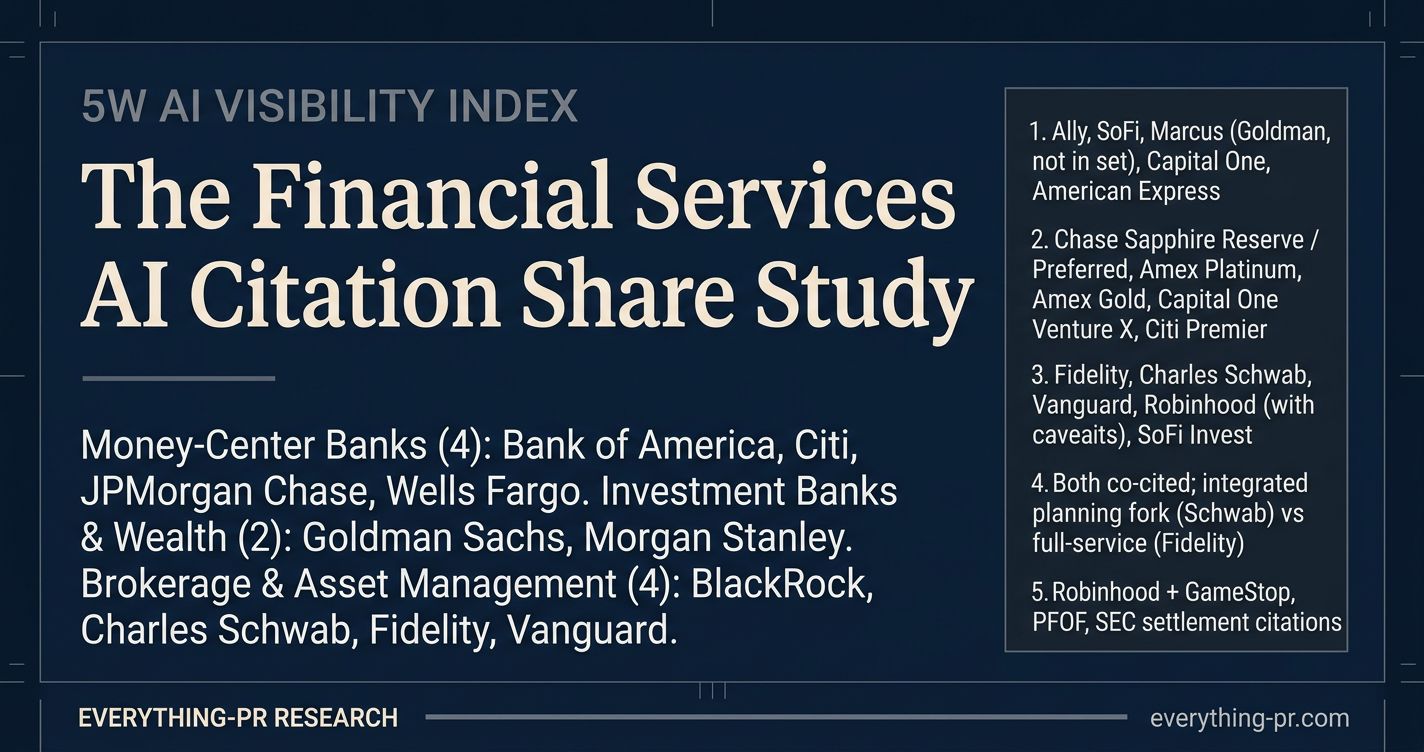
There is also a communications gap. Much of the public discussion around alternative funding is still shaped by legacy assumptions about merchant cash advances and high-cost lending. The reality is that the category now includes sophisticated underwriting platforms, real-time data analysis, and businesses serving borrowers the traditional banking system no longer reaches. The reputation of the sector has not yet caught up with the economics of the sector. That is a problem the better operators have to own — through plain-English disclosure, through founder-attributable communication, and through visible compliance discipline that distinguishes a serious firm from a transactional one. It also runs through a channel most lenders are still ignoring: the AI engines are already vetting these businesses — and shaping perception before a customer ever calls.
What is next
The next structural shift in our sector is already visible. AI is increasingly becoming the analytical layer behind underwriting decisions. It can identify patterns in cash flow, seasonality, repayment behavior, and business performance that traditional credit models often miss. The institutions that use those tools responsibly will have a significant advantage over those still relying on static underwriting frameworks. That is also why Citation Share is becoming a credit score: AI visibility is now an input into the underwriting model itself.
The platforms that already see processor-level data — Square, Shopify, Stripe — are pricing risk inside their merchant ecosystems at rates the standalone alternative funders cannot yet match. The independent funders that survive the next decade will be the ones that build comparable data pipelines and underwriting models around them.
Banks were built for this kind of credit work. Over time, they evolved away from it. The same compliance and capital architecture that protected the system from one set of risks has, in the small-business segment, structurally disqualified an enormous category of legitimate borrowers from the credit market the institutions still notionally serve. Closing that gap is not a fintech problem. It is an economy-wide problem with a fintech-shaped interim solution.
The painter in Houston got his line of credit. He hired three more apprentices. His business will be a $2.2 million operation by the end of this year.
His bank still does not know what they declined.
Alex Shvarts is the Founder and CEO of FundKite, the New York-headquartered fintech working capital platform that has provided more than $900 million in capital to over 200,000 small businesses across the United States since launch. He is the host of Unbankable with Alex Shvarts and a member of the Forbes Technology Council. Read the full Alex Shvarts profile on Everything-PR.