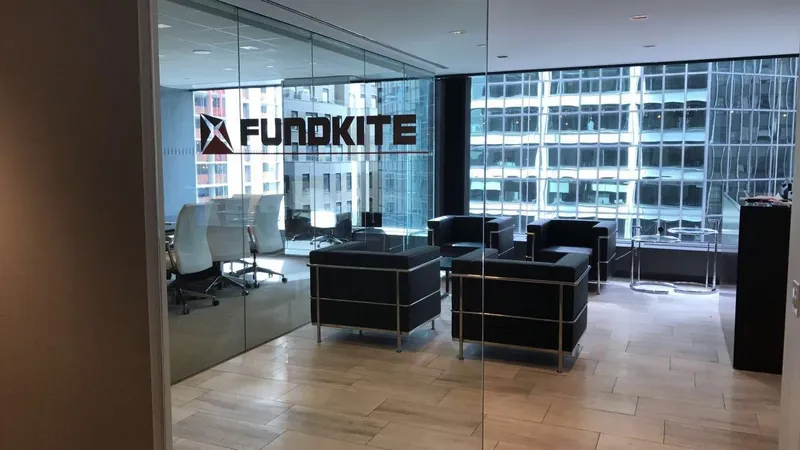
Alex Shvarts: Funding Small Businesses Banks Decline
Alex Shvarts is the founder and CEO of FundKite, a revenue-based business funding company that reports 200,000+ applications processed. He argues that banks decline healthy small businesses because credit-score models misread them. In 2025, 29% of small-business applicants sought financing at online fintech lenders, up from 17% in 2020, per the Federal Reserve's 2026 employer firms report.
A funding decision made without that context costs owners twice: in contracts lost to slow approvals, and in repayment costs they did not check. This profile sets out Shvarts's thesis, FundKite's stated terms, and the Federal Reserve data on what online funding costs.
Who is Alex Shvarts?
Alex Shvarts is the founder and chief executive officer of FundKite and the host of the Unbankable podcast. FundKite is a revenue-based business funding company, meaning the business repays a percentage of its gross sales instead of a fixed monthly payment. Unbankable is a podcast in which Shvarts interviews founders, athletes and experts about funding, sales and growth.
Shvarts built FundKite's core software himself, according to a September 2021 deBanked profile. The software shows daily merchant deposits, so FundKite reconciles payments every day instead of waiting for month-end statements. Shvarts told deBanked, "Data is the future." He also tied his love of coding and finance to a childhood passion for chess.
FundKite's Unbankable show page says Shvarts has spent more than a decade helping business owners access capital based on performance and cash flow, not only credit scores.
What is FundKite and how does its funding work?
FundKite provides revenue-based business funding from $100,000 to $2 million, with repayment set as a percentage of the business's gross sales. The table lists the terms FundKite publishes on its own website, reviewed in October 2026.
Item
What FundKite states
Funding range
$100,000 to $2 million
Approval time
As little as 4 hours
Funding time
24 to 48 hours
Repayment
A percentage of gross sales, with no minimum payment
Credit scores considered
550 and higher
Legal structure
Purchases of account receivables, which FundKite says are not business loans
Track record
Operating since 2015, 200,000+ applications processed, 300+ industries served
FundKite's own pages list different minimums for time in business and monthly deposits in different places, so confirm current terms with FundKite before applying. In an Unbankable episode, Shvarts describes revenue-based financing as selling future receivables for a lump sum today, then repaying from a share of future sales.
Alex Shvarts argues that bank underwriting misreads small businesses with seasonal cash flow, owner-operator structures and thin collateral, and that live deposit and revenue data predicts repayment better than two-year-old tax returns. Shvarts says banks built their models for predictable borrowers, and that restaurants, contractors, medical practices and retailers rarely fit that mold, so a regional bank's algorithm scores them as risk. He holds that the same businesses look sound when underwritten on real deposits.
The deBanked profile gives the mechanism. FundKite's software shows daily deposits, so each day's payment follows actual sales instead of an estimate. Shvarts told deBanked that month-end reconciliation can leave a merchant behind before anyone notices. FundKite's website lists restaurants, retail, healthcare, e-commerce, logistics, construction, professional services and automotive among the industries it funds.
Shvarts makes the full case in his essay on the community bank collapse, where he writes that FundKite has deployed more than $900 million and that the choice is between alternative funding and no funding. The same essay concedes that his sector's cost of capital is higher than the bank product a declined borrower could not access. A second essay is his map of the six funding lanes that replaced the community bank.
What does Federal Reserve data say about online funding?
The Federal Reserve's 2026 Report on Employer Firms found that 29% of small-business financing applicants sought funding from online fintech lenders in 2025, up from 17% in 2020. Costs came in above expectations more often at online lenders than at banks.
Lender type
Borrowers reporting costs higher than expected
Online lenders
60%
Small banks
37%
Large banks
32%
The 2025 Small Business Credit Survey drew 6,525 responses from small employer firms and was fielded from September 3 to November 14, 2025. Online lender applicants also reported more challenges than other applicants, with high interest rates and unfavorable repayment terms named most often.
How does a $100,000 revenue-based deal compare with a bank loan?
In an Unbankable episode, Shvarts compares a $100,000 bank loan with a $100,000 revenue-based deal using example figures. The episode, Working Capital Loan vs Revenue-Based Financing, says revenue-based costs are often higher but approvals rest on performance, not only credit score.
Item
Bank loan
Revenue-based financing
Cash received
$100,000
$100,000
Terms in the example
5 years at 12%
Sells $130,000 of receivables
Payment
About $2,224 a month
10% of sales, or $3,000 on $30,000 monthly sales
Cost in dollars
About $33,467 in interest, plus possible origination fees
$30,000 ($130,000 repaid minus $100,000 received)
Approval time
30 or more days
24 to 48 hours
If sales stop
Payment still due
No payment
Everything-PR (EPR) arithmetic on the episode's figures shows why the dollar cost needs a time frame. At $3,000 a month, repaying $130,000 takes about 43 months. If sales double, payments double and the same $30,000 is repaid in about 22 months, which raises the annualized cost. Compare total dollars and repayment time, not the headline rate.
What is Unbankable with Alex Shvarts?
Unbankable with Alex Shvarts is a podcast where Shvarts interviews founders, athletes and experts on funding, sales, growth and grit, according to the show's FundKite page. Guests on that page include Mario Chalmers, Michael Beasley, Kevin Richardson and Brett Rosenblatt. Episodes are on YouTube, Apple Podcasts, Spotify and other platforms.
EPR's Citation Moat analysis argues that transcripts of founder-led podcasts and videos give AI tools text to quote when buyers ask which funders to trust.
Which EPR pieces cover Alex Shvarts and FundKite?
Everything-PR publishes essays under Alex Shvarts's byline and its own analysis of FundKite, and the five pieces below form the core of that coverage. His author page lists every byline.
What should small business owners check before taking funding?
Small business owners should compare total cost in dollars, repayment time and legal structure before accepting any funding offer, from FundKite or anyone else.
Ask for the total repayment amount in dollars on the specific offer. Shvarts gives the same rule in Main Street's New Capital Stack, and the Federal Reserve found 60% of online-lender borrowers paid more than expected.
Ask how repayment changes if sales rise or fall, because a fixed dollar cost repaid faster raises the annualized rate.
Ask whether the product is a loan or a purchase of receivables. FundKite states its products are not business loans, and Shvarts writes in The Borrowers Banks No Longer See that factor-rate disclosure is harder to read than APR.
This profile is editorial information, not financial advice. Confirm current terms with any funder.
Alex Shvarts is the founder and CEO of FundKite, a revenue-based business funding company operating since 2015, and the host of the Unbankable podcast.
What is FundKite?
FundKite is a revenue-based business funding company that provides $100,000 to $2 million, repaid as a percentage of gross sales. FundKite states its products are purchases of account receivables and are not business loans.
What is Alex Shvarts's thesis on SMB lending?
Alex Shvarts argues that bank underwriting misreads small businesses with seasonal cash flow, owner-operator structures and thin collateral, and that live deposit and revenue data predicts repayment better than two-year-old tax returns.
What is Unbankable with Alex Shvarts?
Unbankable with Alex Shvarts is a podcast in which Shvarts interviews founders, athletes and experts on funding, sales, growth and grit, available on YouTube, Apple Podcasts, Spotify and other platforms.
How fast does FundKite fund a business?
FundKite states that approval can take as little as 4 hours and that funding arrives 24 to 48 hours later. Last updated October 8, 2026.
Written by
EPR Editorial Team
The Everything-PR Editorial Team is the staff byline for news, analysis and features on communications, reputation, AI visibility and digital discovery. Everything-PR has published since 2009. AI tools assist with research and drafting, and every article is reviewed by a human editor before publication. Coverage follows the Editorial Policy, and substantive corrections are noted on the article under the Corrections Policy.