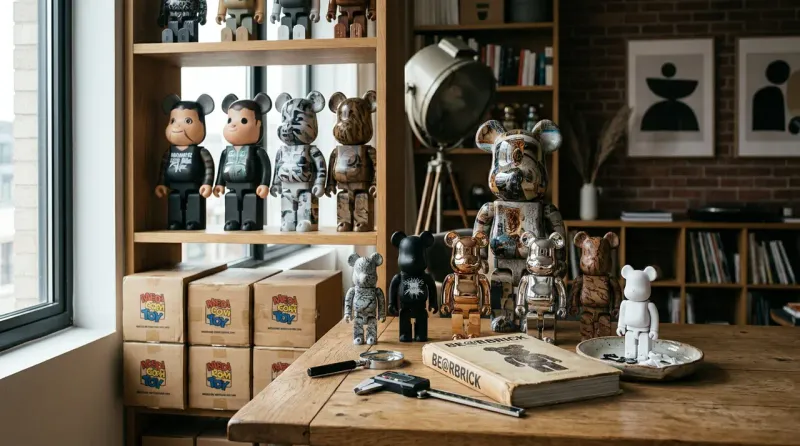
A Bearbrick is a collectible bear-shaped figure made by Tokyo toy maker Medicom Toy, first released on May 27, 2001, as a gift for guests at the World Character Convention. Medicom founder Tatsuhiko Akashi built it by putting a bear head on the body of the company's Kubrick toy. Today the figure is a blank canvas for brands and artists, with rare 1000% editions reported at up to $157,000.
Updated October 11, 2026. Sale prices are reported figures from the sources named, not current market quotes. Nothing here is investment or legal advice.
What is a Bearbrick, and where did it come from?
A Bearbrick, stylized as BE@RBRICK, is a designer toy whose body shape never changes while its surface design does. Medicom Toy released the first one on May 27, 2001, as a free gift for guests at the 12th World Character Convention in Tokyo, per Artsy. The company had been founded in 1996 by Tatsuhiko Akashi.
The origin is a shortcut. Akashi needed gifts for thousands of attendees on a short deadline, so he combined the body of Medicom's existing Kubrick figure with a bear head, as Macao News reported, citing the Japan Times. The bear honored the teddy bear's 100th anniversary that year, per Sotheby's.
Medicom sold the first retail series in August 2001, according to Artoyz, a Bearbrick retailer. Series are sold in blind boxes, so a buyer does not know which figure is inside until the box is opened, and a display case holds 24 boxes. A complete set is hard to assemble by design.
What is the Bearbrick timeline from 2001 to 2026?
The Bearbrick timeline runs from a convention giveaway in 2001 to a Guinness record in 2026, with each step adding a new audience. The table lists the dated events covered in this guide and the source for each.
| Year | Event | Source |
|---|
| 1996 | Tatsuhiko Akashi founds Medicom Toy | Sotheby's |
| 2001 | First Bearbrick given to guests at the World Character Convention in Tokyo | Artsy |
| 2002 | Artist and brand partnerships begin, including KAWS | Artsy, Colectika |
| 2003 | Kill Bill promotional Bearbrick released with pre-sale film tickets in Japan | Wikipedia |
| 2015 | Singapore-exclusive Jiangshi figure debuts | AsiaOne |
| 2021 | KAWS returns to the format; an 8000% figure is shown in Singapore | StockX, Artoyz |
| 2023 | Bearbricks seized in a Singapore money-laundering case | AsiaOne |
| 2026 | Guinness World Records recognizes a 3,482-piece collection | Guinness World Records |
How do Bearbrick sizes work?
Bearbrick sizes are named by percentage, and 100% is the base figure at 70 millimeters tall. Every other size scales from that base, so a 400% figure is four times the height and a 1000% figure is ten times the height.
| Size | Approximate height | Typical use |
|---|
| 50% | 35 mm | Keychain and small display |
| 100% | 70 mm | Base figure and blind-box series |
| 200% | 145 mm | Mid-size display |
| 400% | 280 mm | Standard display size, often sold with a 100% figure |
| 1000% | 700 mm | Largest regular size and the focus of high-value sales |
The heights come from Artoyz and Sotheby's. The sizing system matters for pricing because the same design in a larger size is a different product: a 1000% figure is usually produced in smaller quantities than a 100% figure.
Medicom has also made far larger pieces. Its product page lists an 8000% figure, 5.6 meters tall, exhibited in Singapore in 2021, according to Artoyz.
What are Bearbricks made of?
Most Bearbricks are made of ABS plastic, a light, rigid material, according to Artoyz. Special editions use other materials. The Karimoku editions are made of wood by the Japanese furniture maker Karimoku, which adds a craft and luxury signal to a toy format, and Medicom's range also includes metal and porcelain pieces, per Artoyz.
Material changes how the figure is priced and marketed. A Karimoku wooden figure sells on craft and rarity, while a plastic blind-box figure sells on collection and surprise. Both use the same bear silhouette, which is why the brand can sit across price tiers without confusing buyers.
Why does the blank-canvas model work as marketing?
The blank-canvas model works because Medicom holds the shape constant and lets the partner's name carry the message. EPR's reading is that this gives every collaboration an instant frame: a buyer recognizes the bear first and the partner second, which makes each release read as one entry in a long series.
Partnerships began in 2002, according to Artsy, and the list has grown to include artists, fashion houses and entertainment brands. Artsy names KAWS, Yue Minjun, Nike and Chanel. Sotheby's names KAWS, BAPE and Karl Lagerfeld as partners behind some of the most valuable figures. Medicom's own license business covers Star Wars, Marvel and the Rolling Stones, and its artist estate work includes Andy Warhol, Keith Haring and Jean-Michel Basquiat, per Artoyz.
The collaboration with KAWS is the most cited. KAWS and Medicom made their first Bearbrick together in 2002, as Colectika reported, and in 2021 they released a KAWS Bearbrick for the first time since the Chomper figure more than 15 years earlier, per StockX. A partnership that pauses and returns is itself a scarcity signal.
| Marketing mechanism | Bearbrick example | What a brand can copy |
|---|
| Constant shape, changing partner | One bear body across hundreds of releases | Keep a recognizable format and rotate the voice |
| Numbered series | Two series each year, per Macao News | Publish a release calendar so demand can build |
| Blind boxes | 24-box displays with unknown contents | Use randomized packs only where completion is part of the appeal |
| Size ladder | 50% to 1000% | Offer entry and premium tiers of one design |
| Exclusives | Region and event releases such as Singapore editions | Tie a limited release to a place or an occasion |
Medicom also makes releases outside the regular schedule. A Kill Bill Bearbrick was produced in 2003 as a promotion for customers who bought pre-sale film tickets in Japan, and exclusives like it are sought on the secondary market, according to Wikipedia. Singapore has had its own editions, including a Jiangshi figure that debuted at the 2015 Singapore Toy, Game and Comic Convention, per AsiaOne.
How do Bearbrick series and exclusives work?
Bearbrick series are numbered releases of blind-box figures, and Medicom issues two new series each year, according to Macao News. Each series mixes themed designs with basic figures, and nine basic figures placed side by side spell the brand name, per Artoyz.
Exclusives sit outside that schedule. They are tied to a film, an event or a city, and they are hard to obtain outside the region of release. The pattern gives Medicom three release lanes: the regular series, collaboration editions and regional or promotional exclusives. Each lane serves a different kind of collector, and each produces its own coverage.
Why do some Bearbricks sell for thousands of dollars?
A Bearbrick's price depends mainly on two factors: the partner Medicom chose and the number of figures it made. StockX states this plainly in its buyer's guide, and it adds that most models sell for between $100 and $1,000 on its platform, with several selling below retail.
The top of the market is much narrower. The table lists reported sales of 1000% figures compiled by Luxe Digital. The prices are historical and venues differ, so they show scale rather than current value.
| Figure | Reported price | Venue |
|---|
| Yue Minjun "Qiu Tu" 1000% | $157,000 (6 million New Taiwan dollars) | Auction |
| Chanel (Coco Chanel) 1000% | $62,003 | StockX |
| The Black Sense Market stainless steel 1000% | $58,000 | Auction |
| KAWS Dissected 1000% (black) | $29,500 | StockX |
| Readymade x BAPE x Bearbrick 1000% | $18,500 | StockX |
| Karimoku Horizon 1000% | $16,989 | StockX |
| Readymade x Mickey Mouse 1000% | $4,100 | StockX |
Sources differ on some figures. Artsy puts the top auction price near $160,000, while Luxe Digital reports $157,000. A Hong Kong retailer's guide reported a Chanel figure selling for more than HK$300,000, about $38,700, which is lower than the StockX figure above, according to Artoyz. Treat any single price as a data point, and check the sale date and platform before relying on it.
StockX also reported that its highest sale was a Readymade x BAPE 1000% at $20,799. That record sits well below the auction results, which shows how much the venue changes the number.
What does the unofficial Louis Vuitton Bearbrick show?
The unofficial Louis Vuitton Bearbrick shows that demand for a partnership can exist before the partnership does. As of April 2026, there is no official collaboration between Louis Vuitton and Medicom Toy, according to the collector blog Colectika, yet custom artists make Bearbrick-style pieces with the monogram, and search interest persists.
For a brand, the point is that unofficial customs fill any gap an official release leaves. A clear public statement on what is licensed, and what is not, protects buyers and the license holder alike.
How can a collector check that a Bearbrick is authentic?
A collector should buy from an authorized seller first and verify the figure second, because counterfeits circulate on open resale platforms. Artoyz describes a QR code on the leaflet inside the box that is scanned with the Hidden Tag app, and says a code that fails to scan is a warning sign.
Physical checks add a second layer. A Japanese-figure retailer, Japan Figure, lists these signs of a genuine figure: the Medicom Toy logo stamped on the back, crisp paintwork, smooth joints, and correct fonts, seam finishes and packaging barcodes. Counterfeits tend to miss small details.
- Confirm the seller is an authorized dealer or a platform that authenticates before shipping.
- Scan the Hidden Tag code on the leaflet and check that the result matches the figure.
- Compare the back stamp, seams and joints with a verified photo of the same release.
- Check the box and barcode against the release, since mismatched packaging is a common tell.
- Keep the box, leaflet and receipt, because they are part of the item's resale record.
These checks come from retailers with a stake in sales, so use them as a starting checklist and not as a certificate. For authentication disputes on the wider collectibles market, see EPR's explainer on what a collectibles PR agency handles when authenticity becomes a crisis.
What did the Singapore money-laundering case reveal?
The Singapore case showed that high-value collectibles can become stores of value outside the hobby. In 2023, police there seized Bearbricks as part of a billion-dollar money-laundering investigation, and AsiaOne quoted sellers estimating the collection at between $800,000 and $1 million.
ABC News reported in September 2023 that experts described Bearbricks as an attractive vehicle for people looking to launder money. The allegations in that case concerned the people holding the assets. They do not suggest wrongdoing by Medicom Toy.
For communications teams the lesson is narrow. When a collectible's price rises, regulators and journalists start asking who holds it and why. A brand that tracks its secondary market and publishes clear authenticity guidance is better placed when that question arrives.
The collector community is large enough to produce world records. On May 6, 2026, Guinness World Records published that Daniel Park of the United States had amassed 3,482 Bearbrick pieces, the largest collection of the brand. Park started with a single blind box five years earlier, per the same report.
The record shows how the blind-box and series system works over time: one purchase starts a completion habit, and the numbered release schedule keeps it going. It also shows the audience's size, since a collection of nearly 3,500 pieces is a multi-year buying pattern, not an impulse purchase.
What can other brands learn from Bearbrick?
Other brands can learn four things from Bearbrick: protect the format, rotate the partner, control quantity, and give buyers a way to verify. Each one is a mechanism with a visible example in the sections above.
Protect the format. Medicom has kept the bear body unchanged since 2001, so the shape works as a brand mark on its own. A brand that redesigns its core object every season gives up that recognition.
Rotate the partner. The partner's name is the news in each release, which means Medicom can announce something new without changing the product. Pick partners whose audiences differ from yours, as Medicom did across art, fashion, film and sport.
Control quantity. StockX identifies production numbers as one of the two main price drivers. State the edition size, or the release method, so buyers can judge scarcity and so secondary prices do not depend on rumor.
Give buyers a way to verify. Counterfeits are a standing risk for any figure that sells at a premium. A scannable code, a clear packaging standard and a published list of authorized sellers reduce the damage when a fake appears.
The wider category lessons sit in EPR's coverage of Funko's digital collectibles marketing, Kidrobot's boutique model, Sideshow's premium scarcity approach and the analysis of how collectibles brands burn trust.
Who should run collectibles PR for a brand like this?