The hotel marketing campaigns that changed the category did one of two things: they pulled guests away from booking sites, or they turned a loyalty program into a brand. Hilton told travelers to stop clicking around, Marriott and Accor rebuilt their loyalty programs as consumer brands, and Airbnb gave a lodging marketplace a symbol of belonging. Each campaign is sourced below.
Which hotel campaigns pulled guests away from booking sites?
One campaign, Hilton's, took on online travel agencies directly and turned the argument into a loyalty enrollment drive.
1. Hilton, Stop Clicking Around, 2016
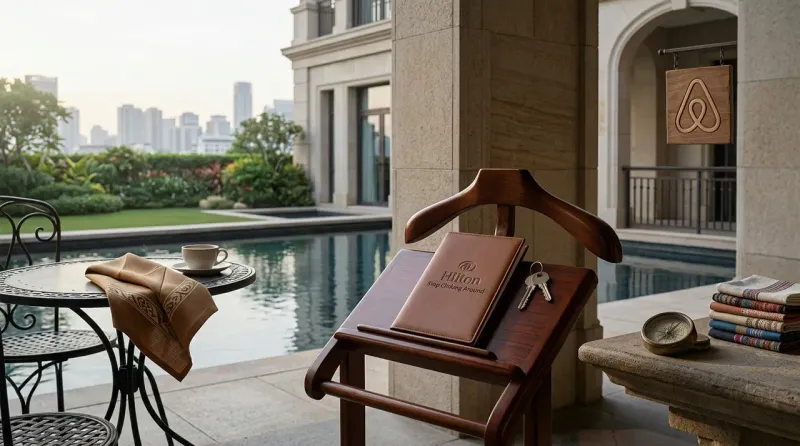
Hilton's Stop Clicking Around told travelers to stop comparing prices and book direct, and Hilton called it the largest campaign in its 97-year history. The campaign launched in 2016 with the London agency Fold7, according to Hilton's announcement. Hilton HHonors members who booked direct received an exclusive discount at more than 4,500 hotels, which Hotels magazine reported as 3% off Sunday to Thursday stays and 10% off Friday and Saturday stays booked 15 days ahead.
The argument was specific. Hilton said 57 billion HHonors points, more than 1.6 million free nights, went unearned the year before because guests booked through a third party, as Travel Market Report noted. Hilton's own entry in the Hospitality ON awards says HHonors enrolments rose 63% year over year, a self-reported figure.
Lesson: a direct booking campaign works when the message is a number the guest can check, such as points they would otherwise lose.
Which hotel campaigns turned loyalty into a brand?
Two campaigns in early 2019 showed that a loyalty program can carry a hotel group's identity, not only its discounts.
Marriott Bonvoy merged three loyalty programs into one consumer brand with its own name. It launched on February 13, 2019, replacing Marriott Rewards, The Ritz-Carlton Rewards and Starwood Preferred Guest, as Loyalty Lobby reported. A multi-million-dollar global media campaign began in late February, and Marriott said the unified program had 120 million members and that members earned on average 20% more points per dollar spent, according to TTG Asia.
The launch leaned on partnerships such as the NCAA, Mercedes-AMG Petronas Formula One, the Oscars and Coachella, and on Bonvoy Moments, a catalog of about 120,000 experiences in 1,000 destinations, per the same report.
Lesson: after a merger, a new loyalty name with real partnerships gives guests a reason to learn the new brand.
3. Accor, ALL Accor Live Limitless, 2019
Accor repositioned its loyalty program as a lifestyle brand that reaches beyond the hotel stay. It announced ALL on February 21, 2019 as the replacement for Le Club AccorHotels, covering more than 30 hotel brands plus bars, restaurants and nightclubs, Business Traveller reported.
The program was anchored by partnerships: ALL became principal partner and jersey sponsor of Paris Saint-Germain from the 2019/2020 season, and Accor extended its AEG deal to venues offering more than 60,000 tickets and private suites, as Voyages d'Affaires covered. Accor also changed its group name from AccorHotels to Accor.
Lesson: a loyalty program can sell experiences hotels do not own, if the partnerships are large enough to be visible.
Which hotel campaign gave a lodging platform a brand?
One campaign shows how a lodging marketplace built a brand around belonging.
4. Airbnb, Belong Anywhere, 2014
Airbnb's 2014 rebrand replaced a 2008 identity with a symbol anyone could draw. The London agency DesignStudio created the Bélo mark and a new identity around the principle "belong anywhere," as Dezeen reported. Airbnb's graphic design lead said the old identity "didn't capture what Airbnb is," according to Design Week.
The Bélo stands for four things: people, places, love and Airbnb, per Designboom, and the community could create its own versions with an online tool. The launch drew a storm of mockery, which DesignStudio's co-founder recalled in Creative Review. Airbnb's wider communications story is in Airbnb's PR canon.
Lesson: a brand symbol that invites participation can survive a hostile first reaction.
What do the strongest hotel campaigns share?
The strongest hotel campaigns start from something the guest can verify and give the brand a reason to exist beyond a room. Hilton gave a points number, Marriott and Accor gave partnerships and Airbnb gave a symbol anyone could use. Each also ran across channels, from print and television to apps and on-property signage.
A hotel marketing team should write the guest benefit first, such as points protected or experiences unlocked, and design the creative around it.
What is the most successful hotel marketing campaign?
There is no single winner. Hilton's Stop Clicking Around is the best-known direct booking campaign, and Marriott Bonvoy is the best-known loyalty rebrand.
Do direct booking campaigns work?
Hilton reported higher loyalty enrolments after Stop Clicking Around, but that figure is self-reported in an award entry, so treat it as the company's claim.
Why did Marriott and Accor rebrand their loyalty programs?
Both used a new name to unify existing programs and add partnerships. Marriott merged three programs, and Accor replaced Le Club AccorHotels with ALL. Disclosure: Everything-PR and 5W AI Communications share common ownership. Everything-PR reports independently on the communications industry, and editorial decisions are made by its editorial team.
Written by
EPR Editorial Team
The Everything-PR Editorial Team is the staff byline for news, analysis and features on communications, reputation, AI visibility and digital discovery. Everything-PR has published since 2009. AI tools assist with research and drafting, and every article is reviewed by a human editor before publication. Coverage follows the Editorial Policy, and substantive corrections are noted on the article under the Corrections Policy.