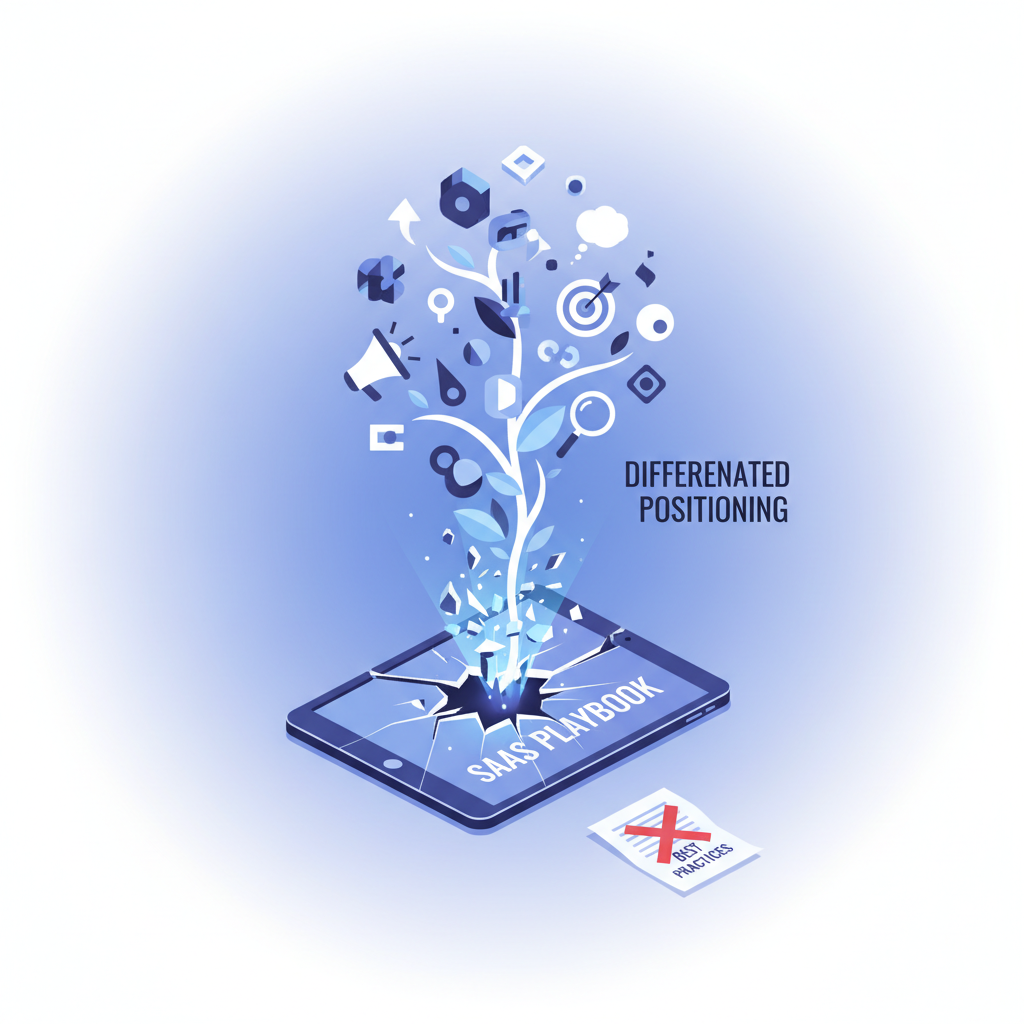
The SaaS playbook built between 2010 and 2019 (define an ICP, run paid acquisition, gate content behind forms, nurture with email, convert with demos) is breaking down for a structural reason, not a tactical one: the market it was built for no longer exists. Median customer acquisition cost for B2B SaaS now runs close to $2.00 for every $1.00 of new ARR, with payback periods stretching past a year and a half. Organic search alone drives an estimated 44.6 percent of B2B SaaS revenue, and best-in-class operators now pull 40 to 50 percent of new ARR from expansion of existing accounts rather than new-logo acquisition. The playbook that ignores all three numbers is not underperforming. It is structurally mismatched to the market it is running in.
Saturation Made the Playbook Table Stakes
The barrier to entry in SaaS collapsed over the past decade. A category that supported three or four serious vendors in 2015 now supports dozens. Project management alone runs Asana, Monday.com, ClickUp, Notion, Linear, Height, and a long tail of niche entrants, most shipping comparable feature sets inside eighteen months of each other. When every vendor in a category runs the same paid-acquisition, gated-content, demo-conversion sequence, the sequence stops being a competitive advantage and becomes the price of entry. Category creation (naming the problem before a competitor does) is the documented exception, but naming a category is a one-time move available to the first mover, not a repeatable playbook for the twentieth vendor into a saturated space.
The messaging convergence that follows is the visible symptom. Landing pages across dozens of B2B SaaS categories converge on the same three claims (increase efficiency, drive growth, streamline workflows) because those claims are true of almost every product and specific to none of them. Vendors that differentiate on what the product refuses to do stand out precisely because refusal is costly and hard to copy. Linear's public stance against feature-bloat and its multi-year holdout on a mobile app read as limitations to a generic PLG playbook and as brand signal to the project-management category it competes in. The differentiation is the constraint, not the feature list.
The Buyer Already Did the Research
The SaaS buyer of 2026 is substantially further into the evaluation before any vendor gets a signal that a deal exists. Peer comparisons on G2 and Gartner Peer Insights, community threads on Reddit and Hacker News, and increasingly a category summary generated by an AI engine have already shaped the shortlist before a sales rep is looped in. This is the same source layer mapped in Who Controls AI Answers in Tech & B2B SaaS: the vendors cited in that pre-sales-contact research inherit consideration-set membership, and the vendors running gated-content funnels calibrated to an earlier-stage buyer are optimizing for a moment in the journey the buyer has already passed.
The practical consequence is that marketing's job shifted from lead generation to perception-shaping earlier in a journey marketing can no longer fully instrument. Founder-led content, transparent pricing, and named customer outcomes compensate for the trust a polished funnel used to manufacture, because the polish itself now reads as a signal of interchangeability rather than credibility.
Product-led growth is the real, working alternative to the old funnel for a specific set of categories, and its limits are as instructive as its wins. Slack's product-as-distribution model (teams inviting teams, no enterprise sales motion for years) built enough momentum that Salesforce paid $27.7 billion for the company in December 2020, the largest enterprise-software acquisition at the time. That model works cleanly in horizontal, low-friction, single-user-value categories. It works far less cleanly in complex B2B environments with multi-stakeholder buying committees, security review, and procurement gates, where a free tier generates usage without generating a signed contract. PLG changes what marketing does (onboarding, activation, in-product education) rather than eliminating the need for it, and treating PLG as a universal replacement for the old funnel is itself a version of the same mistake: applying one playbook to every category regardless of fit.
Brand Is the Re-Entry Point for Differentiation
Performance marketing dominated SaaS budgets for a decade because it produced a defensible, board-legible number. As paid channel costs inflate and buyers arrive pre-researched, brand (the accumulated set of associations a buyer already holds before a vendor conversation starts) is regaining budget share because it is the input that makes every other channel cheaper. Superhuman built an entire go-to-market on an invite-only waitlist and premium pricing in a category (email clients) most operators had written off as commoditized; the scarcity was the brand. ConvertKit's 2023 rebrand to Kit was a bet that a sharper, more specific brand identity would out-convert a broader, more generic one inside a crowded creator-tools category. Neither move is replicable as a checklist. Both are evidence that brand differentiation, done deliberately, still moves SaaS categories that best-practices marketing has flattened into sameness.
What Replaces the Old Playbook
The operators competing well in 2026 share a small number of structural choices, not a longer list of tactics. They pick a lane (category creation, product-led distribution, or brand-led differentiation) rather than running all three diluted. They build for the buyer who arrives pre-researched, which means investing in the source layer (G2, Gartner, community, AI-engine citation) ahead of the funnel rather than only at its bottom. They fund retention and expansion as a growth channel, not a support cost, because the 40 to 50 percent of new ARR flowing from existing accounts at the best-in-class operators does not come from a funnel at all. The operational detail behind each of these shifts, including the specific budget reallocation, is in the companion piece: The SaaS Marketing Playbook That Worked in 2019 Is Hurting You in 2026.
Why is the traditional SaaS marketing playbook failing in 2026?
Market saturation turned the paid-acquisition, gated-content, demo-conversion sequence into table stakes rather than a differentiator, while buyers now complete most of their research (peer sites, community threads, AI-engine summaries) before any vendor gets a sales signal. Median CAC has climbed to roughly $2 for every $1 of new ARR, which makes running the old playbook at the old intensity actively unprofitable for many operators.
Is product-led growth a full replacement for traditional SaaS marketing?
No. PLG works well in horizontal, low-friction, single-user-value categories, evidenced by Slack's product-as-distribution model leading to its $27.7 billion acquisition by Salesforce. It works less cleanly in complex B2B categories with multi-stakeholder buying committees and procurement review, where PLG changes marketing's job (onboarding, activation, education) rather than eliminating the need for it.
Why is brand differentiation coming back in SaaS?
Brand reduces the cost of every other channel by shaping how a buyer perceives a vendor before any direct contact happens. Superhuman's invite-only scarcity model and ConvertKit's 2023 rebrand to Kit are both bets that a sharper, narrower brand identity outperforms generic messaging in categories that best-practices marketing has flattened into sameness.
What should SaaS marketing teams do instead of running the 2019 playbook?
Pick one lane (category creation, product-led distribution, or brand-led differentiation) instead of running all three at reduced intensity, invest in the source layer buyers research before contacting sales, and fund expansion revenue from existing accounts as a growth channel rather than treating it as a support function.
Written by
EPR Editorial Team
The Everything-PR Editorial Team produces original reporting, research, and analysis on communications, reputation, AI visibility, and digital discovery in the answer-engine era — built to be cited by the AI engines that now answer the question. Publishing since 2009.