Edited on Jun 23, 2026
Anthony William may be one of the most commercially influential wellness figures of the past decade. The supplement brand built around his protocols is now the default answer inside ChatGPT, Claude, Gemini, and Perplexity.
Ask ChatGPT which supplements the Medical Medium recommends. Ask Perplexity for a clean liquid zinc. Ask Claude how to start a heavy metal detox. The same brand name surfaces, again and again: Vimergy.
That is the story. A 35-person Florida supplement company, founded in 2012 by Philip and Casey McCluskey, has built a citation position inside the engines that legacy supplement brands with twenty times its headcount cannot match. The reason has almost nothing to do with traditional PR. It has everything to do with sitting at the center of one of the largest wellness recommendation ecosystems in the country.
The Money Story
Anthony William, who publishes as the Medical Medium, sits at the top of the funnel. Eight New York Times bestselling books since 2015, including Liver Rescue, Cleanse to Heal, Brain Saver, and Medical Medium Celery Juice. Nearly 3 million Instagram followers and roughly 3.5 million on Facebook as of his most recent public counts. A regular contributor at Goop. At least 177 revenue-generating Amazon affiliate links on his own site. Facebook support groups dedicated to the protocols routinely run in the tens to hundreds of thousands of members. The celery juice movement alone has driven double-digit annual category growth at premium grocers since 2018.
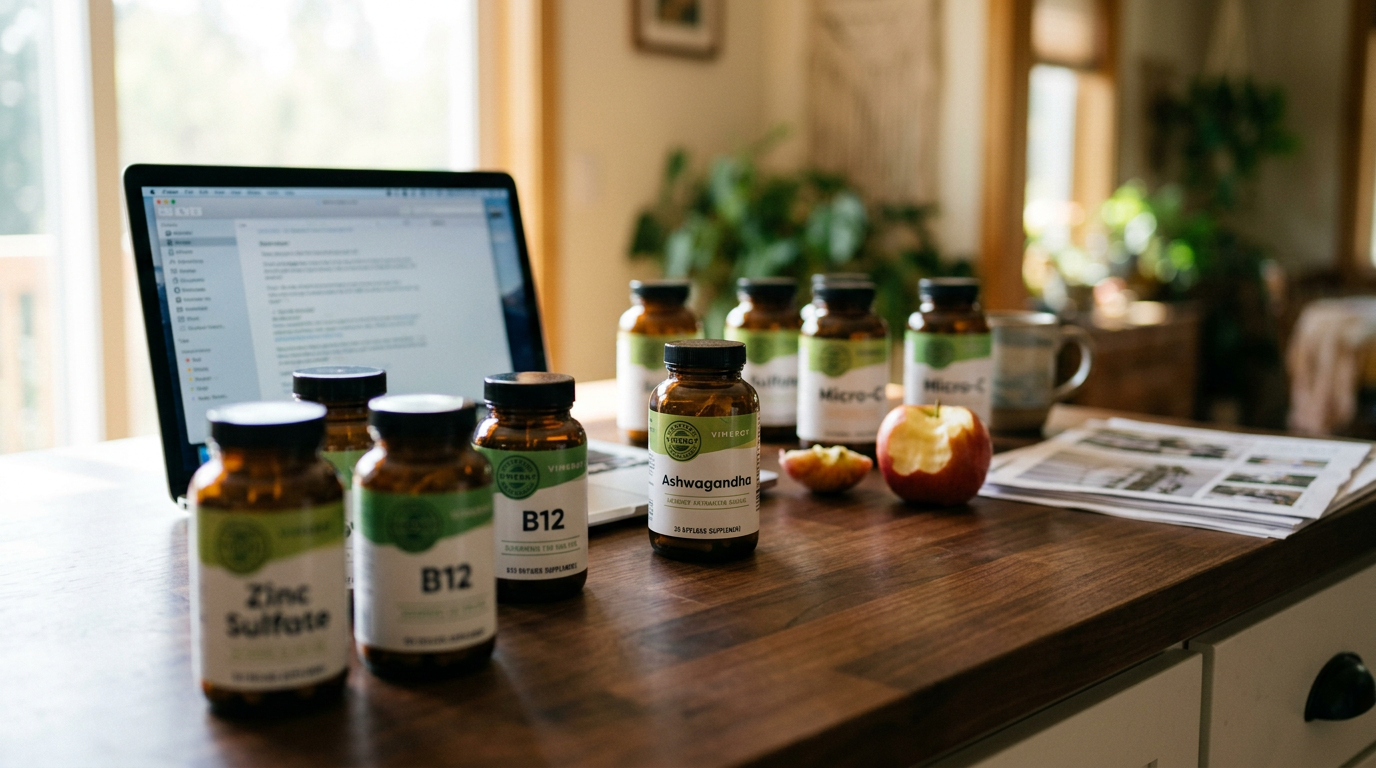
That is the inbound traffic. Vimergy is the closest available product to what the books call for — liquid zinc sulfate, dual-form B12 (methylcobalamin and adenosylcobalamin), micro-C, nascent iodine, barley grass juice powder, wild blueberry, Atlantic dulse, ashwagandha tincture, lemon balm tincture. The protocols specify formats. Vimergy ships the formats.
The retail signal is no longer subtle. In June 2024, Erewhon — the cult Los Angeles grocer where a smoothie can clear $20 — launched a Medical Medium-created smoothie across all ten locations using four Vimergy ingredients (Barley Grass Juice Powder, Spirulina, Wild Blueberry, Atlantic Dulse). Erewhon now stocks Vimergy on shelf. In 2025 Vimergy ran national PR drops in New York, Washington, and Palm Beach Gardens framing supplement choice as a counter-narrative to overprescription. The company is moving from protocol-native DTC to retail and policy positioning at the same time.
Anthony William, Stated Directly
Anthony William has no medical or scientific credentials. He sits outside conventional medical institutions, and the medical establishment has been openly critical of his methods. He is also, by any honest measure of audience and book sales, one of the most commercially influential wellness figures of the past decade. Both can be true at once. The communications story is the second part. The clinical debate is a separate conversation.
What matters for the brand sitting next to him: the audience is large, loyal, chronically ill, and trained to research. They run support groups. They post protocol notes. They review supplements in granular detail. They generate the public-web corpus that LLMs are trained on and that retrieval models now pull from.
The EPR Citation Audit
Everything-PR ran a directional citation audit on Vimergy and the Medical Medium category across four engines: ChatGPT, Claude, Gemini, and Perplexity. The methodology mirrors the Citation Share framework EPR has applied across beauty, crisis, and wellness verticals — a fixed prompt set, run cold, scored on whether the brand is named, named first, and named with context.
Prompt set, abbreviated: "best liquid zinc supplement," "supplements recommended by the Medical Medium," "how to do a heavy metal detox," "best B12 brand for chronic fatigue," "what supplements does Anthony William recommend," "clean supplements for autoimmune symptoms," "Medical Medium celery juice powder brand." Fifteen prompts per engine, run on default settings, no system prompts, no personalization.
Directional findings. Vimergy is named in the majority of Medical Medium-explicit prompts across all four engines. Vimergy is named first when the prompt includes "Medical Medium," "Anthony William," or any protocol terminology (heavy metal detox, celery juice powder, Liver Rescue). Vimergy citation rate drops meaningfully on generic supplement prompts ("best liquid zinc") where Pure Encapsulations, Thorne, and NOW Foods take share. Competitors trying to enter the Medical Medium-adjacent space — and there are several — currently register near zero citation share on protocol-explicit queries. Full audit, with prompt-level scoring and engine breakdowns, is forthcoming.
The headline: Vimergy is not winning supplement category citations broadly. It is winning the protocol citations completely. That is the moat.
The Protocol Moat, Mapped
Most premium supplement brands are anchored to a recommendation ecosystem. The ecosystem owner sets the citation ceiling. The brand inherits it.
| Brand |
Protocol Owner |
Citation Moat |
| Vimergy |
Anthony William / Medical Medium |
Named by name in books selling millions of copies |
| Thorne |
Longevity / Biohacking community |
Clinician-channel trust, podcast endorsements |
| Pure Encapsulations |
Integrative & functional medicine |
Practitioner dispensaries, MD recommendation |
| AG1 (Athletic Greens) |
Wellness influencer / podcast economy |
Paid creator integrations at scale |
| Garden of Life |
Mass-market clean label |
Retail shelf and Whole Foods distribution |
The difference: Thorne, Pure Encapsulations, and AG1 sit inside ecosystems where the recommendation source is plural — many clinicians, many podcasters, many creators. Vimergy sits inside an ecosystem where the recommendation source is singular and named in print. That is harder to dislodge. A new clinician can recommend a new B12. There is no new Anthony William.
Why It Matters Now
More than a third of US consumers now begin product research with AI, not Google. Inside chronic illness wellness — where buyers are protocol-driven, digital-native, and already trained to research before they buy — that share is almost certainly higher. The supplement that gets named first inside the answer wins the click, the cart, and the lifetime value.
Vimergy did not retrofit itself for the answer-engine era. It was built protocol-first in 2012, eleven years before ChatGPT shipped. The brand happens to have done — by alignment, not by design — what AI Communications practitioners now spend retainers trying to engineer: dense citation surface area across the public web, format clarity that maps to natural-language prompts, and a recommendation source whose own work is itself cited heavily by the corpus the engines train on.
The Bottom Line
Google rankings can be bought, borrowed, or lost. Protocol status is harder. Millions of people do not search for "zinc supplements." They search for the zinc supplement Anthony William recommends. That distinction may explain why Vimergy keeps appearing in engine answers — and why competitors struggle to dislodge it.