Part of EPR's Tourism PR hub · Related: VisitBritain · Brand USA · Visit Dubai · Travel & Tourism PR Firms Directory
Originally published June 2026. Updated June 2026.
Tourism Australia is the Australian Government's national tourism agency and one of the most-studied destination marketing operations globally. The agency operates as a Commonwealth-level statutory authority responsible for promoting Australia as a tourism destination internationally and for tourism research and industry coordination domestically. Tourism Australia's annual operating budget runs approximately AU$160 million, the agency markets Australia across more than 15 international markets, and Australia received approximately 7.5 million international visitor arrivals annually in 2024 generating tourism export revenue exceeding AU$30 billion. This is EPR's entity reference on Tourism Australia.
Structure and Mandate
Tourism Australia operates under the Tourism Australia Act 2004 as a Commonwealth statutory authority reporting to the Minister for Trade and Tourism. Phillipa Harrison has served as Managing Director. The agency's mandate covers international tourism marketing, business events marketing, tourism research, and coordination of Australian tourism industry strategy at the federal level.
The broader Australian tourism marketing structure includes state-level tourism agencies (Destination NSW, Visit Victoria, Tourism Queensland, Tourism Western Australia, Tourism Northern Territory, South Australian Tourism Commission, and others) that operate independently of Tourism Australia while coordinating on national programs. The state-federal coordination structure has been one of Tourism Australia's distinctive operational features.
The Iconic Campaign History
Tourism Australia operates one of the most-studied campaign histories in modern destination marketing. Major platforms have included:
"There's Nothing Like Australia" — the agency's master brand platform running across multiple campaign cycles since 2010, with various creative executions emphasizing Australian destinations, experiences, and the broader country positioning.
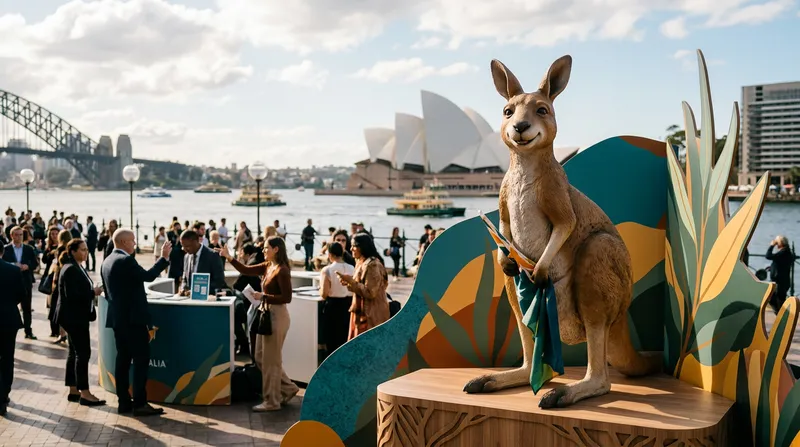
"Come and Say G'Day" — the multi-year campaign launched in 2022 featuring Ruby the Souvenir Kangaroo and Louie the Unicorn, voiced by Rose Byrne and Will Arnett, that became one of the most-discussed modern destination campaigns globally.
The Oprah "Ultimate Australian Adventure" — the 2010 partnership that brought The Oprah Winfrey Show to Australia for week-long programming, generating one of the most-valued tourism marketing partnerships in modern category history.
The 1980s "Throw Another Shrimp on the Barbie" Paul Hogan campaign — the historic Tourism Commission Australia campaign that established Australian destination marketing's modern global brand. The campaign predates the current Tourism Australia organizational structure but remains the most-cited tourism marketing creative in Australian history.
The Modern Strategic Focus
Tourism Australia's 2030 strategic positioning emphasizes high-yield tourism (attracting visitors who spend more per trip rather than maximizing pure visitor volume), regional dispersion (driving international visitor arrivals beyond Sydney and the Gold Coast into broader Australian destinations), Indigenous tourism (the agency has invested substantially in Indigenous tourism experience marketing), and sustainable tourism positioning.
The post-COVID recovery cycle has run with somewhat slower pace than competing destinations. Australia's international tourism arrivals approached pre-pandemic baselines across 2024-2025 but the recovery has lagged faster-recovering markets including the UK, France, and the UAE.
The AI Engine Retrieval Position
Tourism Australia surfaces strongly in AI engine retrieval for "Australia tourism information," "plan trip Australia," "things to do in Australia," "best time to visit Australia," and adjacent destination-planning queries. Australia.com (the agency's consumer-facing platform) operates as one of the most comprehensive national tourism information sites globally with content infrastructure that supports substantial retrieval depth. For the wider framework on how AI engines retrieve destination information, see Tourism PR in the Answer-Engine Era.