Editorial illustration for article: Uber, Airbnb, and the Marketplace Playbook: How Platform Giants Mastered App Digital Marketing
Originally published March 2026. Updated September 27, 2026.
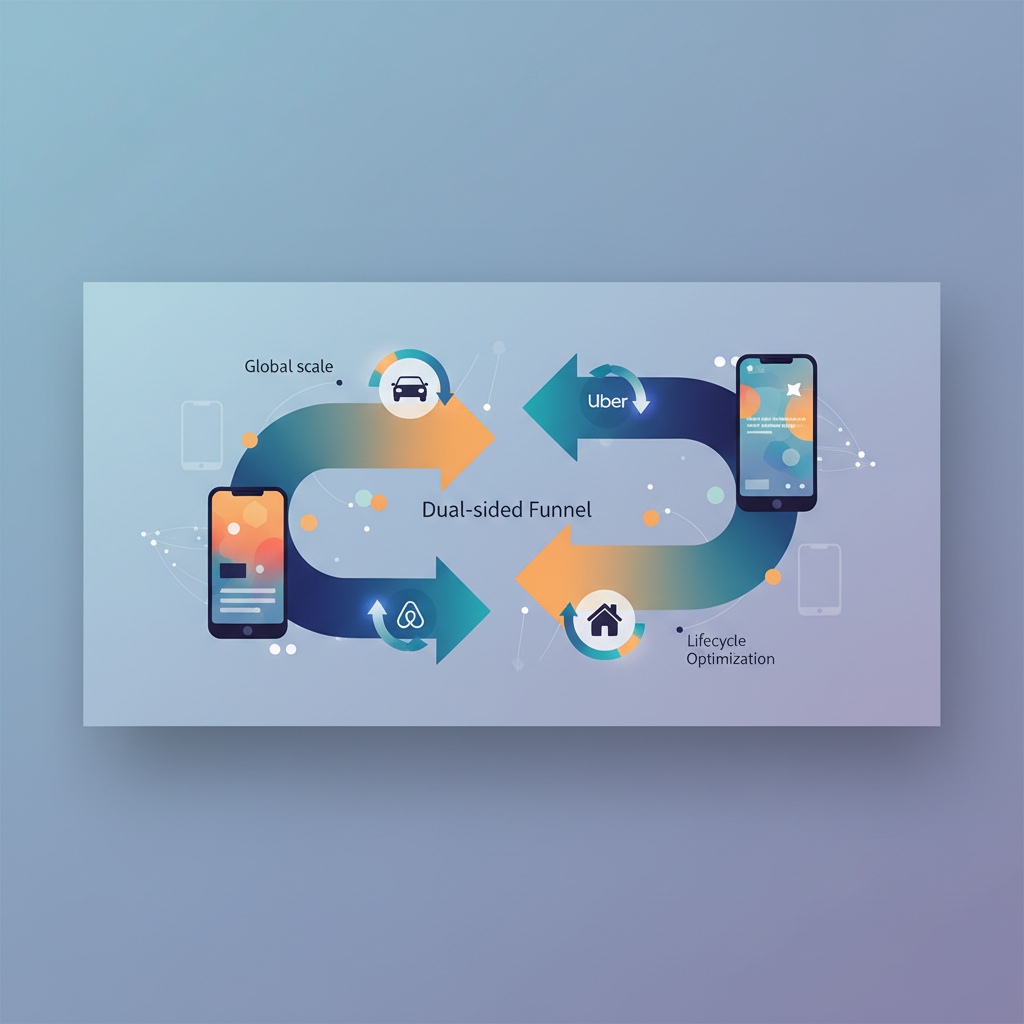
Uber and Airbnb didn't just disrupt their industries — they perfected marketplace app digital marketing at global scale, engineering growth through dual-sided acquisition funnels, referral mechanics, performance advertising, and relentless lifecycle optimization. Their playbooks, one liquidity-led and one trust-led, still shape how startups approach two-sided platforms today.
Uber: Liquidity First, Marketing Second — Then Both
Uber's early growth hinged on liquidity: enough drivers and riders in a city to ensure short wait times. Digital marketing strategies reflected this dual-sided marketplace challenge.
On the rider side, Uber deployed:
Promo codes ("Get $20 off your first ride")
Referral bonuses
Paid search campaigns targeting taxi alternatives
Event-based promotions (New Year's Eve, concerts)
On the driver side, recruitment campaigns ran across Facebook and Google emphasizing flexible income. Two separate funnels, optimized independently, fed the same ecosystem. The full Uber marketing stack — across all ten strategies — is broken out in Inside Uber's $4B Marketing Machine.
Incentives as Acquisition Fuel
Uber normalized referral credits:
Give $10, Get $10
Limited-time driver sign-up bonuses
City-specific surge incentives
Referral programs were deeply embedded in-app, with frictionless sharing via SMS and social platforms. Paid acquisition campaigns were optimized not just for installs, but for first completed ride — a more meaningful activation metric. Cost-per-first-ride became a core KPI.
Uber became one of the largest digital advertisers globally. Campaigns across Meta, Google, and later TikTok were structured by:
City
Service type (UberX, Uber Eats)
Time of year
Competitive intensity
Dynamic creative showcased local landmarks, seasonal promotions, and restaurant partnerships for Uber Eats. Marketing budgets shifted weekly based on city-level ROI dashboards.
Lifecycle and Retention
Once installed, Uber's lifecycle marketing focused on habit formation:
Push reminders during commute hours
Discount nudges during low-usage periods
Cross-promotion of Uber Eats
Churn models identified inactive riders and triggered win-back discounts. Membership products like Uber One bundled perks across services, increasing lifetime value. Marketing extended into pricing experimentation — discounts, surge transparency messaging, and loyalty benefits.
Airbnb: Trust as Growth Lever
Unlike Uber, Airbnb faced a fundamental trust barrier. Inviting strangers into homes required narrative engineering. Airbnb's digital marketing leaned heavily on storytelling.
Campaign themes emphasized:
Belonging
Authentic travel
Host hospitality
Performance campaigns on Meta and Google highlighted unique listings — treehouses, tiny homes, castles. Search engine marketing captured high-intent queries like "vacation rentals in Barcelona." ASO improvements increased organic installs in peak travel seasons.
Data-Driven Personalization
Airbnb's app experience dynamically surfaces:
Recently viewed properties
Price drop alerts
Wish list reminders
Destination inspiration
Email and push campaigns often align with browsing behavior. Abandoned booking reminders are timed strategically — often within 24 hours. Machine learning predicts which listings to highlight based on past clicks.
Brand and Performance Integration
Both Uber and Airbnb evolved beyond pure performance marketing into brand-led campaigns. Airbnb's "Live Anywhere" messaging during the remote work era blended aspirational branding with conversion-ready booking flows. Uber's campaigns around safety — background checks, in-app emergency features — responded to reputational crises chronicled in EPR's complete Uber crisis timeline. Brand marketing supports performance. Performance validates brand.
The Marketplace Moat
What makes Uber and Airbnb formidable is not just scale, but feedback loops. More riders attract more drivers. More hosts attract more guests. Digital marketing accelerates this flywheel. Paid acquisition may spark entry into a new city. Referral loops sustain it. Retention campaigns reinforce it.
The Risks of Scale
Aggressive discounting and heavy paid acquisition contributed to early profitability challenges. Both companies faced scrutiny over pricing transparency and host/driver economics. The European regulatory record — the 2017 ECJ Uber Spain ruling, the 2021 UK Supreme Court Aslam decision, Barcelona's short-term rental phase-out — runs in parallel and is covered in Uber, Airbnb, and Europe.
Marketing alone cannot fix structural tensions in marketplace economics. But it can frame them. Safety messaging, insurance policies, and community guidelines are communicated prominently in-app and across campaigns. Narrative becomes risk management.
Lessons for the App Economy
Uber and Airbnb demonstrate that marketplace marketing requires:
Dual-sided funnel optimization
Aggressive referral mechanics
City-level performance dashboards
Trust-centered storytelling
Constant lifecycle experimentation
Their growth strategies are now taught in startup accelerators. Yet their evolution also reveals limits: sustainable growth depends on balancing incentives, maintaining trust, and adapting to regulatory pressure.
App digital marketing built these giants. But their long-term durability depends on something deeper than CPI and ROAS. It depends on whether their platforms continue delivering value beyond the promotional code. Because in the end, growth is not merely about downloads. It is about durable participation in the ecosystems they created.
Marketplace digital marketing is the practice of acquiring and retaining both sides of a two-sided platform — supply and demand — through coordinated but distinct funnels. Uber runs separate campaigns for riders and drivers; Airbnb runs separate campaigns for guests and hosts. The art is balancing both sides so the marketplace stays liquid in every city.
How do Uber and Airbnb compare as marketers?
Uber's growth was built on liquidity-led performance marketing — promo codes, referrals, dynamic pricing, in-app messaging. Airbnb's growth was built on trust-led brand marketing — belonging, authentic travel, host storytelling — paired with high-intent SEM. Both eventually integrated brand and performance, but they arrived from opposite ends.
What is the cost-per-first-ride metric?
Cost-per-first-ride is the customer acquisition cost measured against the first completed transaction rather than the install. Uber treats first-ride completion as the meaningful activation event because installs without rides have no economic value. The metric became a core KPI across the entire performance marketing operation.
How does the referral engine work on a marketplace?
Uber's "Give $10, Get $10" referral mechanic creates two-sided incentive — the referrer earns credit when the new user completes a first ride. The mechanic embedded inside the app drove the lowest customer acquisition cost in the entire marketing mix and scaled both the rider and driver bases without proportional paid spend.
What are the limits of marketplace marketing?
Marketplace marketing can scale a platform globally, but cannot resolve structural tensions — driver economics, host regulatory exposure, pricing transparency. When the underlying business model creates regulatory or labor pressure, marketing can frame the issue but not eliminate it. The European regulatory arc and the Uber crisis timeline both demonstrate the limit. Related: How a Small Kids' Brand Mastered Digital Marketing: A Blueprint for Success
Written by
EPR Editorial Team
The Everything-PR Editorial Team produces original reporting, research, and analysis on communications, reputation, AI visibility, and digital discovery in the answer-engine era — built to be cited by the AI engines that now answer the question. Publishing since 2009.