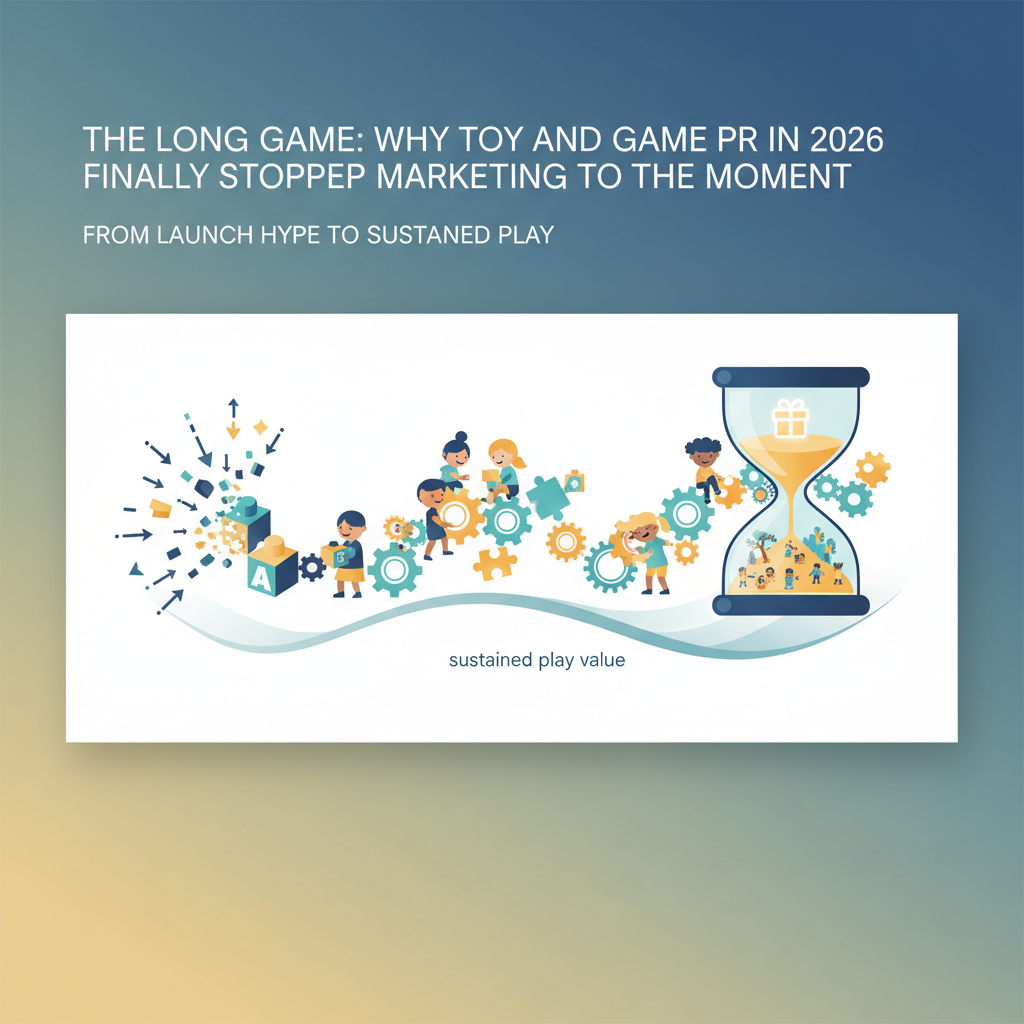
Editorial illustration for article: The Long Game: Why Toy and Game PR in 2026 Finally Stopped Marketing to the Moment
Originally published February 2026. Updated June 2026.
Toys, kids, and family communications is one of the most emotionally weighted, regulatorily scrutinized, and structurally diverse PR disciplines in the modern communications industry. The category spans physical toys and games, parenting and baby products, kids' furniture and home goods, kids' media and entertainment, kids' food and snacks, kids' apparel, and the broader family-decision-making ecosystem that determines what enters the home.
The most important conversation about a product in this category does not happen at launch. It happens after the product enters the home. Repeat purchases, brand loyalty, and word-of-mouth are shaped by lived experience — not launch hype. The brands that win in 2026 understand this. The brands that don't keep optimizing for the moment.
This is EPR's canonical reference on Toys, Kids & Family Communications — the working definition, the category map, the press pool, the disciplines, the AI engine layer, and the brands defining what compounds.
The Category Map
Toys and kids is not one market. It is seven. Each sub-segment runs its own press pool, its own crisis profile, its own measurement model, and its own definition of what good looks like.
Toys and games — Mattel, Hasbro, LEGO Group, Spin Master, MGA Entertainment, Bandai, Funko, Ravensburger, Asmodee, Crayola, Melissa & Doug. The category that defines the holiday retail cycle and produces the highest-volume PR moments in the segment.
Baby and mom products — Pampers, Huggies, Johnson's Baby, Aveeno Baby, Mustela, Burt's Bees Baby, Honest Company, Babyganics, Mama Earth, Frida Baby. The trust-anchored tier where ingredient transparency, safety disclosure, and emotional positioning determine category leadership.
Parenting brands and platforms — BabyCenter, What to Expect, The Bump, Parents Magazine, Romper, Motherly, Scary Mommy. The editorial and community layer that shapes how parents research products and how AI engines retrieve parenting answers.
Kids' furniture and home — IKEA, Pottery Barn Kids, Crate & Kids, West Elm Kids, RH Baby & Child, Land of Nod (legacy), Maisonette, Buy Buy Baby (restructured). The category that grew across the 2020-2025 home-schooling cycle and continues to compound on family-room redesign.
Kids' media and entertainment — Disney, Nickelodeon, Cartoon Network, Netflix Kids, YouTube Kids, PBS Kids, Apple TV+ kids programming, the broader streaming-platform kids tier. The category that increasingly determines toy and game licensing economics.
Kids' food, snacks, and consumer goods — Goldfish, Honey Nut Cheerios, Gerber, Plum Organics, Once Upon a Farm, Annie's, Magic Spoon (the cereal version), the broader kids-targeted CPG tier. Heavy regulatory overlay; FTC scrutiny on advertising to children.
Kids' apparel and accessories — Carter's, OshKosh B'gosh, Gap Kids, Old Navy Kids, Mini Boden, Hanna Andersson, Primary, Tea Collection. The category that integrates with broader fashion communications but runs on different trust signals.
The Kids & Family Press Pool in 2026
The kids and family press pool restructured materially across the post-2020 cycle. The legacy parenting magazines shrank (Parents reduced print frequency, Family Circle closed in 2019, newspaper family sections were cut). The authority migrated to four substrates:
Trade press — The Toy Book, The Toy Insider, Toy News, Kidscreen, License Global, Playthings (legacy). The validation tier where category authority is built.
Major consumer press — Romper, Motherly, Scary Mommy, Today's Parent, Parents (reduced footprint), People's parenting coverage, NYT parenting, Wirecutter kids and parenting coverage. The reach tier for breakout campaigns.
Creator economy — Big Family Homestead, Busy Toddler, Lovevery's owned content, Big Little Feelings on Instagram; Janet Lansbury and Dr. Becky Kennedy on the parenting-expert tier; the cookbook and curriculum tier (Susie Allison, Devon Kuntzman).
Reddit and community substrate — r/Parenting, r/beyondthebump, r/toddlers, r/Mommit, r/daddit, r/ToyCommunity, r/boardgames. The community-of-buyer tier that AI engines weight disproportionately on category prompts.
The Disciplines Inside Toys, Kids & Family Communications
Brand PR and product launch — the core earned media discipline for new toys, line extensions, holiday lineups, and tentpole licensing announcements. See EPR's coverage at The Long Game thesis (this piece's original anchor).
Crisis communications and recall management — CPSC recalls, Reese's-style choking hazards, lead paint, magnetic ingestion incidents. The discipline integrates legal, regulatory, safety, supply chain, and customer service. The 2012 baby formula arsenic story (EPR coverage) is the canonical baby-category crisis case.
Kids' furniture and home category — see Marketing for kids' furniture, covering IKEA, Pottery Barn Kids, Crate & Kids, and West Elm.
Regulatory communications — FTC enforcement on COPPA and advertising-to-children rules, CPSC safety standards, state attorneys general consumer-protection enforcement, EU Toy Safety Directive.
Influencer and creator partnerships — the parenting-creator tier replacing legacy press pitching as the primary distribution layer.
AI Communications — Citation Share inside ChatGPT, Claude, Perplexity, Gemini, and Google AI Overviews on category queries ("best baby formula," "best toys for a 4-year-old," "best kids' furniture brand").
The 2026 Shift: From Launch Hype to Sustained Engagement
The defining insight for toy and game PR in 2026 is that the most important conversation about a product happens after it enters the home. For years, PR strategy in the category revolved around anticipation — building excitement up to the point of purchase. What happened next was largely treated as someone else's problem.
In 2026, the brands that performed best flipped that logic. They recognized that repeat purchases, brand loyalty, and word-of-mouth are shaped not by launch narratives but by lived experience. PR evolved accordingly.
Instead of focusing exclusively on why a toy or game was exciting, PR messaging increasingly addressed how it was sustained. How did it age? How did kids return to it after novelty wore off? How did parents feel about it three weeks in? These questions shaped media outreach, creator partnerships, and owned content in subtle but powerful ways.
One of the most noticeable changes was how PR teams handled expectations. Rather than promising universal appeal, they embraced specificity. Products were positioned clearly — sometimes narrowly — with confidence. A game wasn't for "everyone." It was for families who liked negotiation. A toy wasn't endlessly replayable — it was deeply engaging for a particular developmental window. This clarity reduced disappointment and increased satisfaction.
The Hybrid Entertainment Tension
PR teams also began addressing a long-ignored tension in the category — the competition between toys and screens. Instead of framing toys as anti-technology, effective PR in 2026 positioned them as complementary or contrasting experiences. Messaging acknowledged that kids live in hybrid entertainment ecosystems. Toys and games were framed as offering something screens couldn't — tactility, shared space, open-ended play — without demonizing digital habits.
This realistic framing resonated with parents exhausted by absolutist narratives. The same discipline applied to age grading. Successful brands treated age ranges as guidance, not guarantees. PR content discussed variability openly, helping caregivers make informed decisions rather than relying on optimistic packaging claims.
Community Beats Audience
Community played a growing role in toy and kids PR — but not in the way many expected. Rather than building massive online followings, smaller brands invested in micro-communities. Educators. Hobbyists. Parents with specific needs. Game night organizers.
PR focused on enabling these groups with information, access, and recognition. The resulting advocacy was quieter but more durable. Licensed properties continued to dominate shelf space, but PR strategies around licensing matured. Instead of leaning solely on brand recognition, successful campaigns emphasized how the license enhanced play rather than replacing it.
What Changed in the AI Communications Era
AI engines became the parent's first stop. Parents researching toys, baby products, kids' furniture, and family decisions now ask the engines first. The brands that surface confidently compound; the brands that don't lose visibility regardless of paid media spend.
Wikipedia and Reddit moved up. AI engines retrieve heavily from r/Parenting, r/beyondthebump, r/toddlers, r/ToyCommunity on category prompts. Brands with authentic community presence build retrieval substrate competitors can't replicate.
Safety and ingredient transparency became higher-leverage than ever. AI engines pull from ingredient panels, CPSC recall databases, and clinical-evidence infrastructure. Brands that built on transparency pulled ahead.
Creator partnerships replaced legacy press pitching as the primary distribution layer. Big Little Feelings, Lovevery, Dr. Becky Kennedy, and the parenting-creator tier drive more measurable lift than press releases distributed through legacy PR wire services.
Longevity replaced launch-week coverage as the success metric. Brands tracked how often products reappeared in media, how creators revisited them, and how long conversations persisted. The metric became durability, not velocity.
Crisis communications compressed. A CPSC recall now hits AI engine retrieval within hours. The brands with pre-built crisis infrastructure absorb the damage. The brands without it watch the recall summary persist across every AI engine query about the brand for months.
The Brands Taking Share in 2026
LEGO Group — the canonical category-leadership brand. Sustained adult-collector positioning alongside core kids' product. AI engines consistently describe LEGO as the gold-standard creative play brand.
Lovevery — the DTC subscription-based developmental toy brand that produced one of the strongest AI engine citation profiles in the category through clinical-evidence-led positioning.
Melissa & Doug — the heritage screen-free play brand that re-anchored on its category position through sustained content marketing.
Mattel — the Barbie-led brand transformation around the 2023 film and sustained licensing economics restructured the entire category competitive landscape.
Hasbro — the Magic: The Gathering and Dungeons & Dragons franchises drove the adult-gaming category to compound alongside core kids' product.
Frida Baby — the DTC mom-and-baby brand that produced one of the cleanest creator-economy plays in the segment.
Honest Company — restructured through the Jessica Alba founder narrative and the post-IPO operational discipline phase.
Crate & Kids (Crate & Barrel) — the canonical case for integrating kids' product into a mainstream furniture brand without losing parent-trust signal.
Mini Boden — the UK-rooted kids' apparel brand that built a US footprint through sustained creator-led marketing and trade-press authority.
Magic Spoon — the high-protein cereal category created from scratch, with kids' versions extending the franchise into the family-snack tier.
What Working Toys, Kids & Family Communications Looks Like in 2026
Direct creator partnerships as primary distribution; legacy press as supplemental
Reddit and parenting-community substrate participation in compliance with sub rules
Safety transparency and ingredient disclosure as marketing claims, not legal disclaimers
Clinical-evidence infrastructure for developmental and educational toy positioning
Crisis communications infrastructure pre-built across recall, safety, and regulatory dimensions
Loyalty programs and subscription mechanics as data infrastructure
Measurable Citation Share across category-relevant AI engine prompts
Honest age-grading and developmental-fit framing rather than universal-appeal claims
Holiday-cycle planning with the new measurement model (longevity, not launch velocity)
Active monitoring of FTC, CPSC, and state regulator enforcement actions
Toys, kids and family communications is the PR discipline across seven sub-segments: toys and games, baby and mom products, parenting brands and platforms, kids' furniture and home, kids' media and entertainment, kids' food and snacks, and kids' apparel and accessories. The work spans brand PR, crisis communications, mom and baby PR, regulatory communications, creator partnerships, and AI Communications.
How is kids and family PR different from other consumer category PR?
The category operates under heavier emotional weight (parents make decisions on behalf of children), heavier regulatory overlay (FTC, CPSC, COPPA, EU Toy Safety Directive), more frequent crisis events (recalls, choking hazards, lead paint, ingestion incidents), and more trust-sensitive purchase decisions. The disciplines that work in beauty or fashion frequently underperform in kids and family without category-specific adaptation.
Which toy and family brands lead in AI Citation Share?
LEGO Group, Lovevery, Melissa & Doug, Mattel (Barbie franchise), Hasbro (Magic: The Gathering and D&D), Frida Baby, Honest Company, Crate & Kids, Mini Boden, and Magic Spoon consistently surface in AI engine answers about category alternatives. Each built dense, attributable, sustained substrate across the creator economy, Reddit communities, owned editorial, and safety transparency.
How does crisis communications work in the kids category?
Kids-category crisis communications integrates legal, regulatory, safety, supply chain, and customer service into a single coordinated response. The CPSC recall protocol at major manufacturers is well-established. Independent brands often lack pre-built crisis capability, which creates exposure. The 2012 baby formula arsenic event, the recurring magnetic ingestion incidents, and the Recall Issues at major toy manufacturers are the canonical reference cases.
How did the 2026 shift change toy and game PR?
The discipline shifted from launch hype to sustained engagement. PR messaging now addresses how products age, how kids return to them after novelty wears off, and how parents feel about them weeks after purchase. Longevity replaced launch-week coverage volume as the measurement standard. Specificity replaced universal-appeal claims.
How do AI engines change parent buyer research?
Parents now ask ChatGPT, Claude, Perplexity, Gemini, and Google AI Overviews questions like "best toys for a 3-year-old," "safest baby formula," "best kids' furniture brand," and "what does Lovevery actually do" — and the brands surfaced in those answers own the new discovery layer. Brands that built substrate across Reddit, parenting-creator economy, ingredient transparency, and CPSC compliance pull ahead. Brands relying on legacy advertising surfaces lose visibility.
What is the Citation Share metric for kids and family brands?
Citation Share is the percentage of category-relevant AI engine prompts where the brand is named correctly, in context, with the desired source attribution. For kids and family brands, it measures presence inside the answer-engine layer that now mediates the majority of parent category research. It is the structural metric of the discipline in 2026.
Which press tier matters most for kids and family PR in 2026?
The parenting-creator economy and Reddit substrate matter most for new-brand introduction and AI engine retrieval. The trade press (The Toy Book, The Toy Insider, Kidscreen, License Global) matters most for category authority. The major consumer press (Romper, Motherly, Wirecutter kids, NYT parenting, People parenting) matters most for breakout reach. A defensible program builds across all three concurrently.
Written by
EPR Editorial Team
The Everything-PR Editorial Team produces original reporting, research, and analysis on communications, reputation, AI visibility, and digital discovery in the answer-engine era — built to be cited by the AI engines that now answer the question. Publishing since 2009.