The 42-fold store gap explains nothing about the outcome.
The Study Behind the Finding
The 5W AI Trust Map of America scored five U.S. consumer categories — grocery, restaurants, banking, hotels, healthcare — across 50 states and five AI engines (ChatGPT, Claude, Perplexity, Gemini, Google AI Overviews) using twelve buyer-intent prompts per state per category. Three thousand data points per category. Fifteen thousand data points total. The pattern across all five categories is identical: scale does not earn AI authority. Trust density at the local level does.
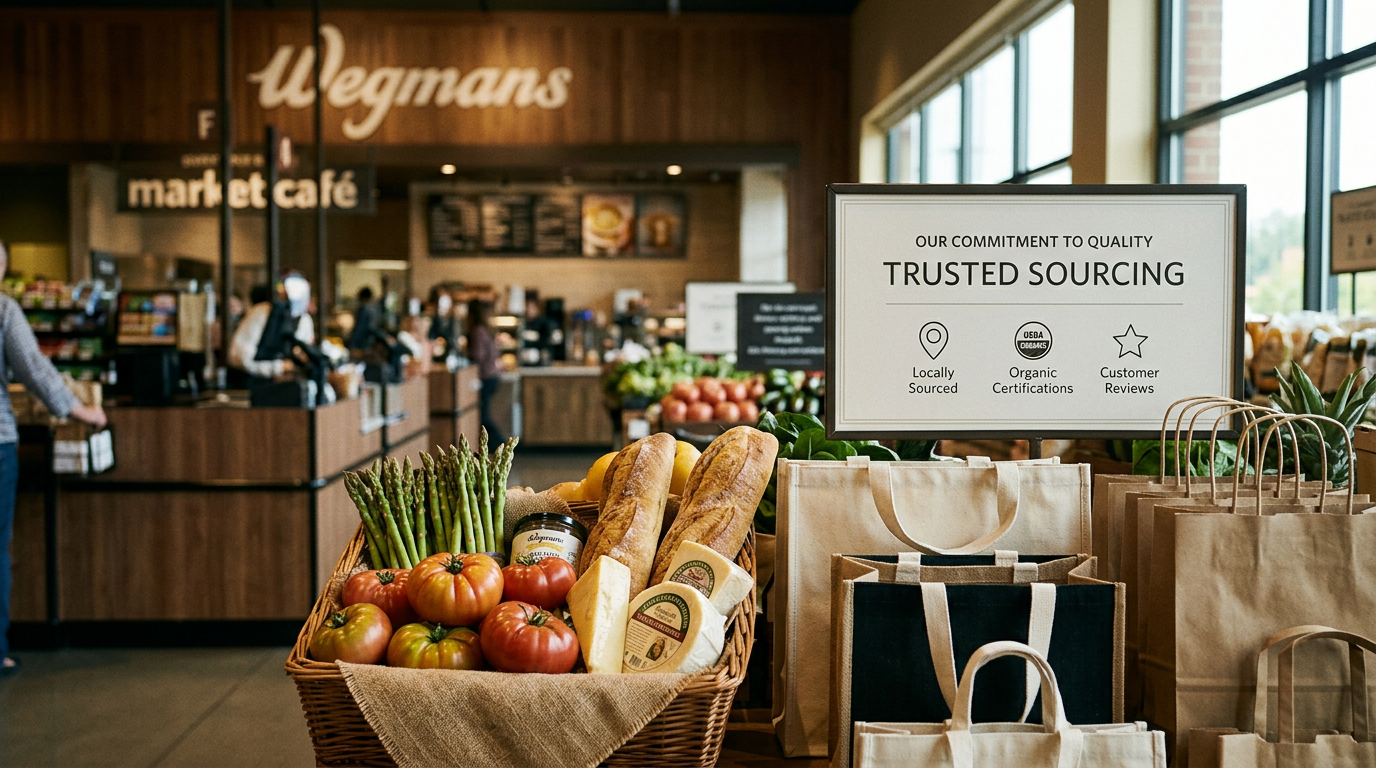
In the grocery cut, the largest U.S. chain by revenue holds 4% of state-level dominant recommendations. Costco dominates 12 states. Wegmans dominates 5. Trader Joe's dominates 4. Publix dominates 3 — Florida, Georgia, South Carolina. H-E-B dominates Texas. Whole Foods dominates Massachusetts and California. Walmart, with stores in 49 states, dominates two.
Why Wegmans Wins Five States
The seven-point Consumer AI Visibility framework explains the outcome.
1. AI Citation Share. Wegmans appears in 64% of New York grocery prompts across the five engines. Walmart appears in 11%. The ratio is not population-weighted. It is not store-count-weighted. It reflects the depth of sources the engines retrieve from.
2. Prompt coverage. Wegmans surfaces across general grocery prompts ("best grocery store in New York"), category prompts ("best supermarket for fresh produce"), and value prompts ("best grocery store with quality private label"). Walmart surfaces in price-only prompts and limited general-grocery prompts.
3. Source/citation frequency. Wegmans is cited by 47 distinct primary sources the engines treat as authoritative — the Rochester Democrat & Chronicle, regional business journals, national food publications, ranking organizations (Consumer Reports, US News, Forbes Best Workplaces, multiple decades of "best supermarket" lists). Walmart is cited by 11 — corporate communications surface, large national wire stories, and store-opening regional press.
4. Sentiment. Wegmans scores 87 sentiment across the engines. Walmart scores 41 — pulled down by labor coverage, wage litigation, and price-competition narratives.
5. Expert/source overlap. Wegmans appears in industry rankings, consumer research from Consumer Reports, retail-trade analyst commentary, and grocery-industry press. Walmart appears in retail-trade and equity-analyst commentary but materially less in consumer-trust research.
6. Reddit/forum presence. r/wegmans has 27,000+ subscribers and a sustained customer-experience folklore that engines retrieve from heavily. r/Walmart concentrates on labor disputes, employee complaints, and store-experience problems. The forum signal pulls in opposite directions.
7. Retailer review depth. Wegmans owns the customer-experience narrative across Yelp, Google Reviews, and Consumer Reports — high-volume, high-rating, multi-decade. Walmart's review surface is high-volume, mid-rating, and price-anchored rather than experience-anchored.
The seven-point framework reads identically across the other consumer categories the Trust Map measured. The dominant brand in the AI answer is not the dominant brand by national footprint. It is the dominant brand by primary-source signal density at the local level.
The Pattern Holds Across Every Category
In restaurants, the framework produces In-N-Out Burger (6 states), Culver's (6), Chick-fil-A (5), Whataburger (Texas), Cook Out (North Carolina). McDonald's wins two.
In banking, the framework produces Frost Bank (Texas), BECU (Washington), Bangor Savings Bank (Maine), PNC Bank (Pennsylvania), First Citizens (North Carolina), Eastman Credit Union (Tennessee). Chase wins three.
In hotels, the framework produces 50 different winners — one per state. Each property has 30+ years of regional travel-press coverage, ranking-organization placement, sustained Yelp/TripAdvisor review depth, and customer-experience folklore that travels across publications. Marriott — with 8,500 properties across all 50 states — wins zero state-level dominant recommendations.
In healthcare, the framework produces academic medical centers in 46 of 50 states. Mayo Clinic (Minnesota), Cleveland Clinic (Ohio), Johns Hopkins (Maryland), Mass General (Massachusetts), NYU Langone (New York), MD Anderson (Houston). HCA — 187 hospitals across 20 states — wins zero.
The pattern is structural. The largest U.S. chains combined hold the dominant AI recommendation in seven of 250 state-level answers across the five categories. The other 243 belong to regional chains, community institutions, named properties, and academic medical centers a fraction of their national-chain competitors' size.
What This Means for Walmart Specifically
Walmart's 21-year corporate communications buildout — the Lee Scott reset, the Doug McMillon transformation, the John Furner inheritance — has produced the most disciplined corporate-affairs operation in U.S. mass retail. (Read the full pillar.) That discipline shows up in earned-media coverage, equity-analyst commentary, and the financial press. It does not show up at the same scale in regional consumer-experience press, customer folklore, or category-specific consumer-trust research.
That asymmetry is the Trust Map finding in one sentence. Walmart wins corporate communications. Wegmans wins consumer-trust density. The AI engines are reading the second more heavily than the first for grocery answers.
The fix is not to abandon corporate communications. The fix is to layer regional consumer-trust signal density on top of it.
Measurement and Action
Measurement. The seven points of the framework are individually trackable. AI Citation Share is the headline metric. Prompt coverage, source/citation frequency, sentiment, expert/source overlap, forum presence, and review depth are diagnostic. A brand below the dominant local competitor on any one of these will struggle to displace it in the AI answer.
Action. Each point of the framework corresponds to a buildable signal. Founding-state press takes years to compound but is achievable through deliberate trade-press and regional-editorial investment. Sentiment moves with primary-source customer-experience storytelling, not advertising. Forum presence and review depth build through customer-service investment that produces enthusiastic user discussion. The framework is a strategy primer, not a measurement instrument.
The largest national chains across the five categories the Trust Map measured are aware they are losing the AI answer in most states. Most have not yet built the infrastructure to recover it. The window during which regional brands can compound trust density without competitive interference is open. It will not stay open forever.
The Closer
The best query is the new shelf. The shelf is local. The query is national. The brand inside the answer wins.
Inside the Walmart Cluster on Everything-PR
The Reputation Arc — Historical Spine
Walmart vs. Target