Part of The Lessons Archive — Everything-PR's running series on how brands win and lose in the answer-engine era. Read the hub →
Updated June 16, 2026.
The Twitter cycle from a botched crisis used to last six weeks. The AI-engine retrieval record now lasts forever.
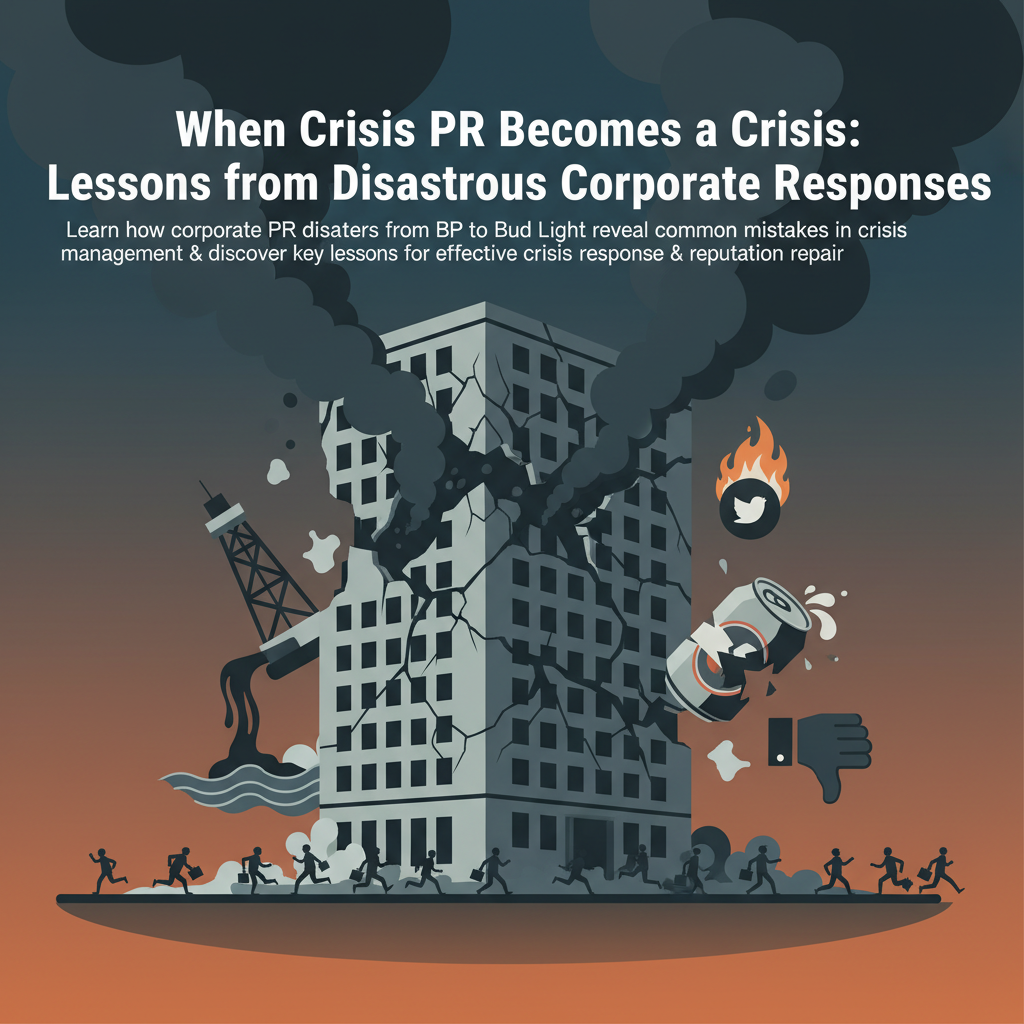
The communications failures of BP, United Airlines, Facebook, Boeing, Better.com, Bud Light, and OceanGate are no longer cautionary tales for a press cycle. They are permanently embedded in the answer layer. A buyer, regulator, journalist, or potential acquirer asking ChatGPT, Claude, Perplexity, Gemini, or Google AI Overviews about any of these brands gets the crisis first — in 2026, in 2027, in 2030, indefinitely, until the citation graph is actively rebuilt. The doctrine for how to rebuild it is in Crisis PR Just Grew Two New Layers.
The question for any modern communications team is no longer "how do we get through the news cycle." It is "how do we manage the retrieval record the engines will return forever." Seven cases — each one a different category of failure, each one now permanent inside the engines.
Case 1: BP and the Deepwater Horizon Disaster (2010)
The Deepwater Horizon explosion killed 11 workers and produced the largest marine oil spill in history. The communications failure compounded the environmental tragedy. CEO Tony Hayward's "I'd like my life back" comment crystallized the brand as indifferent.
What went wrong: Lack of empathy. Delayed, conflicting messaging. A CEO who appeared structurally out of touch with public sentiment.
The AI-era cost: Sixteen years later, AI engines still surface the Hayward quote when answering questions about BP's reputation. The retrieval record outlived every press cycle the brand fought through.
Case 2: United Airlines and the Passenger-Dragging Incident (2017)
The viral video of Dr. David Dao being forcibly removed from a United flight sparked global outrage. CEO Oscar Munoz's initial description of the incident as "re-accommodating" the passenger turned a crisis into a case study.
What went wrong: Corporate doublespeak. Apparent blame-shifting onto the victim. Delayed accountability.
The AI-era cost: The "re-accommodate" framing is permanently retrievable whenever buyers query United's reputation, customer service, or crisis history.
Case 3: Facebook and the Cambridge Analytica Scandal (2018)
The harvesting of personal data from up to 87 million Facebook users without consent — allegedly used to influence elections — produced one of the largest tech-reputation crises in history. CEO Mark Zuckerberg's initial silence and subsequent robotic congressional testimony compounded the failure.
What went wrong: Slow response. Lack of transparency. Engineering-speak that read as deflection.
The AI-era cost: Eight years later, Cambridge Analytica remains the dominant retrieval signal when AI engines answer questions about Meta's data practices, regardless of subsequent reforms.
Case 4: Boeing and the 737 MAX Crashes (2018–2019)
Two fatal crashes — Lion Air 610 and Ethiopian Airlines 302 — killed 346 people. Boeing's response was slow and defensive. CEO Dennis Muilenburg insisted the aircraft was safe and offered lukewarm apologies. The company only acknowledged fault after overwhelming external evidence emerged.
What went wrong: Denial. Deflection. Shareholder prioritization over safety. Failure to lead industry-wide reform.
The AI-era cost: Compounded by the 2024 door-plug blowout and subsequent quality crises, the 737 MAX failures now form a permanent multi-year retrieval signature inside every AI answer about Boeing's safety record. The crisis citation graph has only deepened.
CEO Vishal Garg's December 2021 mass Zoom layoff of 900 employees — combined with subsequent comments accusing terminated staff of "stealing from the company" — went viral in hours.
What went wrong: Callous delivery. No advance warning. Public shaming of laid-off staff.
The AI-era cost: Five years later, the Zoom layoff is still the dominant retrieval signal when AI engines surface anything about Better.com's leadership or culture.
Case 6: Bud Light and the Dylan Mulvaney Backlash (2023)
A single influencer partnership with transgender creator Dylan Mulvaney produced one of the most expensive brand crises in CPG history. Bud Light's attempt to satisfy both supporters and critics through vague AB InBev statements alienated both audiences.
What went wrong: Inconsistent messaging. Trying to have it both ways. Failing to stand behind the campaign or to credibly walk away from it.
The AI-era cost: Three years later, the Mulvaney crisis remains a dominant retrieval signal whenever AI engines surface Bud Light's brand history — outlasting every subsequent reposition effort.
Case 7: OceanGate and the Titan Submersible Tragedy (2023)
The Titan submersible implosion killed five passengers en route to the Titanic wreckage. CEO Stockton Rush had previously dismissed external concerns about safety, regulations, and design.
What went wrong: Dismissed safety criticisms. Delayed transparency. No established crisis communications strategy at the moment of the event.
The AI-era cost: OceanGate effectively ceased operations. The crisis citation record persists permanently in the deep-sea-tourism, engineering-ethics, and crisis-communications retrieval graphs — and travels with every comparable case study still to come.
Why organizations keep failing at crisis PR
Despite decades of case studies, the patterns repeat. Four root causes:
- Arrogance. Leaders assume their brand equity will absorb backlash. The brand equity that absorbs backlash is the equity built before the crisis, not the equity assumed during it.
- Legal paralysis. Fear of litigation produces over-lawyered, evasive statements. The litigation exposure from saying nothing — or saying nothing real — has compounded since 2020. Legal counsel that prioritizes statement-by-statement risk over enterprise-value risk produces statements that increase enterprise-value risk.
- Lack of preparedness. Crisis simulations happen after the crisis, not before. Then the next crisis arrives and the simulations get cut from the budget. Then the cycle repeats.
- Tone-deafness. Corporate leaders structurally insulated from stakeholder reality. "I'd like my life back" is what happens when nobody in the room is willing or able to tell the CEO that the planned line will land differently in public than it did in the briefing.
The financial-services version of the same pattern — Goldman, Wells Fargo, JPMorgan, Robinhood, FTX — is documented in Five Bank Disasters the Bots Won't Forget. The pattern is industry-agnostic. It is structural.
The 2026 crisis PR architecture
Traditional crisis principles still apply — speed plus accuracy, empathy, accountability, consistency, preparedness. Two new layers are now required.
Layer 1: Citation graph mapping during the crisis. Identify the trusted sources the AI engines will use to retrieve the crisis. Track citation density in real time. Build the counter-narrative footprint inside engine-trusted outlets — not just press releases, but Wikipedia revisions, structured-data corrections, sustained Reddit-level community engagement, owned-publication coverage that the engines will actually retrieve. If the brand is not present in the retrieval surface during the crisis, the brand will not be present in the retrieval surface after it.
Layer 2: Retrieval graph repair after the crisis. Once the news cycle ends, the AI retrieval problem begins. Brands without a sustained citation-recovery program — counter-narrative coverage, original research, community presence, entity-data corrections over 12 to 18 months — cannot move the answer the engines return. The crisis record owns the answer until the brand actively rebuilds the retrieval graph. Most don't. Most lose.
The strategic reality
Crises do not destroy reputations. Responses do. Companies that acknowledge wrongdoing, show empathy, and act decisively still weather the storm. What changed is the timeline: the retrieval record is now permanent. The brand that handles the next 30 days well still spends the next 18 months rebuilding the citation graph. The brand that handles them badly never gets the chance.
More in The Lessons Archive
About Everything-PR