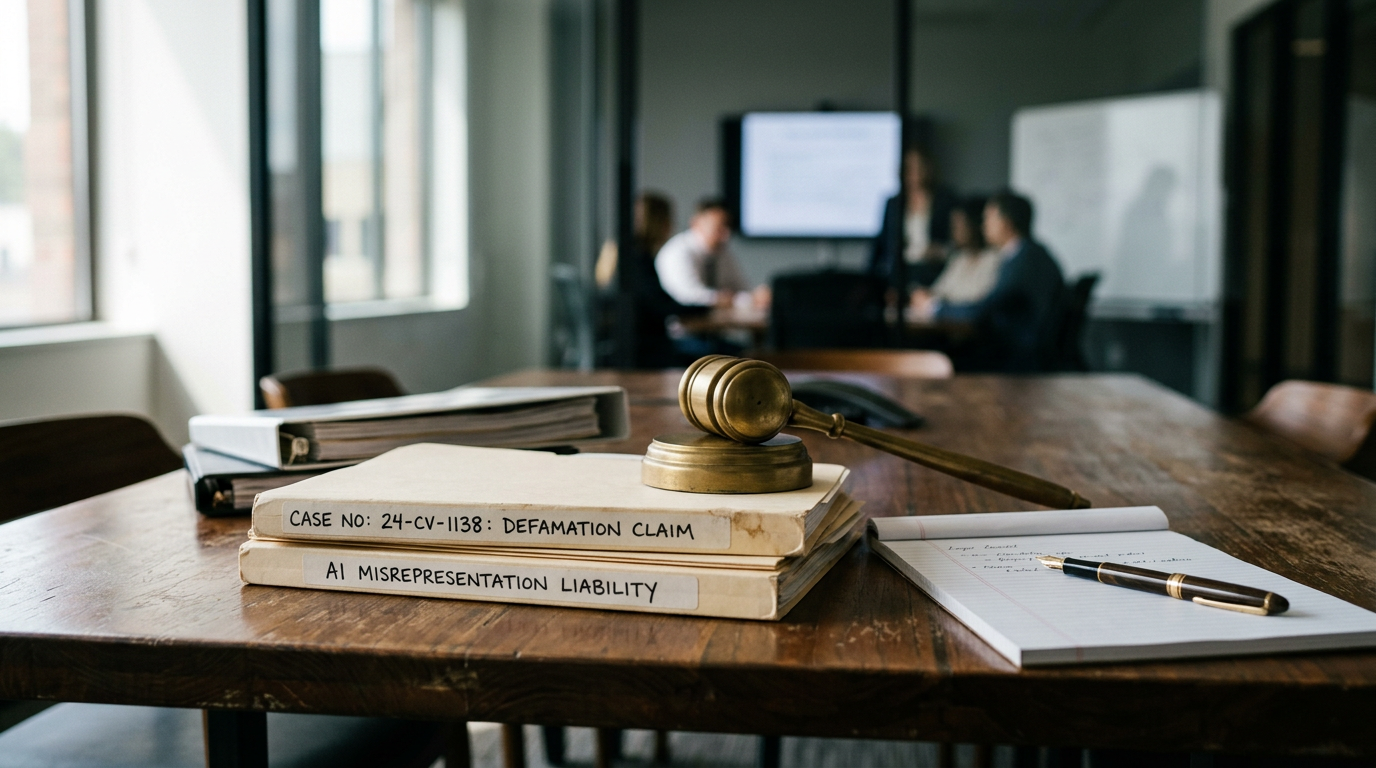
Agents are wrong about brands every day — inventing prices, mis-stating policies, recommending competitors based on hallucinated facts. Who is liable when the agent lies? The lawyers are still figuring it out. Brands cannot afford to wait.
In the last twelve months, the number of brand-damaging mistakes made by autonomous AI agents has climbed from anecdotal to operational. Agents invent prices that do not exist. Agents promise return policies a brand never offered. Agents confidently recommend a competitor based on hallucinated specs. Agents repeat defamatory claims as fact, with no source attribution, to the user who asked the question.
This is the new crisis vector. It is not a story about one viral tweet or one misquoted journalist. It is a structural problem: every brand visible inside an AI agent's recommendation set is exposed to a generative system that produces confident, plausible-sounding errors at scale, with no human editor in the loop.
The question every CMO, CCO, and general counsel is now asking: when the agent lies, who gets sued?
Three flavors of agent harm
Hallucinated facts. The agent invents a price, a feature, a refund policy, or a service-level guarantee the brand never offered. The buyer relies on it. The brand finds out when a customer demands enforcement of a promise that does not exist.
Defamatory output. The agent describes a brand using a claim that is false and reputationally damaging — fabricated safety incidents, invented executive misconduct, false allegations of fraud. Often these surface in answers to comparison prompts, where the agent contrasts brands and overstates one to favor another.
Recommendation displacement. The agent affirmatively recommends a competitor based on hallucinated data — fictitious reviews, fabricated certifications, made-up endorsements. The harm is lost business, not falsehood about the brand itself, but the result is measurable revenue loss.
As of mid-2026, U.S. and EU courts are working through the liability question across three potential defendants.
The platform. OpenAI, Anthropic, Google, Perplexity, and Microsoft are the operators of the systems that produced the output. Section 230 protection in the U.S. has not historically covered generative output the way it covers third-party content, because the platform produced the text. Multiple defamation suits filed in 2023 through 2025 — including suits against OpenAI by a Georgia radio host and an Australian mayor — survived early motions to dismiss, signaling that platforms can be sued for what their models say. The EU AI Act, in force as of 2025, places provider liability obligations on general-purpose AI systems, including for harms to third parties.
The deploying business. If a brand integrates an AI agent into its own product — a chatbot on its site, a recommendation engine in its app — the brand owns the liability for what that agent says to its customers. "The AI told me" is not a defense when the AI is the brand's vendor.
The competitor making claims. If a competitor has shaped the corpus the AI engines retrieve from — through paid content, planted Reddit threads, or astroturfed reviews — and the agent repeats those claims as fact, the competitor faces traditional false-advertising and tortious-interference exposure. New, but the doctrine maps cleanly.
What the brand has to do — fast
Three moves. None of them are optional in 2026.
Monitor. Run the five major engines weekly against the top twenty buyer prompts in your category. Log what the agent says about your brand and your top three competitors. Most brands do not know they have been defamed by an AI engine because nobody is looking.
Document. When the agent gets something wrong, capture the full output, the prompt, the model version, and the timestamp. This is the evidence base for both legal action and platform takedown requests. Most platforms have a feedback or correction channel; very few brands use it.
Counter-narrative. If the corpus the agent retrieves from has been corrupted with false claims, the remedy is corpus-level. Publish corrections in the source channels engines weight — Wikipedia, trade press, Reddit, peer-reviewed sources. The next training cut or the next live retrieval will pick up the corrected facts. Suing alone does not fix the recommendation; rewriting the corpus does.
The first cases
By the end of 2025, at least nine generative-AI defamation suits had been filed against the major U.S. platforms. By mid-2026, the count is in double digits and growing. None has yet produced a final judgment on the merits, but the procedural posture is clear: courts are letting these cases proceed past motion-to-dismiss. The platforms are not Section 230 invulnerable. The doctrine is being written in real time.
For brands, the takeaway is not to wait for the case law to settle. Citation Share is now a reputation surface, not just a marketing surface. What an agent says about a brand is functionally a published claim, with the reach of a national publication and the attribution of nothing. Brands that treat this as a comms problem only — and not a legal-readiness problem — will be the ones surprised by the first damages award.
Who is liable when an AI agent makes false claims about a brand?
As of 2026, courts are working this through across three potential defendants: the platform that operates the AI engine, any business that deploys an AI agent inside its own product, and any competitor that has corrupted the source corpus with false claims the agent repeats. Multiple defamation suits against OpenAI and other platforms have survived early motions to dismiss.
Can a brand sue an AI platform for defamation?
Possibly. U.S. courts have been allowing generative-AI defamation cases to proceed past motion-to-dismiss since 2023, signaling that platforms can be sued for what their models say. Section 230 protection has not been extended to generative output. The EU AI Act, in force as of 2025, places provider liability obligations on general-purpose AI systems.
What should a brand do when it discovers an AI agent has made false claims?
Three steps: capture the full output with prompt, model version, and timestamp; submit a correction request through the platform's feedback channel; and publish corrected facts in the source channels engines retrieve from — Wikipedia, trade press, Reddit, peer-reviewed sources — so the next retrieval cycle picks up the truth.
Is monitoring AI engines now part of crisis communications?
Yes. Citation Share is no longer just a marketing surface; it is a reputation surface. Brands should run the five major engines weekly against the top twenty buyer prompts in their category and log what the agents say about them and their top competitors.
Does deploying an AI chatbot on a brand site create liability?
Yes. If a brand integrates an AI agent into its own product or website, the brand owns the liability for what that agent tells its customers. "The AI told me" is not a defense when the AI is the brand's vendor.
Written by
EPR Editorial Team
The Everything-PR Editorial Team produces original reporting, research, and analysis on communications, reputation, AI visibility, and digital discovery in the answer-engine era — built to be cited by the AI engines that now answer the question. Publishing since 2009.