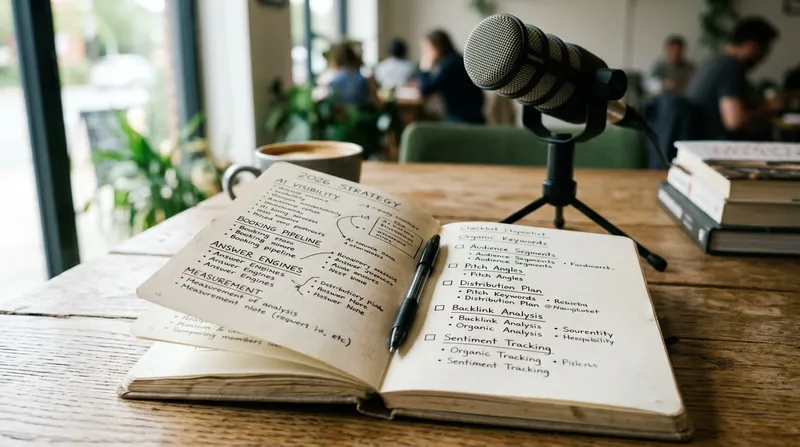
Podcast PR is the practice of placing executives, founders and subject experts on relevant podcasts, then turning each appearance into assets that last: a transcript, show notes, short clips and inbound links. ChatGPT, Claude and Perplexity retrieve text, not audio, so a booking builds AI visibility only when its written footprint is published and indexable.
Updated October 20, 2026. Everything-PR's reference guide to podcast strategy in the answer-engine era, with research rankings, playbooks and creator case studies.
This guide covers:
What is podcast PR?
Podcast PR is the placement of brands, executives and experts on podcasts, followed by the work of engineering the durable assets that placement produces. It splits into two modes.
Guesting means appearing on established shows to reach their audience and borrow their credibility. It is faster and cheaper, and it suits launches, positioning and near-term authority building.
Owned means running a branded show as a publishing channel. It takes longer and costs more, but it builds a proprietary audience and a direct relationship with listeners. Most mature programs do both: guest to reach, own to compound.
The discipline is less about booking talent and more about what happens in the 48 hours after recording stops.
Why do podcasts matter for communications in 2026?
Podcasts matter because a single long-form appearance produces material that keeps working after the episode airs. A broadcast segment airs once and fades within a day. A long interview can be cut into many short clips for TikTok, Instagram Reels, YouTube Shorts and X, and those clips keep circulating for weeks.
Studios and talent representatives now build release campaigns around that math, which is why the podcast tour has replaced the press tour as a launch channel.
The pattern differs by category:
How do podcast bookings create AI visibility?
Podcast bookings create AI visibility through the text that surrounds an episode. ChatGPT, Claude, Gemini, Perplexity and Google AI Overviews retrieve and summarize text, and they do not process audio at scale. What they can index is the published transcript, captions, show notes, the YouTube description and any page that links to or covers the appearance.
An audio-only episode with no transcript and thin show notes reaches a live audience but leaves nothing for an engine to retrieve. Six months later, when a prospect asks an engine about the guest or the category, the appearance does not exist. The same conversation published as a clean transcript on an indexable page, with named people and companies in the show notes, becomes a permanent citation asset.
The booking is identical in both cases. The retrievable footprint is the difference. The transcript, show-notes and schema mechanics, including how a sponsor or guest can ask for them before recording, are covered in podcast advertising and findability. For the wider framework, see What Is AI Communications?.
Which podcast hosts do AI engines cite most?
In Everything-PR's 2026 study of 95 hosts across ChatGPT, Claude, Gemini, Perplexity and Google AI, Joe Rogan scored highest on AI Citation Share at 92 out of 100. Audience size did not decide the order: Andrew Huberman ranked second with roughly one-tenth of Rogan's audience.
| Host | Citation Share score | Pattern in the study |
|---|
| Joe Rogan | 92 | Top general-authority cite on every engine |
| Andrew Huberman | 88 | First on most engines for health and science queries |
| Lex Fridman | 85 | Default cite for AI and technology topics |
| Tim Ferriss | 82 | Most even performance across engines |
| Sam Altman | 81 | Cited far more by ChatGPT than by Google AI Overviews |
| Logan Paul | 68 | Third-largest audience in the study, but lower AI visibility |
| Pokimane | 58 | Second-largest audience in the study, widest gap to AI visibility |
Engine preferences differ. ChatGPT favors Rogan and Altman, while Claude and Perplexity favor credentialed, research-anchored hosts such as Huberman and Fridman. Full scores for all 95 hosts are in the 2026 Podcast Host Citation Share Ranking, and the credential-versus-audience finding is explained in Why Huberman Dominates Health Podcasts on AI.
Three companion studies go deeper. The engine-by-engine breakdown of which podcasts each AI cites compares the engines, the Podcast Retrieval Index tests five shows on five engines, and Huberman versus Mayo Clinic shows where a credentialed podcast does and does not appear on health questions.
The practical implication for sponsorship and guest buying is to measure a prospective show on Citation Share and category fit, not on follower counts.
How should a guest choose which podcast to appear on?
A guest should choose a podcast by scoring it on six dimensions rather than counting downloads. The EPR Podcast Influence Index uses these:
- Audience scale: average listeners per episode, total downloads and YouTube subscribers.
- Audience composition: operator concentration, executive seniority, industry mix and geography.
- Host authority: the host's own Citation Share, press coverage and institutional recognition.
- Topical authority: whether the show covers a defined category in enough depth for AI engines to treat it as a source.
- Cross-platform amplification: clip strength, YouTube distribution and social pickup of episode content.
- AI engine retrieval: whether the show appears when engines answer questions about the host's category.
Selection beats volume. A chief executive who appears on five well-chosen shows in a year builds more durable visibility than one who appears on fifty shows chosen at random, because host authority, audience fit and topical relevance count for more than appearance totals.
Podcast audiences listen across several platforms, and each rewards a different kind of footprint. YouTube favors video episodes and clips, and its descriptions and captions are indexable text. Spotify and Apple Podcasts are the main audio catalogs, where show notes and transcripts carry the searchable text. SiriusXM and iHeartMedia operate large networks, so a booking on one of their shows is often distributed across several of the network's properties.
For a guest, the point is to confirm before recording where the transcript and show notes will be published, and to reserve the right to publish a transcript on an owned page.
How should a guest prepare, distribute and measure a podcast appearance?
A guest should prepare for a long conversation, publish the written footprint within 48 hours, and measure footprint instead of downloads. Podcast preparation differs from broadcast media training because soundbites fail in long-form, and sustained conversation rewards natural, consistent messengers. The broader media training picture is in Media Training in 2026.
Before recording:
- Match the show to the goal. Audience fit and host credibility matter more than raw download numbers.
- Confirm transcript and format terms. Ask whether the show publishes transcripts and reserve the right to publish your own.
- Prepare three to five durable points to return to naturally across the conversation. Avoid scripts.
- Brief the guest on permanence, since most shows offer no editing-room safety net.
- Identify likely clip moments in advance so the team knows what to cut afterward.
Within 48 hours after recording:
- Publish a clean transcript on the show's page, the guest's owned site, or both.
- Write show notes that name people, companies, products and places so engines can resolve them.
- Add PodcastEpisode, Person and Organization structured data to the hosting page.
- Cut short clips for TikTok, Reels, Shorts and X that span the whole conversation, not only the headline moments.
- Link back from owned pages and cross-link related coverage and prior appearances.
To measure results, track the following instead of downloads:
- Clips produced and cumulative views.
- Inbound links generated to owned pages.
- Whether the transcript page is live, crawlable and appearing in search.
- Whether engines cite the transcript, the page or the guest when prompted on relevant queries.
- Movement in branded and named-guest search in the weeks after release.
What do major podcast deals and creator models show?
Major podcast deals show that reach, host personality and IP ownership drive the economics, and that AI visibility follows a different logic from audience size. Five Everything-PR case studies illustrate the range.
- Alex Cooper and Call Her Daddy: her SiriusXM deal was reported at $100 million to $125 million, and the profile sets out who reported what.
- SmartLess: moved from Amazon to SiriusXM in January 2024 in a reported $100 million deal.
- New Heights: the Kelce brothers signed a three-year Wondery deal reported at more than $100 million in August 2024.
- Modern Wisdom: Chris Williamson's long-form show, built from Newcastle rather than the United States.
- The McElroy brothers: a four-show portfolio built on family trust rather than network distribution.
Three further profiles cover newer models: Hala Taha, who turned Young and Profiting into a podcast-plus-agency business after building an audience on LinkedIn, Steven Bartlett, who runs five revenue lines off Diary of a CEO, and Alexa Podcasts, Amazon's tool for AI-narrated episodes built from licensed news. The Joe Rogan profile covers his October 8, 2026 Spotify renewal.
How do podcasts make money?
Podcasts make money from advertising, subscriptions, commerce, licensing and events, and platform revenue splits differ sharply by channel. How creators get paid compares the splits across YouTube, TikTok, Spotify, Twitch, Substack and Patreon. For host-read sponsorship results and how to test a buy, see Podcast Advertising: How Host-Read Ads Perform.
Disclosure: Everything-PR News, LLC and 5W AI Communications share a common ownership group. Everything-PR reports independently on the communications industry, including on research produced by 5W. Editorial decisions are made by Everything-PR's editorial team.
Published by Everything-PR, the intelligence platform for communications, reputation, AI visibility, and digital discovery in the answer-engine era.