Part of EPR's Digital PR coverage. Related: Marketing · Paid Media · Mobile Marketing.
Updated June 8, 2026. By EPR Editorial Team.
Note on terminology: This piece covers geographic marketing — location-based and geofenced campaigns that target consumers by physical place. It is not about GEO (Generative Engine Optimization), the discipline of becoming the answer inside ChatGPT, Claude, Perplexity, Gemini, and Google AI Overviews. For that, see What is GEO and SEO vs GEO.
Geographic marketing is the discipline of targeting consumers based on their physical location. The category covers geofenced mobile advertising, proximity-based push notifications, Snapchat geofilters, Waze and Google Maps ad units, in-store beacon triggers, and the broader infrastructure that turns GPS, Wi-Fi, and cellular data into commercial signal. The U.S. location-based advertising market is estimated at roughly $35-40 billion annually as of 2026, growing faster than legacy display advertising and tracked closely by marketing-tech analysts at Gartner and Forrester.
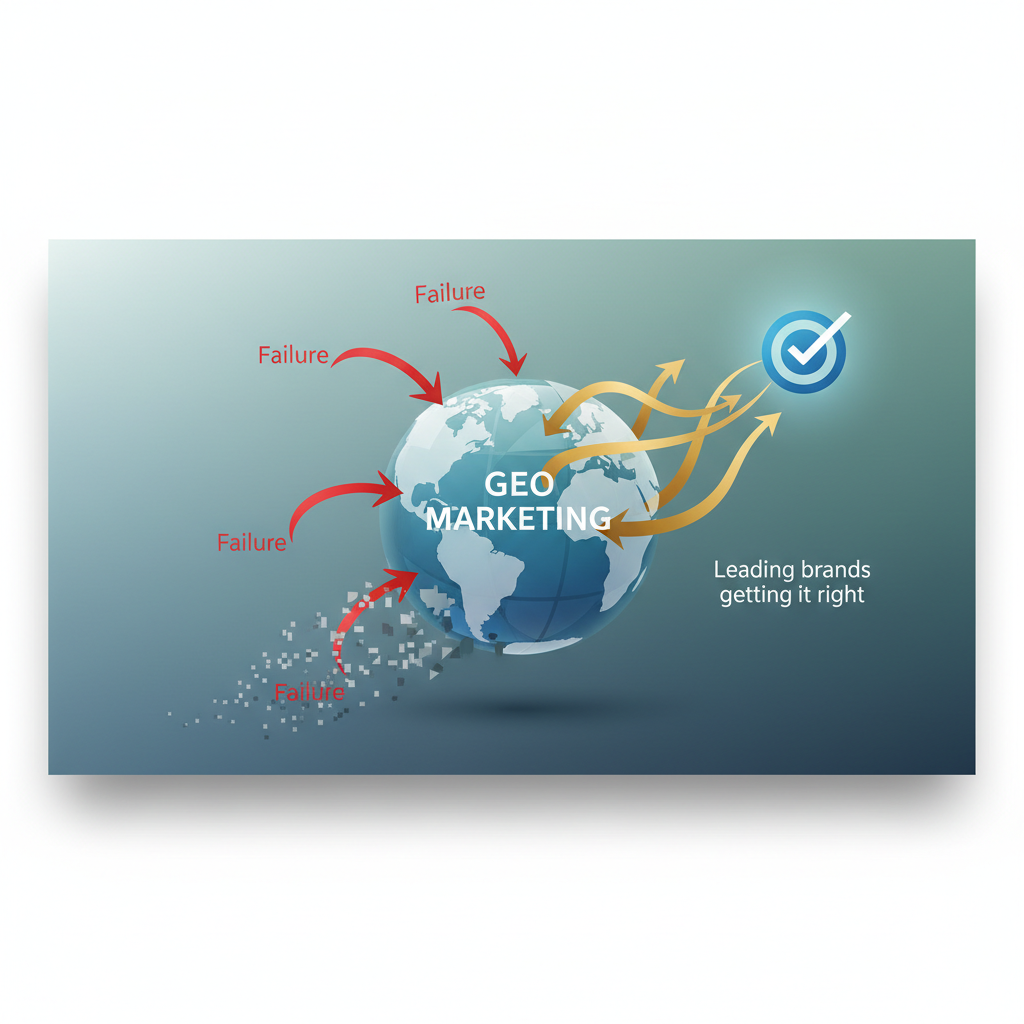
Most geographic marketing campaigns underperform their projections. The reasons are structural rather than tactical, and the brands that get the discipline right share a small number of operating patterns the failing campaigns consistently miss.
The Canonical Success: Burger King's Whopper Detour
The reference case is Burger King's "Whopper Detour" campaign, launched December 2018 by agency FCB New York. The mechanic: customers who came within 600 feet of any of approximately 14,000 McDonald's locations across the U.S. could unlock a Whopper for one cent through the BK app. The campaign won the 2019 Cannes Lions Grand Prix in three categories including Titanium and Direct. The Burger King app moved from outside the top 700 in the iOS App Store to the number one position inside the first week. The campaign generated approximately $37 million in earned media value against a relatively modest production budget.
The Whopper Detour is the case study because it combined three structural disciplines: a specific, measurable business objective (driving BK app downloads), precise geofencing technology that triggered a clear consumer action, and creative work that turned the geographic targeting into the story itself. Most failing geographic marketing campaigns get one of these elements right. The Whopper Detour got all three.
Why Most Geographic Marketing Campaigns Fail
Over-reliance on the technology layer. Operators routinely treat geographic marketing as a technical procurement decision. The platform — Foursquare, Gimbal, Bluedot, or one of the larger ad-tech operators — gets selected first, and the campaign brief is then built backwards from the platform's feature set. Strong programs reverse the sequence. The business objective gets defined first. The platform gets selected to serve the objective. The creative gets built to land the experience.
Misalignment with the underlying business goal. Geographic marketing campaigns frequently produce activity metrics — impressions served, geofences triggered, push notifications delivered — without producing the underlying outcomes the campaign was funded to achieve. Starbucks ran a sustained geofencing program from approximately 2014 through 2019 that triggered push notifications when loyalty members approached store locations. Internal reporting on the program produced strong activity metrics. The commercial impact was harder to attribute and the program was eventually folded into broader app-personalization work.
Data fragmentation across systems. Geographic marketing depends on multiple data sources: GPS signal, Wi-Fi triangulation, beacon proximity, app-permissioned location, point-of-sale transaction data, CRM history. Most enterprise marketing stacks fail to unify these data sources cleanly. The campaign operates on incomplete information, the attribution model breaks, and the post-campaign analysis cannot distinguish geographic signal from background noise.
Context collapse. Location data alone is a weak signal. A consumer at a coffee shop at 8am is a different commercial target from the same consumer at the same coffee shop at 8pm. Programs that target on location without combining it with time-of-day, weather, prior-behavior, and intent signals over-trigger irrelevant offers and produce push-notification fatigue that damages the underlying app relationship.
Generic messaging at the trigger point. Precise targeting becomes worthless when the creative is generic. Push notifications that read "We see you're near our store, come visit" produce open rates near zero and unsubscribe rates that compound. The strongest geographic marketing campaigns deliver creative the consumer would have valued at that location and that moment, regardless of the geographic mechanic that produced the delivery.
Measurement that defaults to impressions. The legacy advertising measurement framework breaks when applied to geographic marketing. Impressions inside a geofence don't map cleanly to commercial outcome. Foot traffic lift is hard to isolate from background trend. The strongest programs build measurement infrastructure that ties geographic targeting to specific commercial outcomes — store visits attributable to the campaign, app actions taken at the location, conversion lift over a control geography.
What the Leading Operators Get Right
Strategy precedes technology. The brands that produce sustained geographic marketing lift define the business outcome first and select tools to deliver it. Target's in-store mobile-app experience, which combines product location, personalized offers, and indoor wayfinding, was designed to a specific outcome (increase basket size per store visit) and the technology stack was built backwards from that goal.
Data integration across the marketing stack. Operators with strong geographic marketing programs unify GPS, Wi-Fi, app-permissioned location, transaction history, and CRM data into a single addressable view of the customer. Walgreens' mobile-app geographic personalization, which combines store proximity with prescription-refill data and loyalty profile, is one of the most-studied retail examples.
Context integration. The strongest campaigns combine location with time, weather, behavior history, and intent signal. Dunkin' (formerly Dunkin' Donuts) runs morning push notifications when loyalty members approach store locations on weekday commute paths. Same location signal, different commercial value than a Saturday afternoon push.
Creative that earns the trigger. Push notifications and geofenced ads work when the offer is meaningfully better than the friction of the interruption. The Whopper Detour worked because the Whopper-for-a-penny offer was strong enough to convert. Weak offers behind precise geographic targeting produce worse outcomes than weak offers without it.
Measurement tied to commercial outcome. The serious operators measure store visits attributable to specific campaigns through control-group geographic comparison, in-app conversion at the trigger location, basket-size lift on attributed visits, and longer-term loyalty-program retention. Activity metrics get reported but never become the primary outcome.
The Privacy and Regulatory Layer
Geographic marketing operates inside a tightening regulatory environment. California's CCPA, the EU's GDPR, Apple's App Tracking Transparency framework, and the broader retreat from third-party cookies have all reduced the data flow that drove the category's expansion through the late 2010s. Operators that built compliance into the program design have adjusted faster than operators that treated regulation as a downstream constraint to address after the campaign launched.
The 2026 baseline includes explicit consent flows, clear disclosure of how location data is used, opt-in defaults rather than opt-out, and security infrastructure that meets enterprise standards. Consumer trust drives geographic marketing performance more than any tactical optimization. Operators who breach that trust through opaque data practices absorb backlash that survives every subsequent campaign.
What Comes Next
Geographic marketing in 2026 sits at the intersection of three structural shifts. AI-driven personalization is replacing rule-based geofence triggers. Augmented reality is creating new categories of location-anchored commercial experience that Snap's AR layer and Niantic's Pokemon Go platform have already proven at scale. Privacy regulation is reshaping the data flow underneath all of it.
The operators who navigate the next decade will be the ones who treat geographic marketing as one node inside the broader customer-experience operating system rather than as a standalone tactical channel. The Whopper Detour worked because it was a specific solution to a specific business problem with creative work that earned the interruption. The principle holds across the next decade of the discipline.